On eBird ↗
Gray-crowned Goldfinch
Live sightings near you, the range map, bar charts of when it is seen, and Macaulay Library photos and recordings.
Gray-crowned Goldfinch
Carduelis caniceps
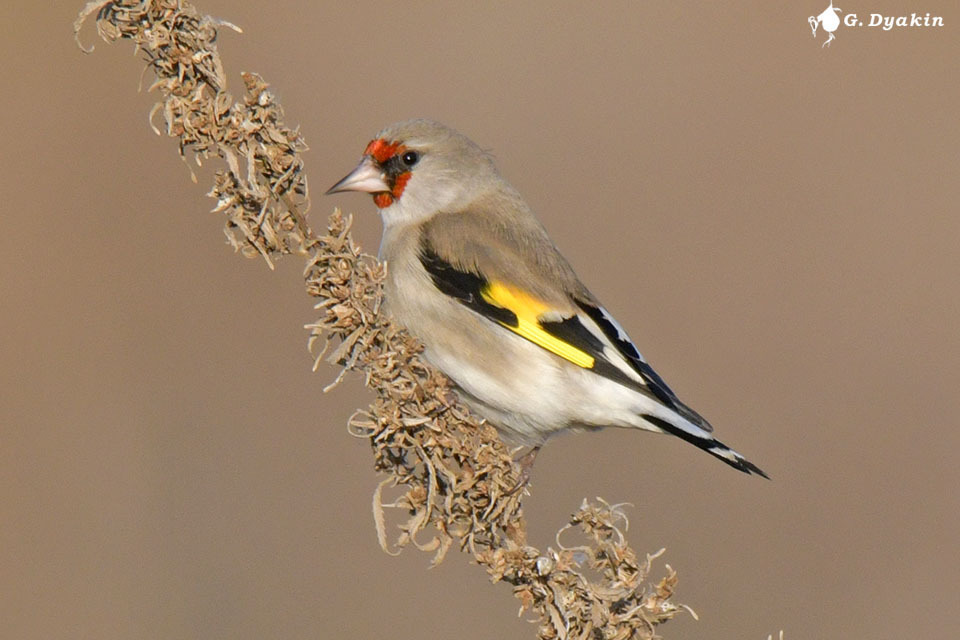
The grey-crowned goldfinch (Carduelis caniceps), also known as the eastern goldfinch, Himalayan goldfinch or the grey-capped goldfinch, is a small passerine bird in the family Fringillidae that is distributed throughout Central Asia and the Himalayas.
From the article Grey-crowned goldfinch on Wikipedia (CC BY-SA), quoted section by section
Description
The grey-crowned goldfinch is 10.5–14 cm (4.1–5.5 in) long with a wingspan of 21.5–25.5 cm (8.5–10.0 in). They weigh about 15–21 g (0.53–0.74 oz).
The male has a brighter and more extensive red on the face and brighter yellow on the wing than the female, which appears to be the only notable difference between the sexes. Both sexes have a pinkish bill.
The juvenile lacks the red in the face, has faint streaking on breast and has buffish tips to coverts and tertial markings. The juvenile has duller and darker legs compared to the adult's pink to dull brown legs.
Range & habitat
The grey-crowned goldfinch breeds in southern and eastern Iran east through Afghanistan to the western Himalaya in northern and western Pakistan, northwestern India, and western Nepal, and northeast through Central Asia to the far west of Xinjiang in China. In the nonbreeding season it is found to lower levels in the Himalaya and Central Asia; in the Himalaya, it is a altitudinal migrant, breeding at 2,400–4,200 m altitude (rarely down to 1,500 m), and descending in winter to 1,900–2,400 m (rarely down to 75 m) altitude; similar altitudinal migration also occurs in Kazakhstan. It occupies open and sparse deciduous woodland, mixed deciduous and conifer woods, forest edges at an altitude of 2100-3600 m, orchards and often parks and gardens. It usually lives at altitudes higher than the European goldfinch.
Vagrancy. The species has been recorded as a vagrant in Beijing, China. A vagrant, possibly C.carduelis subulata, was recorded in Japan. Escaped or released captive birds have been reported in North America, but much more rarely than European goldfinch, with fewer than 1% of the number of that species.
Wikipedia: “Distribution”
What it does
The diet consists mainly of seeds of various flowers, such as thistles, sunflowers, zinnia, chinar and dandelions. They are also known to eat arthropods.
Wikipedia: “Diet”
In human culture
The genus name Carduelis comes from Linnaeus's specific epithet for the European Goldfinch Fringilla carduelis. Carduelis is the Latin name for the goldfinch. The epithet caniceps is derived from the Latin canus (grey) and caput (head).
Wikipedia: “Etymology”
Listen
Looking for field recordings…
Where it lives
Recorded sightings
—
geo-referenced records in GBIF, from museums, herbaria and field observers.
Drag the globe to turn it. Dots are where records exist, not a range map; darker means more records.
In the stacks
Searching the stacks…
Every page naming Carduelis caniceps in the Biodiversity Heritage Library →
This page is assembled live from iNaturalist, GBIF, Wikipedia, the Source Library and the Internet Archive. It is not yet part of the hand-edited codex. iNaturalist taxon 1584584.