On eBird ↗
Tufted Antshrike
Live sightings near you, the range map, bar charts of when it is seen, and Macaulay Library photos and recordings.
Tufted Antshrike
Mackenziaena severa
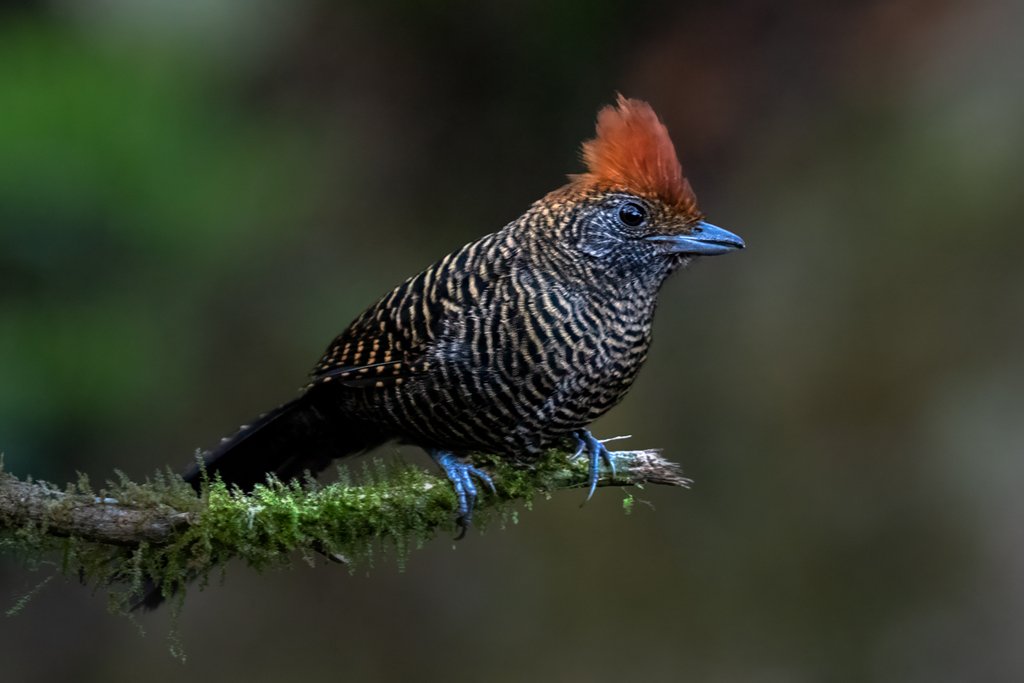
The tufted antshrike (Mackenziaena severa) is a species of bird in subfamily Thamnophilinae of family Thamnophilidae, the "typical antbirds". It is found in Argentina, Brazil, and Paraguay.
From the article Tufted antshrike on Wikipedia (CC BY-SA), quoted section by section
Description
The tufted antshrike is a large dark antbird, 20 to 23 cm (7.9 to 9.1 in) long and weighing 50 to 80 g (1.8 to 2.8 oz). The species exhibits significant sexual dimorphism, though both sexes have a crest (that usually is flattened), red irises, and a moderately long black bill with a hook at the end like true shrikes. Adult males are mostly sooty gray with a blackish forehead and crest and browish black wings. Adult females are mostly blackish brown. Their forehead and crest are rufous, their upperparts have cinnamon bars, their tail has faint paler bars, and their underparts have pale buff bars. Subadult males resemble adult males but are more brownish overall.
Range & habitat
The tufted antshrike is found in Brazil from southeastern Bahia and east-central Minas Gerais south to Rio Grande do Sul and through eastern Paraguay into northeastern Argentina's Misiones Province. The tufted antshrike is a bird of the Atlantic Forest. It inhabits the understorey to mid-storey of evergreen forest and secondary forest in the lowlands and foothills. It favors areas with dense tangles of vines, thickets, and stands of bamboo. It also occurs in patches of highly degraded forest and also overgrown banana and Eucalyptus plantations and orchards that have dense stands of bamboo. In elevation it ranges from sea level to 1,400 m (4,600 ft).
Wikipedia: “Distribution and habit”
What it does
The tufted antshrike feeds on a variety of large insects and other arthropods; its diet also includes molluscs and small vertebrates including frogs, lizards, snakes, bird eggs and nestlings. It forages singly or in pairs, mostly within about 3 m (10 ft) of the ground but as high as 10 m (35 ft) in dense bamboo and vine tangles. It hops from branch to branch and along the ground, reaching from a perch to glean prey from leaves, stems, and branches. It occasionally drops to the ground to seize prey.
Wikipedia: “Feeding”
Listen
Looking for field recordings…
Where it lives
Recorded sightings
—
geo-referenced records in GBIF, from museums, herbaria and field observers.
Drag the globe to turn it. Dots are where records exist, not a range map; darker means more records.
In the stacks
Searching the stacks…
Every page naming Mackenziaena severa in the Biodiversity Heritage Library →
This page is assembled live from iNaturalist, GBIF, Wikipedia, the Source Library and the Internet Archive. It is not yet part of the hand-edited codex. iNaturalist taxon 15856.