On eBird ↗
White-browed Antbird
Live sightings near you, the range map, bar charts of when it is seen, and Macaulay Library photos and recordings.
White-browed Antbird
Myrmoborus leucophrys
The white-browed antbird (Myrmoborus leucophrys) is a species of perching bird in the family Thamnophilidae. It is found in Bolivia, Brazil, Colombia, Ecuador, French Guiana, Guyana, Peru, Suriname, and Venezuela. Its natural habitats are subtropical or tropical moist lowland forests and subtropical or tropical moist montane forests.
From the article White-browed antbird on Wikipedia (CC BY-SA), quoted section by section
Description
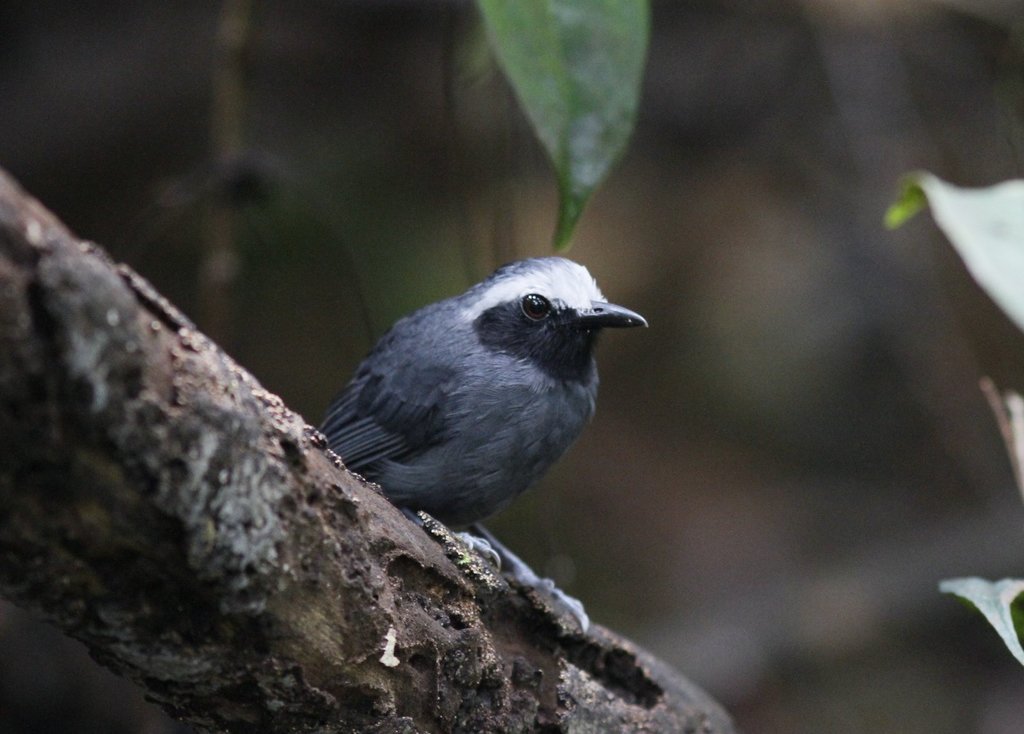
The white-browed antbird is 12 to 13.5 cm (4.7 to 5.3 in) long and weighs 18 to 22 g (0.63 to 0.78 oz). Adult males of the nominate subspecies M. l. leucophrys have the eponymous white forehead and supercilium. They are otherwise mostly dark bluish gray that is darkest on their wings and tail and lightest on their crissum. Their face below the white, their chin, and their throat are black. Adult females have a cinnamon to yellow-buff forehead and supercilium. Their crown is olive-brown with a reddish tinge and the rest of their face is black. They have olive-brown upperparts. Their wings and tail are dark yellowish brown with pinkish to pale buff-brown tips on their wing coverts. Their throat and underparts are mostly white with some blackish gray on the sides and light olive-gray flanks. Males of subspecies M. l. angustirostris are similar to nominate males but paler. Females have a paler supercilium than the nominate and paler (almost white) tips on the wing coverts. Males of M. l. erythrophrys have a wider white forehead band and supercilium and a less well-defined black throat than the nominate. Females have a darker and redder supercilium that has little contrast from the crown. Males of M. l. koenigorum have an entirely white crown and the black of their throat extends onto the breast. Females are similar to erythrophrys females.
Range & habitat
The white-browed antbird has a curious distribution across the northern Amazon Basin and the Guianan Shield and in the southern Amazon Basin, but not in a large area of Amazonia between them. The subspecies are found thus:
M. l. erythrophrys: east slope of the Andes from northwestern Venezuela south into Colombia to the Putumayo River M. l. leucophrys: from the Putumayo in extreme southern Colombia south on the east slope of the Andes of eastern Ecuador and eastern Peru into northeastern Bolivia, and east across much of southern Amazonian Brazil south of the Amazon M. l. angustirostris: from southern Venezuela east across the Guianas and northern Brazil north of the Amazon to the Atlantic in Amapá state M. l. koenigorum: upper valley of the Huallaga River in Peru's Department of Huánuco The white-browed antbird uses various habitats in different parts of its range. In the Amazon Basin it typically occurs near water, using both várzea and transitional forests. There it favors heavy shrub cover and Heliconia thickets and sometimes bamboo. Subspecies M. l. angustirostris is often found in similar habitat but about equally on the edges and in overgrown clearings of terra firme forest. A relatively small part of the angustirostris population in southern Venezuela also occurs on shrubby and stunted woodlands on white-sand soils bordering savanna. …
Wikipedia: “Distribution and habitat”
What it does
The white-browed antbird feed on a wide variety of insects and spiders. It typically forages singly, in pairs, or in small family groups in dense vegetation, mostly on the ground or within about 1 m (3 ft) of it and rarely up 3 m (10 ft). It hops and makes short flights between feeding stops, bobbing its tail. It captures prey by gleaning, jumping, lunging, and making short sallies from a perch; it also drops to the ground to snatch prey. It regularly attends army ant swarms to capture prey fleeing the ants, but is subordinate to obligate ant-followers. It seldom joins mixed-species feeding flocks.
Wikipedia: “Feeding”
Listen
Looking for field recordings…
Where it lives
Recorded sightings
—
geo-referenced records in GBIF, from museums, herbaria and field observers.
Drag the globe to turn it. Dots are where records exist, not a range map; darker means more records.
In the stacks
Searching the stacks…
Every page naming Myrmoborus leucophrys in the Biodiversity Heritage Library →
This page is assembled live from iNaturalist, GBIF, Wikipedia, the Source Library and the Internet Archive. It is not yet part of the hand-edited codex. iNaturalist taxon 15875.