On eBird ↗
White-plumed Antbird
Live sightings near you, the range map, bar charts of when it is seen, and Macaulay Library photos and recordings.
White-plumed Antbird
Pithys albifrons
The white-plumed antbird (Pithys albifrons) is a small species of insectivorous bird found in the understories of rainforests. It is smaller than most species of its family (Thamnophilidae), weighing 26 grams on average. The family Thamnophilidae is known commonly as the antbirds, as they use the presence of ants (army ants in particular) to locate food. This species is largely solitary except during the breeding season, and different individuals will follow individual ant swarms.
From the article White-plumed antbird on Wikipedia (CC BY-SA), quoted section by section
Description
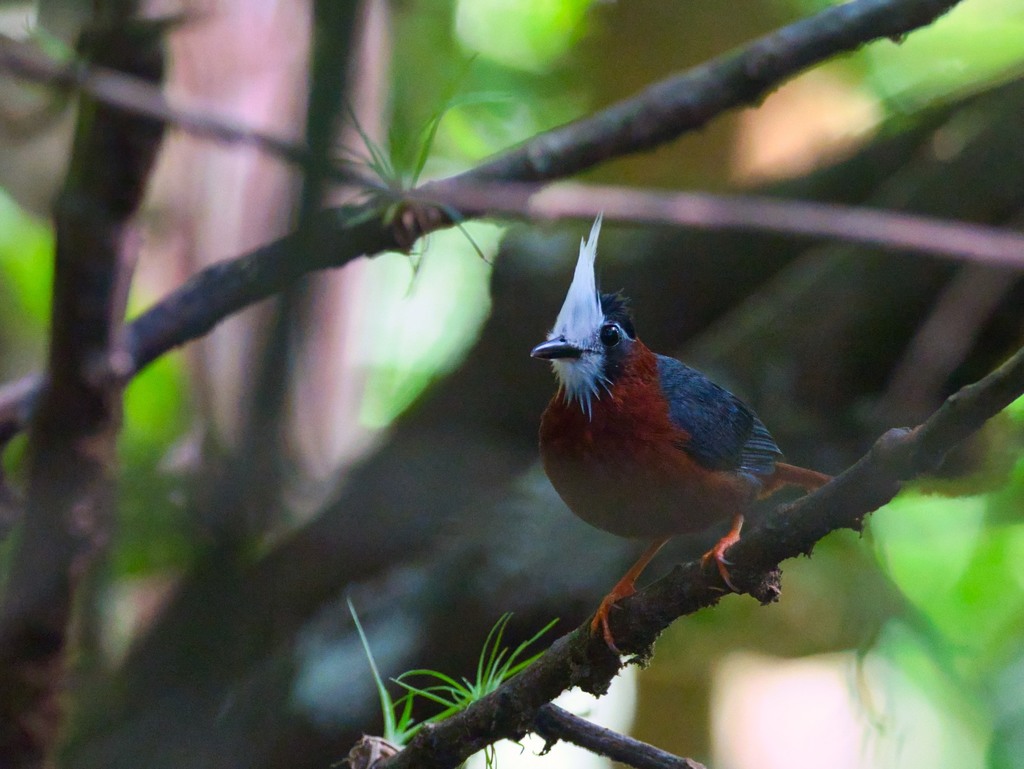
The white-plumed antbird is 11.5 to 12.5 cm (4.5 to 4.9 in) and weighs 18 to 23 g (0.63 to 0.81 oz). The species is monomorphic, meaning both sexes look the same. Adults of both subspecies have the eponymous white tufts on their forehead and chin. Their crown and the rest of their face are black; the nominate subspecies has a white stripe over and behind the eye. Their upperparts and wings are gray. Their nape, tail, and underparts are rufous-chestnut with a gray tinge on the flanks. Their feet and tarsus are bright orange. Their bill is about 1.16 cm (0.46 in) long and 0.47 cm (0.19 in) wide, indicative of its insect food source. Juvenile birds do not have the white plumes, postocular streak, and rufous-chestnut "collar" of adults, and their upperparts are browner and underparts grayer. The white-plumed antbird uses a complex basic molt strategy, meaning that the juvenile performs a preliminary molt before it molts into its characteristic adult feathers. This first molt occurs soon after they begin to feed themselves. As adults, they perform at most one molt a year and plumage remains unchanging. A complete wing molt is quite variable, slow and irregular, especially in breeding birds. The molt takes approximately 301 days to complete, thus there can only be a single annual molt. molts may not occur annually and can start at any time of year.
Range & habitat
The nominate subspecies of the white-plumed antbird is found in the southern Venezuelan states of Bolívar and Amazonas, east through the Guianas, and in Brazil east of the Rio Negro and north of the Amazon to the Atlantic in Amapá state. Subspecies P. a. peruvianus is found from extreme western Venezuela south through eastern Colombia, Brazil west of the Rio Negro, and eastern Ecuador into northern and central Peru. In Peru it occurs north of the Amazon and Maranon rivers and along the base of the Andes south to the Department of Ayacucho. The species inhabits the understorey of terra firme evergreen forest in the lowlands and foothills and also adjacent mature secondary forest. It occurs in higher abundance in forests with high canopies, high vegetation complexity, and many plant species. In elevation it occurs up to 1,350 m (4,400 ft) in Brazil, to 2,250 m (7,400 ft) on Cerro Duida in Venezuela, and to 1,100 m (3,600 ft) in Colombia and Ecuador. They show higher survival in the eastern Amazon rainforest than in the western. Each pair occupies a home range exceeding 200 ha (490 acres) in order to ensure that swarms of army ants to follow to food can be found at all times. The species generally shuns open landscapes and will not cross rivers. They have, however, been found crossing roads to get from one patch of forest to another.
Wikipedia: “Distribution and habitat”
What it does
White-plumed antbirds are very persistent in holding on to territories and may remain even in case of conflict with other individuals, if enough food sources are available. They are generally solitary outside of the breeding season and will tend to follow individual ant swarms through the forest. Like other antbirds, they perform anting, which is the process of brushing small insects through their wing and tail feathers. It is still unknown whether the main function of this process is to ease irritation during molting, kill mites, or detoxify distasteful insects.
Diet. The white-plumed antbird is an insectivore that eats insects, arthropods, and at times lizards. It typically forages within 1 m (3 ft) of the ground but will feed up to 1 m (3 ft) above it. It seldom joins mixed-species feeding flocks. It is an obligate antbird, feeding almost entirely on prey disturbed by army ants swarms. As many as 20 individuals have been noted following a swarm.
Alarm behavior. While foraging, white-plumed antbirds may remain immobile for long periods of time so that they will not be attacked by larger antbirds or predators. In case of confrontation or alarm, they may "panic, flee and chip" instead. This reaction to danger involves the bird darting back and forth making chipping noises, spreading its tail and flicking rapidly to find their last prey items before fleeing. …
Wikipedia: “Behavior”
Listen
Looking for field recordings…
Where it lives
Recorded sightings
—
geo-referenced records in GBIF, from museums, herbaria and field observers.
Drag the globe to turn it. Dots are where records exist, not a range map; darker means more records.
In the stacks
Searching the stacks…
Every page naming Pithys albifrons in the Biodiversity Heritage Library →
This page is assembled live from iNaturalist, GBIF, Wikipedia, the Source Library and the Internet Archive. It is not yet part of the hand-edited codex. iNaturalist taxon 15880.