On eBird ↗
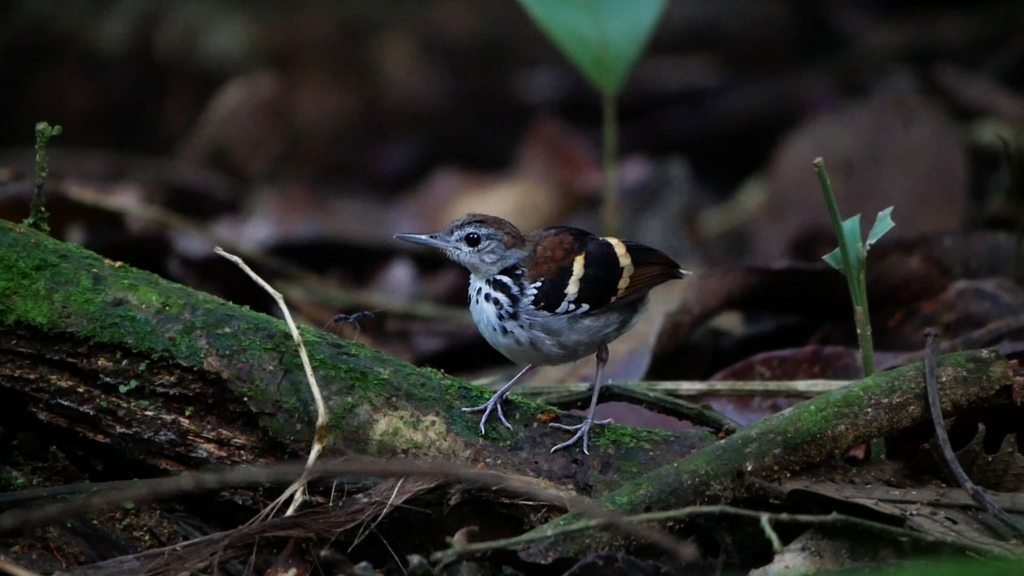
Banded Antbird
Live sightings near you, the range map, bar charts of when it is seen, and Macaulay Library photos and recordings.
Banded Antbird
Dichrozona cincta
The banded antbird (Dichrozona cincta) – sometimes called banded antwren despite not being close to the true antwrens – is a species of bird in subfamily Thamnophilinae of family Thamnophilidae, the "typical antbirds". It is found in Bolivia, Brazil, Colombia, Ecuador, Peru, and Venezuela.
From the article Banded antbird on Wikipedia (CC BY-SA), quoted section by section
Description
The banded antbird is 9 to 10 cm (3.5 to 3.9 in) long and weighs 14 to 15.5 g (0.49 to 0.55 oz). The species has a long bill and a short tail. Adult males of the nominate subspecies have a thin white supercilium and a blackish line through the eye on an otherwise grayish face. Their crown, nape, and upper back are cinnamon-brown with a white patch between the scapulars. Their lower back, rump, and uppertail coverts are banded with black, white, and gray. Their wings are black with cinnamon to chestnut edges on the flight feathers and buff to white tips on the coverts. Their tail is mostly black except for the mostly white outermost feathers. Their throat, breast, and belly are white with a band of black spots across the breast and brownish gray flanks. Adult females have a buff band on the lower back and fewer spots on buff-tinged underparts. The other two subspecies differ somewhat from the nominate and each other in the depth of their back color, the amount of gray on their flanks, and the extent of spotting on the breast.
Range & habitat
The nominate subspecies of the banded antbird is found from east of the Andes in south-central and southeastern Colombia through extreme southwestern Venezuela into the upper Rio Negro watershed in northwestern Brazil. Subspecies D. c. stellata is found in eastern Ecuador, northern Peru, and western Brazil. Subspecies D. c. zononota is found in southern Peru, northwestern Bolivia, and west-central Brazil. The species inhabits evergreen forest, primarily terra firme away from waterways, and favors areas with an open understorey and much leaf litter. It is almost entirely terrestrial. In general it is found up to 800 m (2,600 ft) above sea level but reaches only 500 m (1,600 ft) in Colombia and 450 m (1,500 ft) in Ecuador.
Wikipedia: “Distribution and habitat”
What it does
The banded antbird's diet has not been detailed but is thought to be arthropods. It mostly forages singly and sometimes in pairs, and does not join mixed-species feeding flocks. It forages almost entirely while walking on the ground, probing and flipping leaf litter. It also reaches and jumps to glean from leaves and stems.
Wikipedia: “Feeding”
Listen
Looking for field recordings…
Where it lives
Recorded sightings
—
geo-referenced records in GBIF, from museums, herbaria and field observers.
Drag the globe to turn it. Dots are where records exist, not a range map; darker means more records.
In the stacks
Searching the stacks…
Every page naming Dichrozona cincta in the Biodiversity Heritage Library →
This page is assembled live from iNaturalist, GBIF, Wikipedia, the Source Library and the Internet Archive. It is not yet part of the hand-edited codex. iNaturalist taxon 15894.