On eBird ↗
Black-throated Antshrike
Live sightings near you, the range map, bar charts of when it is seen, and Macaulay Library photos and recordings.
Black-throated Antshrike
Frederickena viridis
The black-throated antshrike (Frederickena viridis) is a species of bird in the family Thamnophilidae. It is found in Brazil, French Guiana, Guyana, Suriname, and Venezuela. Its natural habitat is subtropical or tropical moist lowland forests.
From the article Black-throated antshrike on Wikipedia (CC BY-SA), quoted section by section
Description
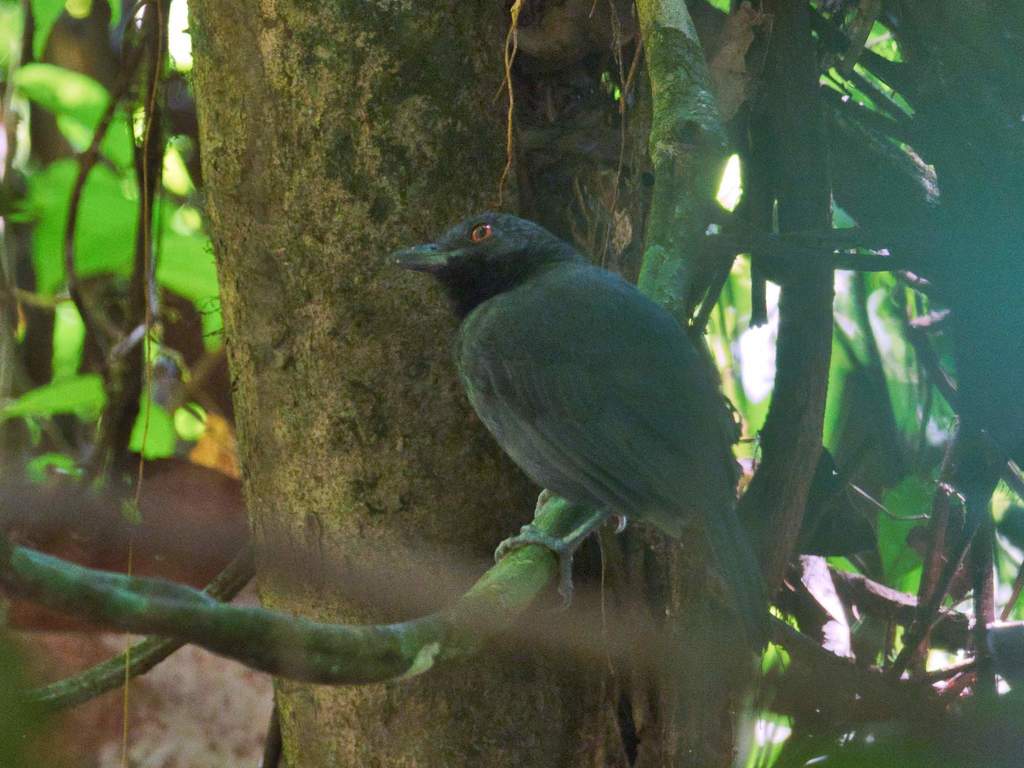
The black-throated antshrike is a large dark antbird, 19 to 22 cm (7.5 to 8.7 in) long and weighing 65 to 75 g (2.3 to 2.6 oz). The species exhibits significant sexual dimorphism, though both sexes have a crest (that usually is flattened), red irises, and a heavy black bill with a hook at the end like true shrikes. Adult males are mostly slate gray with a black head, throat, and breast, a usually hidden small white patch between their scapulars, and faint white bars on their tail. Adult females have a rufous crest, nape, upperparts, and wings. Their forehead, sides of their head, underparts, and tail are barred with pale buff to white and blackish brown; their flanks have a rufous tinge. Subadult males have mixed gray and brown upperparts and underparts like adult females'.
Range & habitat
The black-throated antshrike is found from eastern Bolívar state in Venezuela east through the Guianas and through northeastern Amazonian Brazil north of the Amazon from the lower Rio Negro east to the Atlantic in Amapá. It inhabits lowland evergreen forest, typically those on sandy soils and in terra firme. It favors dense vegetation in the understorey, especially at openings such as those formed by fallen trees. In elevation it ranges from sea level to 700 m (2,300 ft) in most of its range but only to 500 m (1,600 ft) in Venezuela.
Wikipedia: “Distribution and habitat”
What it does
The black-throated antshrike's diet has not been detailed but is known to include large insects and other arthropods. It forages singly or in pairs, mostly low to the ground or on it in dense foliage and vine tangles. It hops deliberately from branch to branch and along the ground, reaching or jumping from a perch to glean prey from leaves, stems, branches, leaf litter, and rotten logs. It occasionally follows army ant swarms to catch prey disturbed by the ants.
Wikipedia: “Feeding”
Listen
Looking for field recordings…
Where it lives
Recorded sightings
—
geo-referenced records in GBIF, from museums, herbaria and field observers.
Drag the globe to turn it. Dots are where records exist, not a range map; darker means more records.
In the stacks
Searching the stacks…
Every page naming Frederickena viridis in the Biodiversity Heritage Library →
This page is assembled live from iNaturalist, GBIF, Wikipedia, the Source Library and the Internet Archive. It is not yet part of the hand-edited codex. iNaturalist taxon 15897.