On eBird ↗
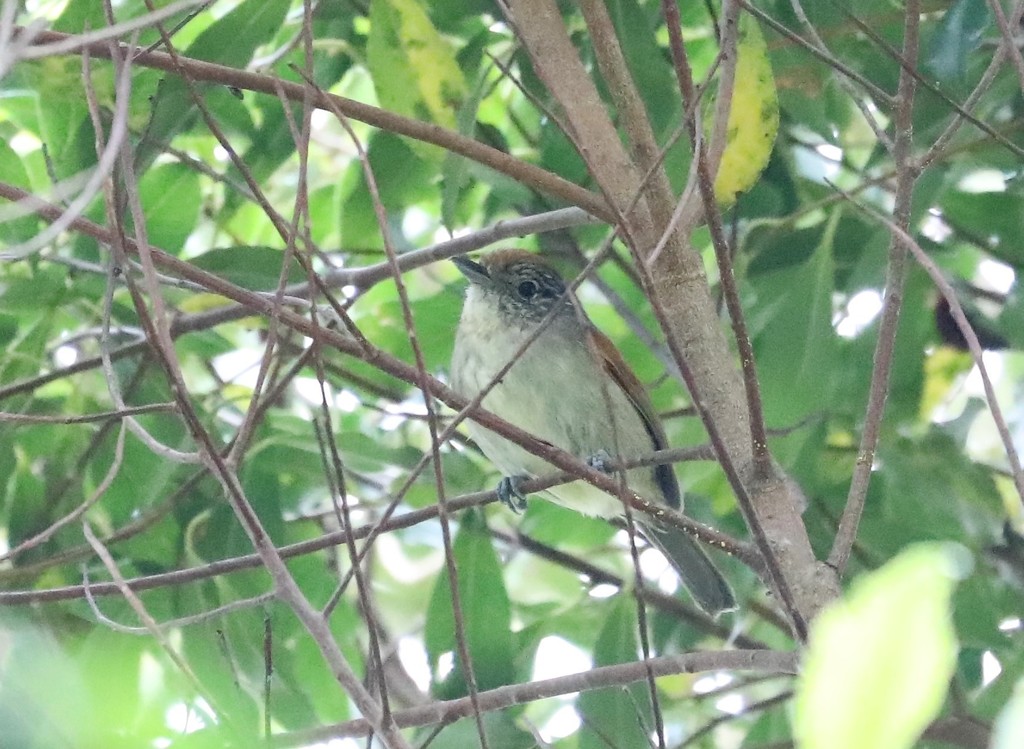
Rufous-backed Antvireo
Live sightings near you, the range map, bar charts of when it is seen, and Macaulay Library photos and recordings.
Rufous-backed Antvireo
Dysithamnus xanthopterus
The rufous-backed antvireo (Dysithamnus xanthopterus) is a species of bird in subfamily Thamnophilinae of family Thamnophilidae, the "typical antbirds". It is endemic to Brazil.
From the article Rufous-backed antvireo on Wikipedia (CC BY-SA), quoted section by section
Description
The rufous-backed antvireo is about 12 cm (4.7 in) long. Adult males have a gray forehead, crown, nape, and upper back; their forehead, upper sides of the face, and lores have white spots. Their rest of their upperparts, wings, and tail are rufous. The center of their throat is white. Most of their underparts are pale gray (that is almost white on the belly) and their flanks are ochraceous. Adult females have a rufous crown and the spots on their face are pale buff. Most of their underparts are also pale buff, with pale olivaceous sides and flanks.
Range & habitat
The rufous-backed antvireo is native to the Serra do Mar coastal forests, primarily between Rio de Janeiro and Paraná states. Since 2013 there have been scattered records from further south in Santa Catarina. The species inhabits the mid-storey to the subcanopy of montane evergreen forest and mature secondary forest. In elevation it ranges between 750 and 1,700 m (2,500 and 5,600 ft).
Wikipedia: “Distribution and habitat”
What it does
The rufous-backed antvireo feeds mostly on insects and its diet also includes other arthropods and the berries of Rapanea mistletoe. It usually forages singly or in pairs, and frequently as part of a mixed-species feeding flock. It typically feeds between about 3 and 12 m (10 and 40 ft) above the ground, especially in the outer parts of trees, in the tops of bamboo, and in woody vine tangles. It feeds mostly with short sallies to snatch prey from overhanging leaves. It also gleans by reaching or lunging while perched. It has not been observed following army ants.
Wikipedia: “Feeding”
Listen
Looking for field recordings…
Where it lives
Recorded sightings
—
geo-referenced records in GBIF, from museums, herbaria and field observers.
Drag the globe to turn it. Dots are where records exist, not a range map; darker means more records.
In the stacks
Searching the stacks…
Every page naming Dysithamnus xanthopterus in the Biodiversity Heritage Library →
This page is assembled live from iNaturalist, GBIF, Wikipedia, the Source Library and the Internet Archive. It is not yet part of the hand-edited codex. iNaturalist taxon 15913.