On eBird ↗
Stripe-backed Antbird
Live sightings near you, the range map, bar charts of when it is seen, and Macaulay Library photos and recordings.
Stripe-backed Antbird
Myrmorchilus strigilatus
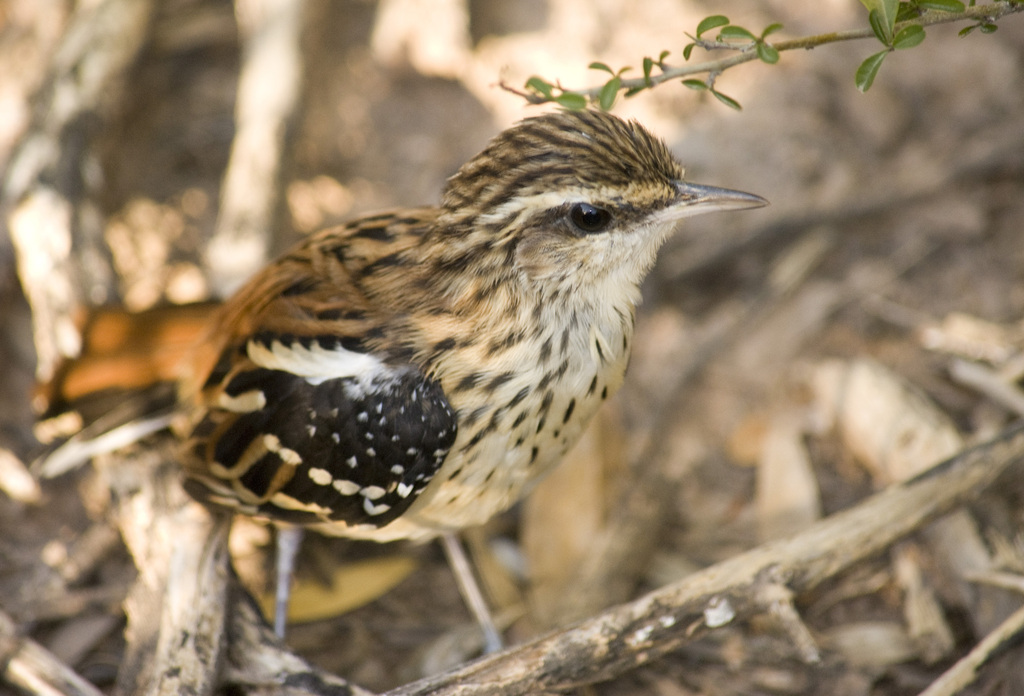
The stripe-backed antbird (Myrmorchilus strigilatus) is a species of bird in the family Thamnophilidae. It is monotypic within the genus Myrmorchilus. It is found in Argentina, Bolivia, Brazil and Paraguay, where its natural habitat is subtropical or tropical dry forests.
From the article Stripe-backed antbird on Wikipedia (CC BY-SA), quoted section by section
Description
The stripe-backed antbird is 15 to 16 cm (5.9 to 6.3 in) long and weighs 23 to 26 g (0.81 to 0.92 oz). Adult males of the nominate subspecies have a white supercilium and a dark line through the eye on an otherwise buffy face. Their crown, neck, and back are rufous with black streaks; their rump and uppertail coverts are plain rufous. Their central tail feathers are rufous and the outer ones black with white outer edges and tips. Their wings are black with some rufous on the edges of the flight feathers; their wing coverts are black with white tips. Their throat and breast are black. The rest of their underparts are white with black spots on the sides and flanks and a buff tinge to the crissum. Adult females have a buff throat, breast, and belly with darker streaks on the sides and breast. Males of subspecies M. s. suspicax have a buff supercilium, flanks, and crissum; females have a brownish supercilium and deeper buff flanks and crissum than the nominate.
Range & habitat
The stripe-backed antbird has a disjunct distribution. The nominate subspecies is found in northeastern Brazil in an area roughtly bounded by eastern Piauí, Rio Grande do Norte, and northern Minas Gerais. Subspecies M. s. suspicax is found in the western parts of Brazil's Mato Grosso and Mato Grosso do Sul states, in southeastern Bolivia, in western Paraguay, and in northern Argentina as far south as Santa Fe Province. The nominate subspecies primarily inhabits caatinga woodlands and scrublands. Subspecies M. s. suspicax primarily inhabits the woodlands and scrublands of the Gran Chaco. In both ecozones it favors areas with dense ground cover. In elevation it ranges up to about 1,100 m (3,600 ft).
Wikipedia: “Distribution and habitat”
What it does
The stripe-backed antbird feeds on arthropods, especially insects. It typically forages singly or in pairs, and mostly on the ground under dense vegetation though it will feed as high as 2 m (7 ft) above the ground. It picks through leaf litter and terrestrial bromeliads, reaches up to glean from foliage, and sometimes jumps to glean from higher leaves, branches, and vines.
Wikipedia: “Feeding”
Listen
Looking for field recordings…
Where it lives
Recorded sightings
—
geo-referenced records in GBIF, from museums, herbaria and field observers.
Drag the globe to turn it. Dots are where records exist, not a range map; darker means more records.
In the stacks
Searching the stacks…
Every page naming Myrmorchilus strigilatus in the Biodiversity Heritage Library →
This page is assembled live from iNaturalist, GBIF, Wikipedia, the Source Library and the Internet Archive. It is not yet part of the hand-edited codex. iNaturalist taxon 15938.