On eBird ↗
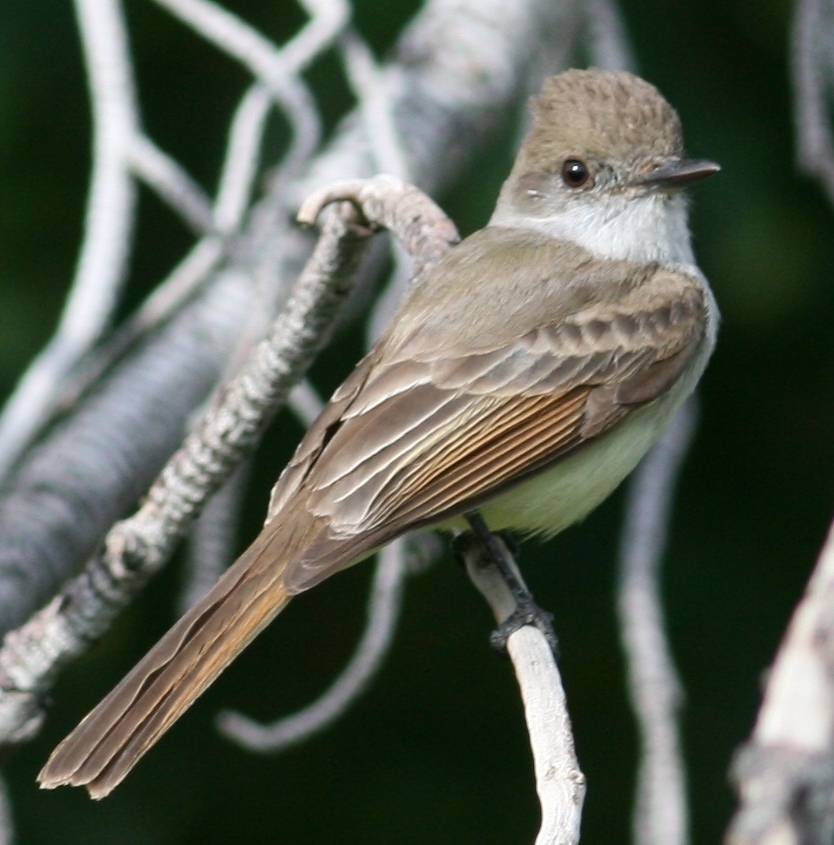
Dusky-capped Flycatcher
Live sightings near you, the range map, bar charts of when it is seen, and Macaulay Library photos and recordings.
Dusky-capped Flycatcher
Myiarchus tuberculifer
The dusky-capped flycatcher (Myiarchus tuberculifer) is a passerine bird in the tyrant flycatcher family. It breeds in forest and other woodland from southern Arizona, as well as the Chisos Mountains, Texas, south to northern Argentina and on Trinidad. It is resident in most of its range, but American breeders retreat to Mexico in winter.
From the article Dusky-capped flycatcher on Wikipedia (CC BY-SA), quoted section by section
Description
The dusky-capped flycatcher is 16 to 18.5 cm (6.3 to 7.3 in) long and weighs 14 to 27 g (0.49 to 0.95 oz). The sexes have the same plumage. Adults of the nominate subspecies M. t. tuberculifer have a sooty brown crown and face; the crown feathers form a slight crest. Their upperparts are mostly dark greenish olive-brown with browner uppertail coverts. Their wings are mostly dusky with thin dull white edges on the secondaries and thin buffy-white edges on the inner primaries. Their greater and median wing coverts have buffy brown edges. Their tail is dark grayish brown. Their throat and breast are gray and their belly and undertail coverts yellow. The other subspecies of the dusky-capped flycatcher differ from the nominate and each other thus:
M. t. olivascens: blackish crown and pale gray face; grayish olive to olive green upperparts; rusty to ochre uppertail coverts; wings like the back with ochre, rufous, and yellowish to white edges on various feather groups; fuscous tail with ochre feather edges; pale gray throat and upper breast; straw yellow lower breast and belly M. t. …
Range & habitat
The subspecies of the dusky-capped flycatcher are found thus:
M. t. olivascens: southeastern Arizona and southwestern New Mexico south through Mexico to Oaxaca (and see below) M. t. lawrenceii: from Nuevo León in eastern Mexico south into Guatemala and El Salvador M. t. querulous: southwestern Mexico from southern Sinaloa south to Oaxaca; Tres Marias Islands M. t. platyrhynchus: Cozumel Island M. t. manens: from eastern Tabasco in eastern Mexico south into northern Belize, including Yucatán Peninsula M. t. connectens: western Belize and northern Guatemala south through Honduras to central Nicaragua M. t. littoralis: Pacific coast of Nicaragua into northwestern Costa Rica M. t. nigricapillus: extreme southeastern Nicaragua, most of Costa Rica, and western Panama including offshore islands M. t. brunneiceps: from the Panama Canal Zone into northwestern and western Colombia to Cauca and Huila departments M. t. pallidus: northern and northeastern Colombia and western and northern Venezuela north of the Orinoco River M. t. tuberculifer: Trinidad; central Colombia, eastern Ecuador, eastern Peru, and northern Bolivia east through Venezuela south of the Orinoco, the Guianas, and Amazonian Brazil; separately southeastern Brazil M. t. nigriceps: southwestern Colombia south through most of western Ecuador M. t. …
Wikipedia: “Distribution and habitat”
What it does
The dusky-capped flycatcher's diet has not been detailed in much of its range but it is known to feed on insects and berries. In much of its range it typically forages singly; in Mexico it often is seen in pairs as well. In Mexico and much of South America it is known to join mixed-species feeding flocks. In the few places that its foraging technique has been observed, it captures insect prey with short sallies from a perch, sometimes taking it in mid-air and sometimes from vegetation while briefly hovering.
Wikipedia: “Feeding”
Listen
Looking for field recordings…
Where it lives
Recorded sightings
—
geo-referenced records in GBIF, from museums, herbaria and field observers.
Drag the globe to turn it. Dots are where records exist, not a range map; darker means more records.
In the stacks
Searching the stacks…
Every page naming Myiarchus tuberculifer in the Biodiversity Heritage Library →
This page is assembled live from iNaturalist, GBIF, Wikipedia, the Source Library and the Internet Archive. It is not yet part of the hand-edited codex. iNaturalist taxon 15990.