On eBird ↗
Spot-billed Ground-Tyrant
Live sightings near you, the range map, bar charts of when it is seen, and Macaulay Library photos and recordings.
Spot-billed Ground-Tyrant
Muscisaxicola maculirostris
The spot-billed ground tyrant (Muscisaxicola maculirostris) is a species of bird in the family Tyrannidae, the tyrant flycatchers. It is found in Argentina, Bolivia, Chile, Colombia, Ecuador, and Peru and as a vagrant in Brazil.
From the article Spot-billed ground tyrant on Wikipedia (CC BY-SA), quoted section by section
Description
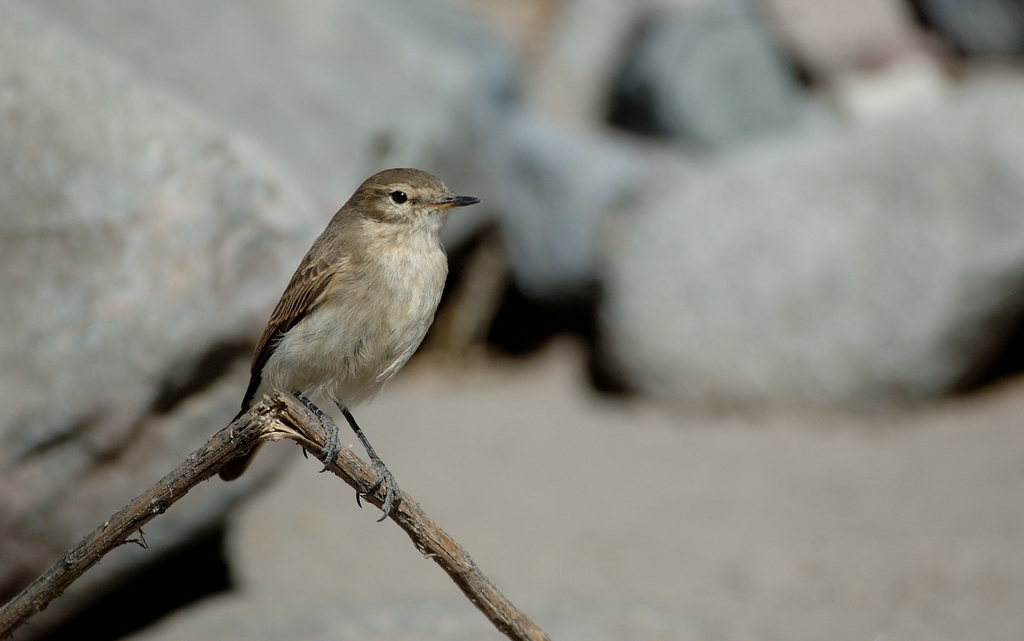
The spot-billed ground tyrant is 14 to 15.5 cm (5.5 to 6.1 in) long and weighs 11 to 17 g (0.39 to 0.60 oz). The sexes have the same plumage. Adults of the nominate subspecies have an olive-brown crown, a whitish to buffy white supercilium and spot above their lores, a dusky line through the eye, and an olive to gray patch on the ear coverts on an otherwise whitish to dusky face. Their nape and back are olive-brown. Their wing coverts are olive-brown with buff to rufous edges. Their remiges are dusky to brownish with thin pale rufous edges. Their tail is dusky brownish to black with thin whitish or pale yellowish outer webs on the feathers. Their chin and throat are whitish, their breast and belly whitish with olive mottling or dusky streaking on the breast, and their undertail coverts whitish to white. With wear their upperparts fade to grayish and the wing covert edges pale. They have a narrow, sharp, medium-length blackish to brownish-black bill with a conspicuous yellow to orangish yellow base to the mandible. They have a dark brown iris and black legs and feet. Juveniles are essentially paler versions of adults, though the edges on their wing coverts are more rusty. Subspecies M. m. niceforoi has more light brown (less olive) upperparts than the nominate, with blackish uppertail coverts. …
Range & habitat
The three subspecies of the spot-billed ground tyrant are wholly allopatric. The nominate subspecies is the southernmost and has by far the largest range. It is found in the Andes from southern Amazonas and Cajamarca departments in northern Peru south through the rest of the country, reaching the coast in the southern part of the country. Its range extends through western and central Bolivia and along the entire length of the Andes of Chile and Argentina. Subspecies M. m. niceforoi is found locally along the Colombian Andes from southern Boyacá Department south to Cundinamarca Department and the Bogotá area. M. m. rufescens is found in the Andes of Ecuador from Imbabura Province south to Chimborazo Province and perhaps further south. There are is a record in far southern Colombia. In addition, the South American Classification Committee of the American Ornithological Society has records of vagrants of the species in Brazil. The spot-billed ground tyrant inhabits a variety of landscapes, all of which are sparsely vegetated and often rocky. The nominate subspecies occurs from the temperate zone all the way up to alpine areas, typically on slopes with rock walls and some grasses and shrubs. In Argentina is also occurs around saline lakes. …
Wikipedia: “Distribution and habitat”
What it does
The spot-billed ground tyrant feeds primarily on insects and also includes fruits and maybe flowers and nectar in its diet. It typically forages singly or in pairs during the breeding season and often in small flocks outside it. It stands and walks in the open and often perches on rocks, shrubs, or partway up a rock wall to search. It typically captures prey on the ground and with short flights to hawk it in mid-air. In agricultural areas it sometimes follows tractors and other machinery.
Wikipedia: “Feeding”
Listen
Looking for field recordings…
Where it lives
Recorded sightings
—
geo-referenced records in GBIF, from museums, herbaria and field observers.
Drag the globe to turn it. Dots are where records exist, not a range map; darker means more records.
In the stacks
Searching the stacks…
Every page naming Muscisaxicola maculirostris in the Biodiversity Heritage Library →
This page is assembled live from iNaturalist, GBIF, Wikipedia, the Source Library and the Internet Archive. It is not yet part of the hand-edited codex. iNaturalist taxon 16143.