On eBird ↗
Black-fronted Ground-Tyrant
Live sightings near you, the range map, bar charts of when it is seen, and Macaulay Library photos and recordings.
Black-fronted Ground-Tyrant
Muscisaxicola frontalis
The black-fronted ground tyrant (Muscisaxicola frontalis) is a species of bird in the family Tyrannidae. It breeds in the southern Andes and winters north, reaching southern Peru. Its natural habitat is subtropical or tropical high-altitude grassland.
From the article Black-fronted ground tyrant on Wikipedia (CC BY-SA), quoted section by section
Description
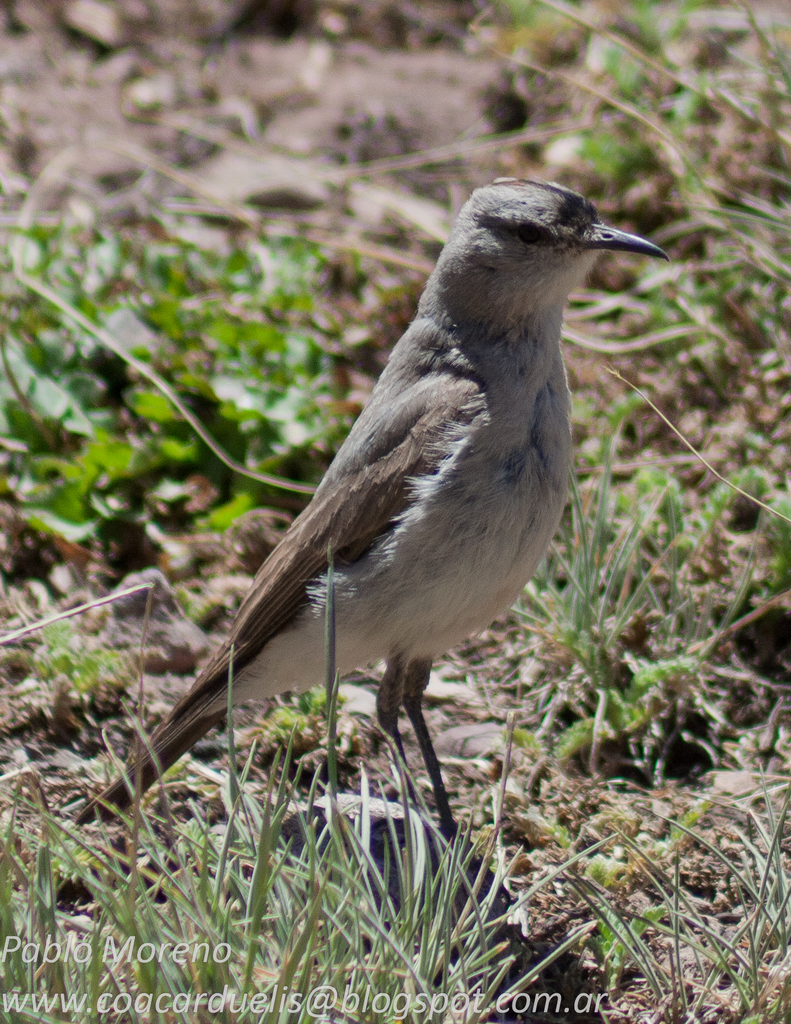
The black-fronted ground tyrant is 16.5 to 19 cm (6.5 to 7.5 in) long. The sexes have the same plumage. Adults have a black forecrown ("front"), a blackish chestnut hindcrown, conspicuous white lores, and a pale broken eye-ring on an otherwise ashy gray face. Their upperparts are ashy gray. Their wings are a duskier gray. Their tail is black with whitish outer webs of the outermost feathers. Their throat and underparts are pale gray-white. They have a dark brown iris, a slim black bill with a decurved tip, and black legs and feet. Juveniles have a sooty forecrown and pale buff edges on the wing coverts.
Range & habitat
The black-fronted ground tyrant is a bird of the Andes. It is found in Peru primarily in Arequipa and Puno departments and very rarely as far north as Ancash Department. Its range continues south through western Bolivia, along eastern Chile to the Maule Region, and along western Argentina to western Río Negro Province. It inhabits puna grassland and sparsely vegetated stony hillsides and often favors areas near water features such as bogs and marshes. In elevation it ranges overall mostly between 2,500 and 4,300 m (8,200 and 14,100 ft) but is known as low as 1,800 m (5,900 ft). In Peru it is known between 3,750 and 4,300 m (12,300 and 14,100 ft).
Wikipedia: “Distribution and habitat”
What it does
The black-fronted ground tyrant feeds primarily on insects but apparently also includes the fruits of Cumulopuntia boliviana cactus in Peru. It is almost wholly terrestrial but will perch on rocks. It runs and hops along the ground, stopping to stand erect before grabbing prey, or sallies to it from a rock. It mostly forages by itself.
Wikipedia: “Feeding”
Listen
Looking for field recordings…
Where it lives
Recorded sightings
—
geo-referenced records in GBIF, from museums, herbaria and field observers.
Drag the globe to turn it. Dots are where records exist, not a range map; darker means more records.
In the stacks
Searching the stacks…
Every page naming Muscisaxicola frontalis in the Biodiversity Heritage Library →
This page is assembled live from iNaturalist, GBIF, Wikipedia, the Source Library and the Internet Archive. It is not yet part of the hand-edited codex. iNaturalist taxon 16149.