On eBird ↗
Cinereous Ground-Tyrant
Live sightings near you, the range map, bar charts of when it is seen, and Macaulay Library photos and recordings.
Cinereous Ground-Tyrant
Muscisaxicola cinereus
The cinereous ground tyrant (Muscisaxicola cinereus) is a species of bird in the family Tyrannidae. The term cinereous describes its colouration. It is found in Argentina, Bolivia, Chile, and Peru. Its natural habitat is subtropical or tropical high-altitude grassland.
From the article Cinereous ground tyrant on Wikipedia (CC BY-SA), quoted section by section
Description
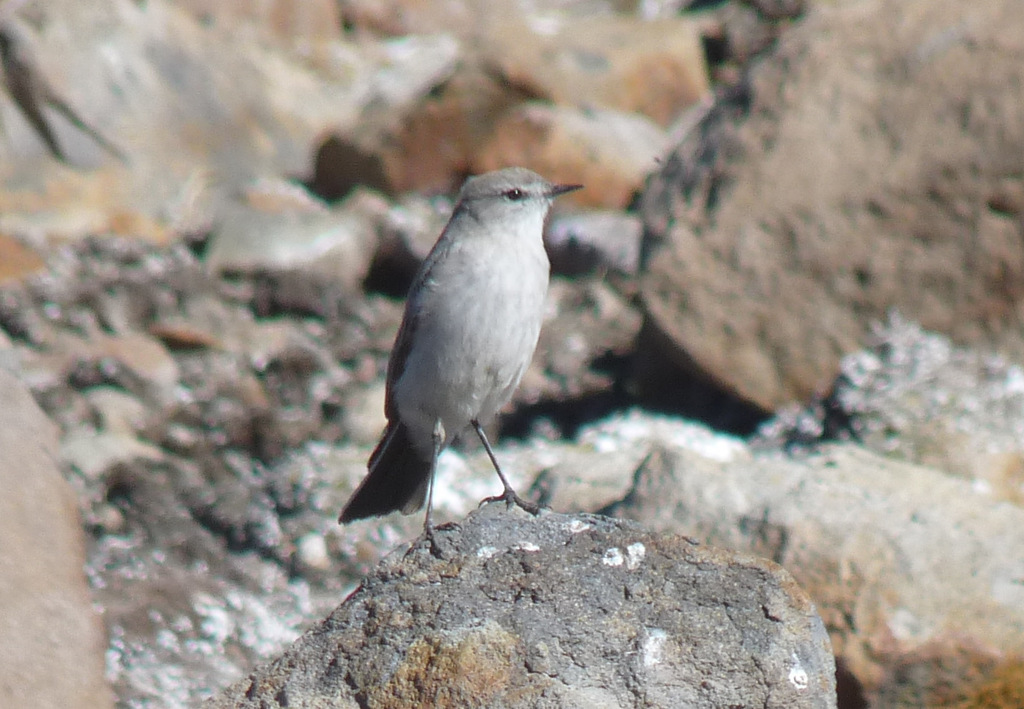
The cinereous ground tyrant is 15.5 to 16.5 cm (6.1 to 6.5 in) long. The two subspecies and the sexes have the same shades of gray plumage ("cinereous" means ash-colored). Subspecies M. c. argentinus is slighter larger than the nominate. Adults have a grayish brown crown, dusky lores, and a thin white supercilium to above the eye. Their nape and back are grayish brown. Their wings are a duskier grayish brown with some paler edges on the coverts. Their tail is blackish with thin white edges on the outermost feathers. Their underparts are mostly grayish white with a somewhat whiter belly. They have a dark brown iris, a black bill, and black legs and feet.
Range & habitat
The cinereous ground tyrant is found from Pasco and northern Lima departments in central Peru south through western Bolivia and northwestern Argentina to the Maule Region in central Chile. Within that range subspecies M. c. argentinus is found in Argentina between Jujuy and Catamarca provinces. It primarily inhabits puna grassland and also montane scrublands and rocky pastures near water. In the non-breeding season it favors dry rocky areas. In elevation it overall ranges between 2,500 and 5,000 m (8,200 and 16,400 ft) though only 4,000 to 4,700 m (13,100 to 15,400 ft) in Peru.
Wikipedia: “Distribution and habitat”
What it does
The cinereous ground tyrant feeds on insects. It is almost wholly terrestrial; it will perch on rocks or a wall. It runs and hops along the ground, stopping to stand erect before grabbing prey, or less frequently makes a short sally to the ground from a low perch.
Wikipedia: “Feeding”
Listen
Looking for field recordings…
Where it lives
Recorded sightings
—
geo-referenced records in GBIF, from museums, herbaria and field observers.
Drag the globe to turn it. Dots are where records exist, not a range map; darker means more records.
In the stacks
Searching the stacks…
Every page naming Muscisaxicola cinereus in the Biodiversity Heritage Library →
This page is assembled live from iNaturalist, GBIF, Wikipedia, the Source Library and the Internet Archive. It is not yet part of the hand-edited codex. iNaturalist taxon 16163.