On eBird ↗
Russet-winged Spadebill
Live sightings near you, the range map, bar charts of when it is seen, and Macaulay Library photos and recordings.
Russet-winged Spadebill
Platyrinchus leucoryphus
The russet-winged spadebill (Platyrinchus leucoryphus) is a species of bird in the family Tyrannidae. It is found in Argentina, Brazil, and Paraguay. Its natural habitat is subtropical or tropical moist lowland forest. It is threatened by habitat loss.
From the article Russet-winged spadebill on Wikipedia (CC BY-SA), quoted section by section
Description
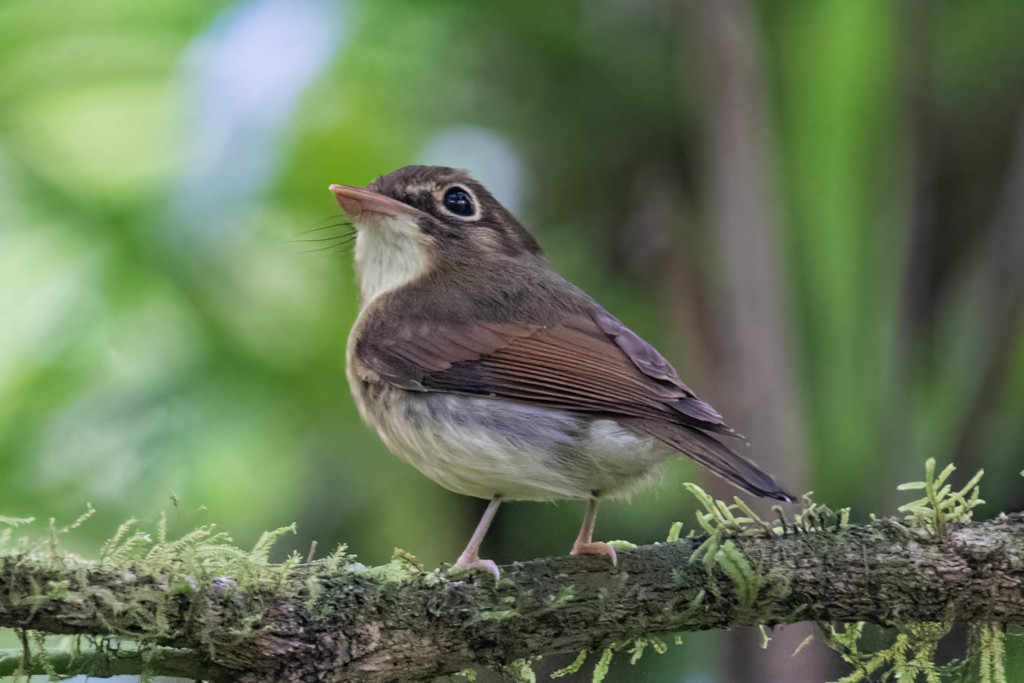
The russet-winged spadebill is the largest member of its genus. It is 12 to 12.5 cm (4.7 to 4.9 in) long and weighs about 17 g (0.60 oz). It has a large head and a longer tail than others of its genus. The sexes have the same plumage. Adults have an olive-brown crown with a partially hidden white patch in the center. They have pale buff-white to yellowish as a spot above the lores, as an eye-ring, and on the ear coverts. They have dark brown lores, a dark stripe through the eye, and a dark stripe below the pale ear coverts. Their upperparts are olive-brown. Their wings are brown with wide russet edges on the coverts and flight feathers. Their tail is brown. Their throat is white and their underparts mostly dull yellow or white with an olive-brown wash on the breast and sides. They have a dark brown iris, a wide flat bill with a yellow-edged black maxilla and a yellowish mandible, and pale orange to dull pinkish legs and feet.
Range & habitat
The russet-winged spadebill is found in southeastern Brazil from Espirito Santo south to northeastern Santa Catarina and Rio Grande do Sul and from there west into eastern Paraguay and northeastern Argentina's Misiones Province. It is a bird of the Atlantic Forest, where it primarily inhabits the undergrowth of humid primary forest and mature secondary forest. In elevation it ranges from sea level to at least 1,000 m (3,300 ft).
Wikipedia: “Distribution and habitat”
What it does
The russet-winged spadebill feeds on arthropods. It typically forages singly and only once has been noted joining a mixed-species feeding flock. It sits still, typically in the crown of a small tree about 3 to 8 m (10 to 25 ft) above the ground, and captures prey mostly with short upward or outward sallies from the perch to grab it from the underside of leaves and twigs. After a sally it typically lands on a different perch.
Wikipedia: “Feeding”
Listen
Looking for field recordings…
Where it lives
Recorded sightings
—
geo-referenced records in GBIF, from museums, herbaria and field observers.
Drag the globe to turn it. Dots are where records exist, not a range map; darker means more records.
In the stacks
Searching the stacks…
Every page naming Platyrinchus leucoryphus in the Biodiversity Heritage Library →
This page is assembled live from iNaturalist, GBIF, Wikipedia, the Source Library and the Internet Archive. It is not yet part of the hand-edited codex. iNaturalist taxon 16248.