On eBird ↗
Peruvian Tyrannulet
Live sightings near you, the range map, bar charts of when it is seen, and Macaulay Library photos and recordings.
Peruvian Tyrannulet
Zimmerius viridiflavus
The Peruvian tyrannulet (Zimmerius viridiflavus) is a species of bird in the family Tyrannidae. As traditionally defined, it is endemic to Peru, but recent genetic evidence suggests it should include the taxon flavidifrons as a subspecies, in which case the range of the Peruvian tyrannulet extends into far southern Ecuador. Alternatively, flavidifrons is sometimes considered a separate species, the Loja tyrannulet, but it is not closely related to the golden-faced tyrannulet as previously believed.
From the article Peruvian tyrannulet on Wikipedia (CC BY-SA), quoted section by section
Description
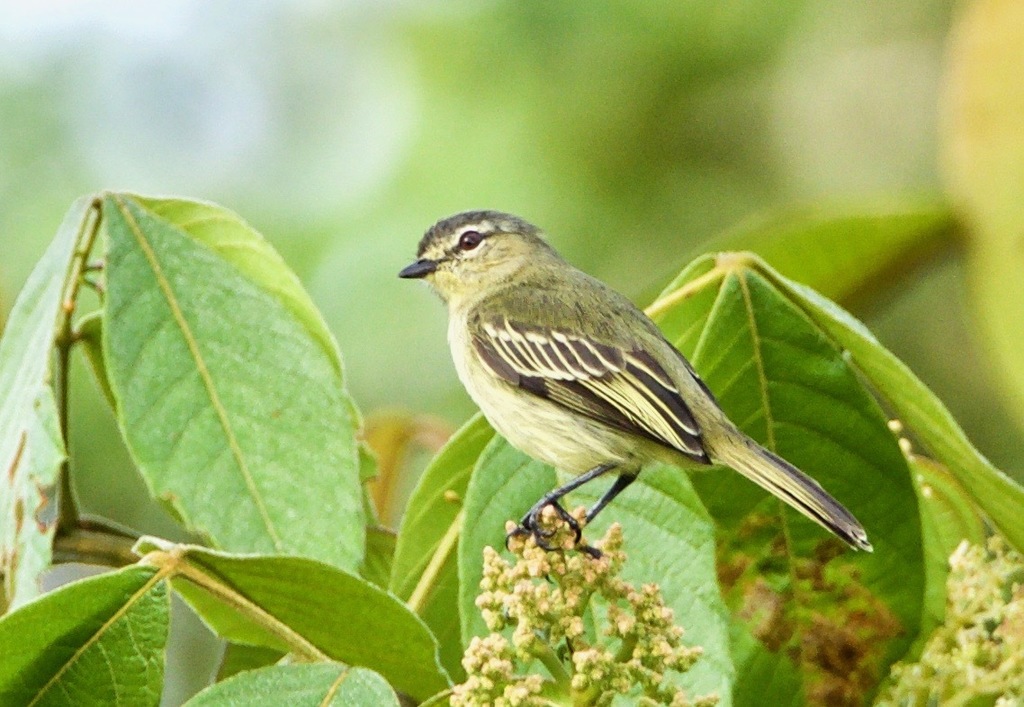
The Peruvian tyrannulet is about 11 to 12 cm (4.3 to 4.7 in) long and weighs 9 to 10 g (0.32 to 0.35 oz). The sexes have the same plumage. Adults have pale yellow lores and eye-ring and a dark stripe through the eye on an otherwise buff-washed bright olive face. Their crown is darkish olive to grayish olive and their back and rump are bright olive. Their wings are dark dusky with bright yellow-green edges on the coverts and flight feathers. Their tail is dusky olive. Their throat is pale yellow, their breast and flanks olive-yellow with some olive markings, and their belly bright yellow. They have a gray to medium brown iris with a tan rim, a small, rounded, bill whose maxilla is gray to blackish and mandible medium gray, and dark gray to black legs and feet.
Range & habitat
The Peruvian tyrannulet is found intermittently on the east side of the central Peruvian Andes in the departments of Huánuco, Junín, and Ayacucho. It primarily inhabits the canopy and edges of humid montane forest and occasionally occurs in secondary forest. In elevation it ranges between 1,000 and 2,500 m (3,300 and 8,200 ft).
Wikipedia: “Distribution and habitat”
What it does
The Peruvian tyrannulet feeds on insects; it probably also feeds on small fruits like those of mistletoes (Loranthaceae). It forages singly or in pairs and often joins mixed-species feeding flocks. It feeds mostly in the forest canopy, perching horizontally with its tail cocked and actively moving about and gleaning food while perched or with short flights.
Wikipedia: “Feeding”
Listen
Looking for field recordings…
Where it lives
Recorded sightings
—
geo-referenced records in GBIF, from museums, herbaria and field observers.
Drag the globe to turn it. Dots are where records exist, not a range map; darker means more records.
In the stacks
Searching the stacks…
Every page naming Zimmerius viridiflavus in the Biodiversity Heritage Library →
This page is assembled live from iNaturalist, GBIF, Wikipedia, the Source Library and the Internet Archive. It is not yet part of the hand-edited codex. iNaturalist taxon 16270.