On eBird ↗
Snethlage's Tody-Tyrant
Live sightings near you, the range map, bar charts of when it is seen, and Macaulay Library photos and recordings.
Snethlage's Tody-Tyrant
Hemitriccus minor
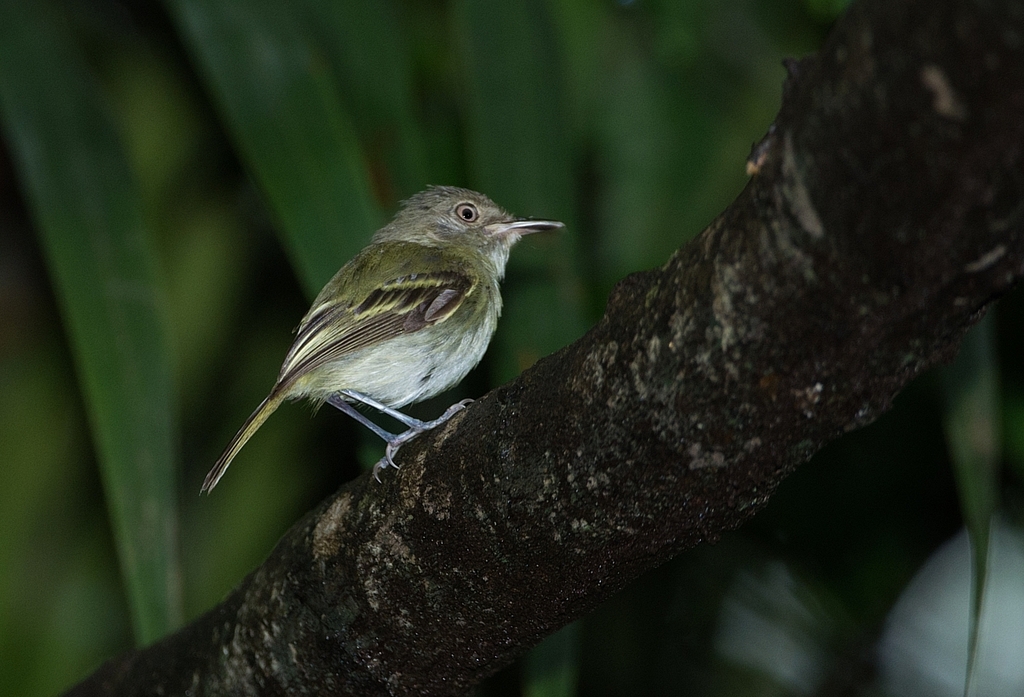
The Snethlage's tody-tyrant (Hemitriccus minor) is a species of bird in the family Tyrannidae. It is found in Bolivia, Brazil, and Venezuela. Its natural habitat is subtropical or tropical moist lowland forests.
From the article Snethlage's tody-tyrant on Wikipedia (CC BY-SA), quoted section by section
Description
Snethlage's tody-tyrant is about 10 cm (3.9 in) long and weighs 7 to 7.9 g (0.25 to 0.28 oz). The sexes have similar plumage. Adults of the nominate subspecies have an olive-green crown with a short bushy crest. Their face, back, and rump are olive-green. Their wings and tail are olive with greenish yellow edges on the flight feathers and yellowish ends on the coverts; the last show as two somewhat indistinct wing bars. Their throat and underparts are mostly pale yellow with faint grayish olive streaks except on the center of the belly. Some individuals have mostly white underparts. Females have slightly brighter upperparts and yellower underparts than males. Subspecies H. m. pallens has paler underparts and more distinct wing bars than the nominate. H. m. snethlageae is smaller than the nominate, with a shorter tail, yellower and more distinct wing bars, and brighter yellow underparts. All subspecies have a white to pale yellow iris and gray to pinkish gray legs and feet. Their bill is flattish with a wide base; it is mostly brown to blackish with a pinkish base to the mandible.
Range & habitat
Snethlage's tody-tyrant is a bird of the Amazon Basin, though sources differ on the distribution of the subspecies within it. According to Clock in the Cornell Lab of Ornithology's Birds of the World, the nominate subspecies is the easternmost. It is found in Brazil's Pará state in the area of the lower Xingu and Tocantins rivers. Subspecies H. m. snethlageae is the most widespread. Clock places it in central Brazil from the Madeira River east to the Tapajos River and south to northern Rondônia and Mato Grosso states and into northeastern Bolivia's Beni and Santa Cruz departments. Clock places H. m. pallens on both sides of the Amazon from near the Peruvian border in western Amazonas state east to the Negro and Madeira rivers. The Clements taxonomy generally agrees with Clock, sometimes providing a little more detail. (Cornell maintains the Clements taxonomy so the two are not wholly independent.) The IOC World Bird List places the nominate subspecies in "se Amazonian Brazil", H. m. snethlageae in "w Amazonian Brazil", and H. m. pallens in "c Amazonian Brazil to ne Bolivia". This source switches the ranges of snethlageae and pallens as defined by Cornell/Clements. In addition to the ranges described by the above sources, the South American Classification Committee of the American Ornithological Society (SACC) places the species in Venezuela without naming a subspecies. …
Wikipedia: “Distribution and habitat”
What it does
Snethlage's tody-tyrant feeds on insects. It typically forages singly or in pairs and is not known to join mixed-species feeding flocks. It feeds mostly in thick undergrowth between about 3 and 8 m (10 and 25 ft) above the ground, using short upward sallies from a perch to glean prey from the underside of vegetation.
Wikipedia: “Feeding”
Listen
Looking for field recordings…
Where it lives
Recorded sightings
—
geo-referenced records in GBIF, from museums, herbaria and field observers.
Drag the globe to turn it. Dots are where records exist, not a range map; darker means more records.
In the stacks
Searching the stacks…
Every page naming Hemitriccus minor in the Biodiversity Heritage Library →
This page is assembled live from iNaturalist, GBIF, Wikipedia, the Source Library and the Internet Archive. It is not yet part of the hand-edited codex. iNaturalist taxon 16287.