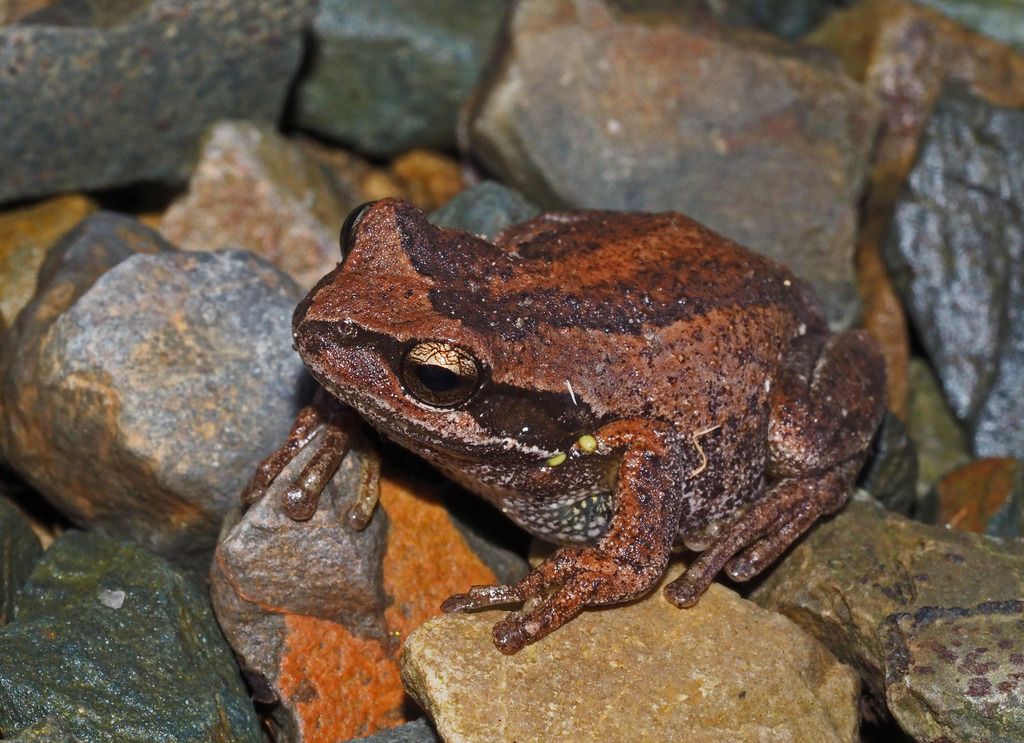
Verreaux's Tree Frog
Rawlinsonia verreauxii
The whistling tree frog (Rawlinsonia verreauxii), or Verreaux's tree frog, is a species of frog found in Australia. It has been divided into two subspecies, the nominate Verreaux's tree frog (R. v. verreauxii) and the Verreaux's alpine tree frog (R. v. alpina). The alpine tree frog is restricted to the southern alps of New South Wales and Victoria. Verreaux's tree frog is widespread throughout south-eastern Queensland, coastal and highland regions of New South Wales, and south-eastern Victoria.
From the article Whistling tree frog on Wikipedia (CC BY-SA), quoted section by section
Description
R. v. verreauxii is light brown to red brown above, with an often indistinct, broad, darker patch starting between the eyes and continuing over the back. A dark band starting at the nostril runs across the eye and down to the shoulder, underlined by a white line starting at the mouth. The thighs and backs of the legs are red with small black spots, with some larger black spots present on the fronts of the thighs.
R. v. alpina is mostly green on the dorsal surface with two brown bands running parallel to each other down the back. These bands start at the eye and are separated by a narrow band of green. The thighs and backs of the legs are the same as above. The belly of both subspecies is white. Both reach a maximum size of about 35 mm (1.4 in).
What it does
Verreaux's tree frog inhabits swamps, dam impoundments, and creeks in woodland, farmland, forest and cleared land. Males call from pond-side vegetation or from the ground all year round, but calling intensifies during autumn and spring and after rain. As its name implies, this frog makes a whistling noise. The alpine tree frog inhabits alpine ponds and pools of creeks in moorland, alpine forest and partly cleared land. Males have a similar call as above and call from beside the breeding sites during spring and summer. Chytrid fungus is believed to be partly responsible for the decline of the alpine subspecies.
Wikipedia: “Ecology and behaviour”
Listen
Looking for field recordings…
Where it lives
Recorded sightings
—
geo-referenced records in GBIF, from museums, herbaria and field observers.
Drag the globe to turn it. Dots are where records exist, not a range map; darker means more records.
In the stacks
Searching the stacks…
Every page naming Rawlinsonia verreauxii in the Biodiversity Heritage Library →
This page is assembled live from iNaturalist, GBIF, Wikipedia, the Source Library and the Internet Archive. It is not yet part of the hand-edited codex. iNaturalist taxon 1633169.