- Animals
- ›Chordates
- ›Vertebrates
- ›Mammals
- ›Therians
- ›Placental Mammals
- ›Ungulates, Carnivorans, and Allies
- ›Carnivorans
- ›Mustelids
- ›Otters
- ›Lutra
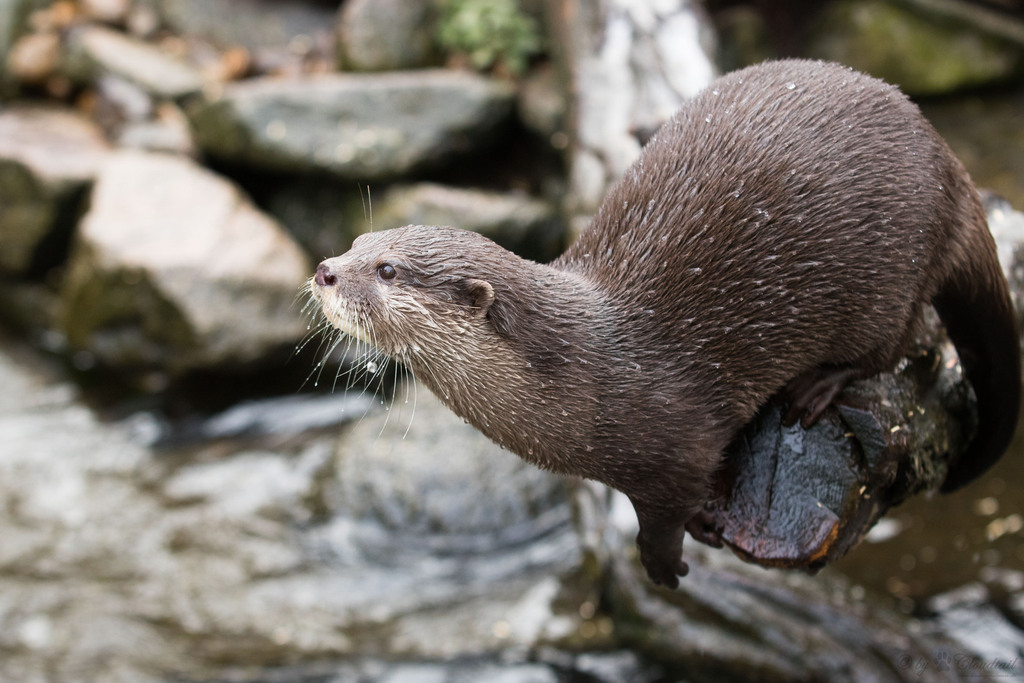
Asian Small-clawed Otter
Lutra cinerea
The Asian small-clawed otter (Lutra cinerea), also called oriental small-clawed otter and small-clawed otter, is an otter species native to South and Southeast Asia. It is the only species of the subgenus Amblonyx in the genus Lutra. It has short claws that do not extend beyond the pads of its webbed digits. With a total body length of 730 to 960 mm (28.6 to 37.6 in), and a maximum weight of 3.5 kg (7.7 lb), it is the smallest otter species.
The Asian small-clawed otter lives in riverine habitats, freshwater wetlands and mangrove swamps. It feeds on molluscs, crabs and other small aquatic animals. It lives in pairs, but also has been observed in family groups with up to 12 individuals.
From the article Asian small-clawed otter on Wikipedia (CC BY-SA), quoted section by section
Description
The Asian small-clawed otter has deep brown fur with some rufous tinge on the back, but paler below. Its underfur is lighter near the base. The sides of the neck and head are brown, but its cheeks, upperlip, chin, throat and sides of the neck are whitish. Its skull is short, and the naked rhinarium rounded above. The muzzle has long coarse vibrissae on either side. Its eyes are located toward the front of the head. The small ears are oval-shaped with an inconspicuous tragus and antitragus. Its paws are narrow with short digits that are webbed to the last joint. There are short hairs on the lower sides of the interdigital webs. The four-lobed plantar pads are longer than wide. The claws are short, almost erect, and in some individuals even absent. Females have four mammary glands. The Asian small-clawed otter is the smallest otter species in Asia. In head-to-body length, it ranges from 470 to 610 mm (18.4 to 24 in) with a 260 to 350 mm (10.2 to 13.6 in) long tail. The tapering tail is thick and muscular, especially at the base, and more than half the length of the body. Hind feet are 97 to 102 mm (3.8 to 4 in) long. Length of skull ranges from 3.3 to 3.7 in (84 to 94 mm). It does not have upper premolars and only four cheek teeth above. Adult captive otters range in weight from 2.7 to 3.5 kg (6.0 to 7.7 lb).
Wikipedia: “Characteristics”
Range & habitat
The Asian small-clawed otter's native range comprises parts of India to Southeast Asia including the islands of Sumatra, Java, Borneo and Palawan. It lives in freshwater wetlands such as swamps, meandering rivers, irrigated rice fields as well as estuaries, coastal lagoons and tidal pools. It occurs in West Bengal, Assam and Arunachal Pradesh, and in coastal regions of Odisha. In Karnataka, Nilgiri and Palni hills in Tamil Nadu, it lives in shallow mountain creeks up to an elevation of 2,000 m (6,600 ft). In West Java, it inhabits areas along slow-flowing irrigation channels, pond areas and rice fields surrounded by vegetation that offers shelter. It also occurs in mangrove forests. In February 2025, the Asian small-clawed otter was photographed in Dadeldhura District in far-western Nepal. In the 1980s, a few Asian small-clawed otters escaped from captivity in England and established a population in the wild. It was likely driven out by the recovery of the native Eurasian otter.
Wikipedia: “Distribution and habitat”
What it does
The Asian small-clawed otter is mostly active after dark. It lives in groups of up to 15 individuals. In the Bangladesh Sundarbans, 53 individuals were recorded in 351 km (218 mi) of water courses in 13 locations between November 2014 and March 2015. Group size ranged from one to 12 individuals. Group members communicate using 12 or more distinct calls, and utter a variety of yelps and whimpers. When disturbed, they scream to rally the help of others. When swimming on the surface, otters row with the forelimbs and paddle with the hind limbs. When diving under water, they undulate their bodies and tails. Captive otters swim at speeds of 0.7–1.2 m/s (2.3–3.9 ft/s). Observations of wild Asian small-clawed otters revealed that they smear their spraint at latrine sites, using their hind feet and tails. Large groups smeared more than groups of three or fewer animals. The frequency of latrines with smeared scats varied in different locations, indicating a preference for certain sites. Spraint smearing most likely facilitates social ties among group members and is associated with territorial marking displays. They use grassy or sandy banks for resting, sun bathing and grooming. In marshes, they mostly use islands.
Diet. The Asian small-clawed otter feeds mainly on crabs, mudskippers and Trichogaster fish. Its diet varies seasonally. …
Wikipedia: “Behaviour and ecology”
Listen
Looking for field recordings…
Where it lives
Recorded sightings
—
geo-referenced records in GBIF, from museums, herbaria and field observers.
Drag the globe to turn it. Dots are where records exist, not a range map; darker means more records.
In the stacks
Searching the stacks…
Every page naming Lutra cinerea in the Biodiversity Heritage Library →
This page is assembled live from iNaturalist, GBIF, Wikipedia, the Source Library and the Internet Archive. It is not yet part of the hand-edited codex. iNaturalist taxon 1638835.