- Animals
- ›Chordates
- ›Vertebrates
- ›Mammals
- ›Therians
- ›Placental Mammals
- ›Ungulates, Carnivorans, and Allies
- ›Carnivorans
- ›Mustelids
- ›Otters
- ›Lutra
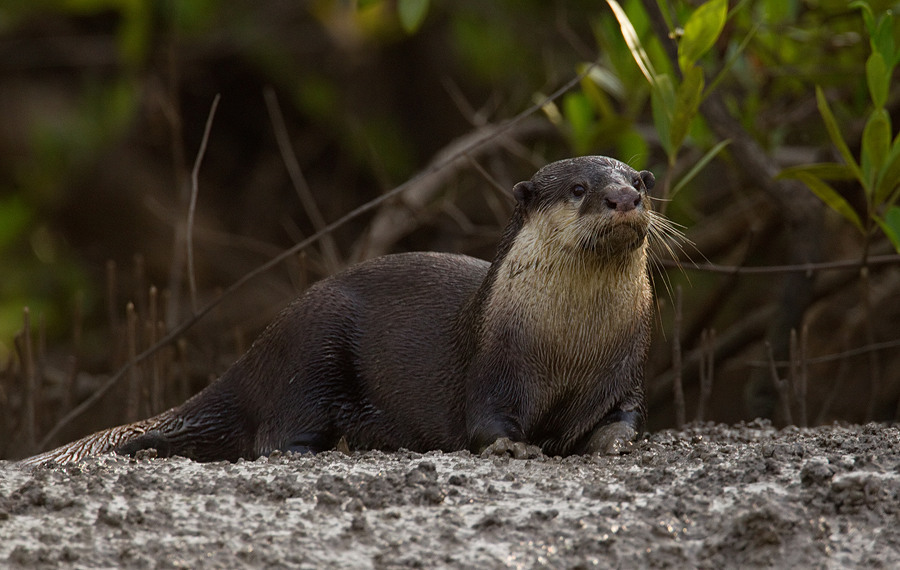
African Clawless Otter
Lutra capensis
The African clawless otter (Aonyx capensis), also known as the Cape clawless otter or groot otter, is the second-largest freshwater otter species. It inhabits permanent water bodies in savannah and lowland forest areas through most of sub-Saharan Africa. It is characterised by partly webbed and clawless feet, from which their name is derived. The word 'aonyx' means clawless, derived from the prefix a- ("without") and onyx ("claw/hoof").
From the article African clawless otter on Wikipedia (CC BY-SA), quoted section by section
Description
The African clawless otter has a chestnut-coloured thick, smooth fur with almost silky underbellies. It is characterized by white facial markings that extend downward towards its throat and chest areas. Paws are partially webbed with five fingers, but without opposable thumbs. All lack claws except for digits 2, 3, and 4 of the hind feet. Its large skull is broad and flat, with a relatively small orbit and a short snout. Molars are large and flat, used for crushing of prey. Male otters are slightly larger than females on average. Adults are 113–163 cm (44–64 in) in length, including their tails that comprised about a third of their length. Weights range from 10–36 kg (22–79 lb), with most otters averaging between 12 and 21 kg (26 and 46 lb). They are the third largest otter on average after the sea otter and giant otter and probably the third largest extant mustelid appearing to slightly outrival the wolverine, hog badger and European badger in mean body mass. Despite being closely related to the Asian small-clawed otter, the African clawless otter is often twice as massive.
Range & habitat
African clawless otters can be found anywhere from open coastal plains, to semiarid regions, to densely forested areas. Surviving mostly in southern Africa, the otters live in areas surrounding permanent bodies of water, usually surrounded by some form of foliage. Logs, branches, and loose foliage greatly appeal to the otter as this provides shelter, shade, and great rolling opportunities. Slow and rather clumsy on land, they build burrows in banks near water, allowing for easier food access and a quick escape from predators. In the False Bay area of the Cape Peninsula, they have been observed scavenging along beaches and rocks and hunting in shallow surf for mullet. They are mainly nocturnal in urban areas and lie up during the day in quiet, bushy areas.
Wikipedia: “Distribution and habitat”
What it does
The African clawless otter spends its days swimming and catching food. A number of African clawless otters were radio-tracked across boulders and reed beds, which gave them shelter and enabled them to catch more of their preferred (crab) prey. Though mostly solitary animals, African clawless otters live in neighboring territories of family groups of up to five individuals. Each still having its own range within that territory, they mostly keep to themselves unless seeking a mate. Territories are marked using a pair of anal glands which secrete a particular scent. Each otter is very territorial over its particular range. They return to burrows (holts) for safety, cooling or a rubdown using grasses and leaves. Mainly aquatic creatures, their tails are used for locomotion and propel them through the water. They are also used for balance when walking or sitting upright.
Reproduction. Females give birth to litters of two to five young around early spring. Mating takes place in short periods throughout the rainy season in December. Afterwards, both males and females go their separate ways and return to their solitary lives once more. Young are raised solely by the females. Gestation lasts around two months (63 days). Weaning takes place between 45 and 60 days, with the young reaching full maturity around one year of age.
Diet. …
Wikipedia: “Behaviour and ecology”
Listen
Looking for field recordings…
Where it lives
Recorded sightings
—
geo-referenced records in GBIF, from museums, herbaria and field observers.
Drag the globe to turn it. Dots are where records exist, not a range map; darker means more records.
In the stacks
Searching the stacks…
Every page naming Lutra capensis in the Biodiversity Heritage Library →
This page is assembled live from iNaturalist, GBIF, Wikipedia, the Source Library and the Internet Archive. It is not yet part of the hand-edited codex. iNaturalist taxon 1638841.