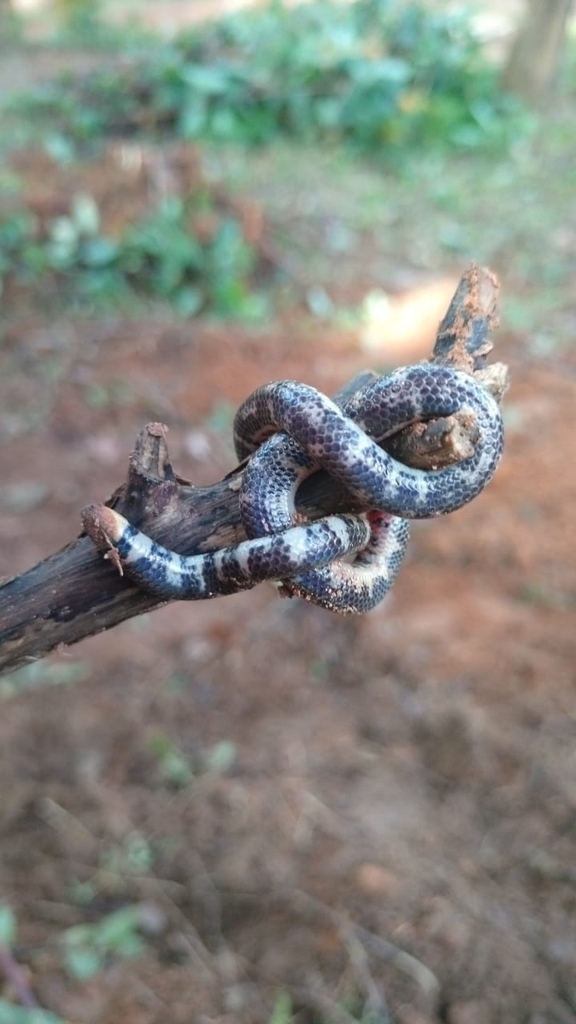
Siruvani Hills Shieldtail
Rhinophis siruvaniensis
Rhinophis siruvaniensis, is a species of snake in the family Uropeltidae. The species is endemic to the Siruvani Hills in the Western Ghats of India.
From the article Rhinophis siruvaniensis on Wikipedia (CC BY-SA), quoted section by section
Description
Rhinophis siruvaniensis is dark brownish black on its dorsum and creamy white on its ventral with irregular patches projecting ventrolaterally. Juveniles are around 12–14 cm (4+3⁄4–5+1⁄2 in) long including the tail and adults are known to reach up to 30 cm (11+3⁄4 in) long including the tail. The dorsal scales are in 17 rows at midbody and the ventrals number 202-205, and there are 4-8 pairs of subcaudals. The snout is acutely pointed. The eye bulges slightly out of the ocular shield. The frontal is longer than broad. The tail ends in a large convex rugose shield, with several narrow, evenly spaced, broken ridges, somewhat tapering towards the tip.
Range & habitat
Rhinophis siruvaniensis is only known from its type locality, the Siruvani Hills. It lives between 800–1100 m in wet evergreen forests. The species is also found in villages and spice plantations. The holotype was discovered within cardamom and coffee plantations. Other specimens have been found under fallen logs and rocks. They are found in burrows up to 30 cm (11+3⁄4 in) deep.
Wikipedia: “Distribution and habitat”
In human culture
The specific name, siruvaniensis, is from its known distribution, the Siruvani Hills.
Wikipedia: “Etymology”
Where it lives
Recorded sightings
—
geo-referenced records in GBIF, from museums, herbaria and field observers.
Drag the globe to turn it. Dots are where records exist, not a range map; darker means more records.
In the stacks
Searching the stacks…
Every page naming Rhinophis siruvaniensis in the Biodiversity Heritage Library →
This page is assembled live from iNaturalist, GBIF, Wikipedia, the Source Library and the Internet Archive. It is not yet part of the hand-edited codex. iNaturalist taxon 1648516.