On eBird ↗
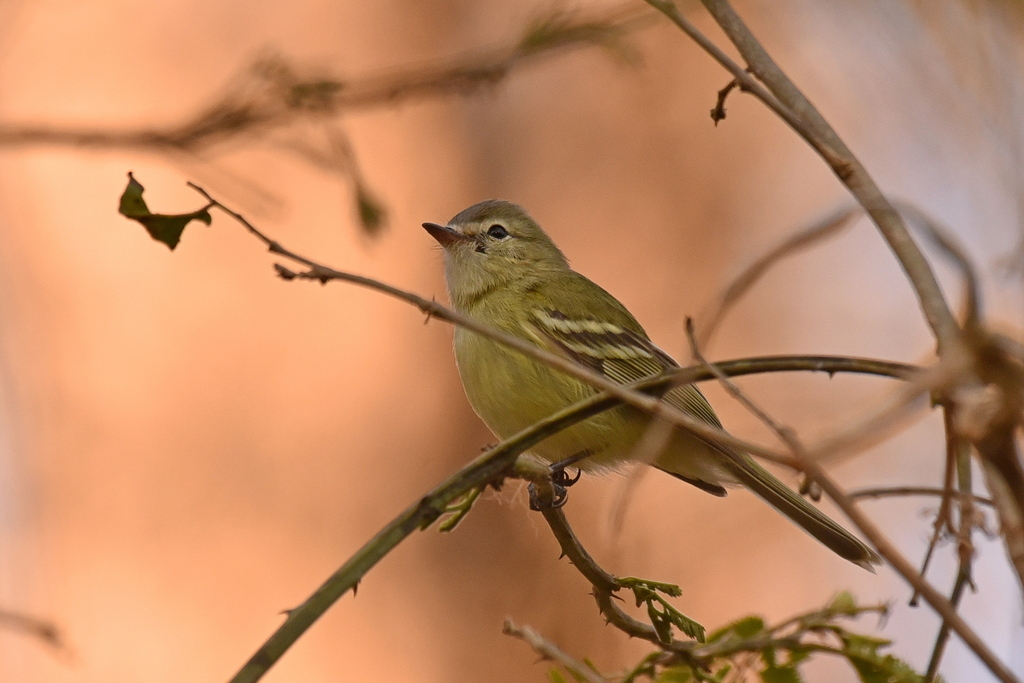
Reiser's Tyrannulet
Live sightings near you, the range map, bar charts of when it is seen, and Macaulay Library photos and recordings.
Reiser's Tyrannulet
Phyllomyias reiseri
The Reiser's tyrannulet (Phyllomyias reiseri) is a species of bird in the family Tyrannidae. It is found in central Brazil and northern Paraguay. Its natural habitats are subtropical or tropical dry forests and subtropical or tropical moist lowland forests.
From the article Reiser's tyrannulet on Wikipedia (CC BY-SA), quoted section by section
Description
Reiser's tyrannulet is 11 to 11.5 cm (4.3 to 4.5 in) long and weighs 7 to 8 g (0.25 to 0.28 oz). The sexes have the same plumage. Adults have a bright olive crown, nape, back, and rump with faint grayish tips on the crown feathers. They have yellowish white lores, supercilium, and cheeks and a thin olive line through the eye. Their wings are dusky with pale yellowish edges on the flight feathers and the ends of the coverts; the last show as two bars on the closed wing. Their tail is dusky olive. Their throat and lower face are whitish and their underparts pale yellow with faint olive streaks on the breast and sides. Their iris is pale brown, their short rounded bill has a blackish maxilla and a black-tipped pinkish to white mandible, and their legs and feet are gray.
Range & habitat
Reiser's tyrannulet is found from southern Piauí state in Brazil southwest into east-central Paraguay's Concepción Department. It inhabits subtropical dry deciduous forest and, in the cerrado region, gallery forest .
Wikipedia: “Distribution and habitat”
What it does
The diet and foraging behavior of Reiser's tyrannulet have not been studied. It is thought to forage in the canopy and on the edges of the forest.
Wikipedia: “Feeding”
Listen
Looking for field recordings…
Where it lives
Recorded sightings
—
geo-referenced records in GBIF, from museums, herbaria and field observers.
Drag the globe to turn it. Dots are where records exist, not a range map; darker means more records.
In the stacks
Searching the stacks…
Every page naming Phyllomyias reiseri in the Biodiversity Heritage Library →
This page is assembled live from iNaturalist, GBIF, Wikipedia, the Source Library and the Internet Archive. It is not yet part of the hand-edited codex. iNaturalist taxon 16497.