On eBird ↗
Orange-eyed Flatbill
Live sightings near you, the range map, bar charts of when it is seen, and Macaulay Library photos and recordings.
Orange-eyed Flatbill
Tolmomyias traylori
The orange-eyed flatbill or orange-eyed flycatcher (Tolmomyias traylori) is a species of bird in the family Tyrannidae. It is found in the Amazon (specifically in várzea forest) in south-eastern Colombia, eastern Ecuador, and north-eastern Peru. First recognized as a species due to its distinct voice, it was only described in 1997; the binomial commemorates the American ornithologist Melvin Alvah Traylor Jr. The International Union for Conservation of Nature has rated the conservation status of this species...
From the article Orange-eyed flatbill on Wikipedia (CC BY-SA), quoted section by section
Description
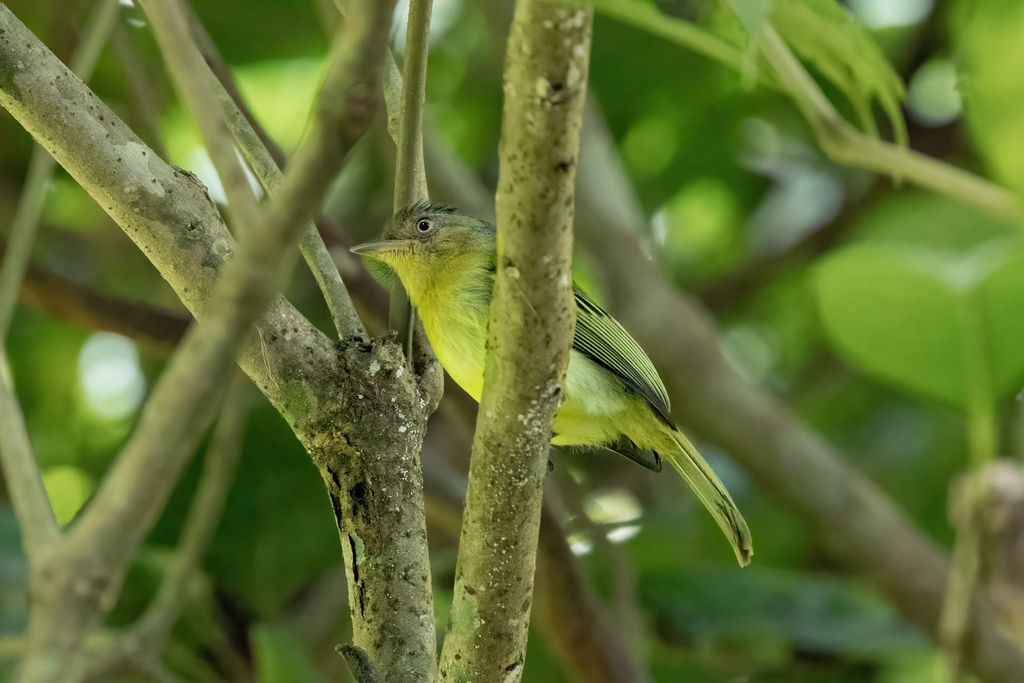
The orange-eyed flatbill is about 13.5 cm (5.3 in) long; one male weighed 11.5 g (0.41 oz). The sexes have the same plumage. Adults have a cinnamon forecrown with olive-gray tips on the feathers. They have an olive-gray crown, buff lores, a pale eye-ring, and cinnamon-buff ear coverts. Their nape, back, rump, and uppertail coverts are pale olive-green. Their wings are dusky with greenish yellow edges on the greater coverts that form two wing bars and thin olive-green edges on the flight feather edges, some of which also have a cream far outer edge. Their tail is dusky with olive-green outer webs on most of the feathers. Their throat and chin are whitish buff, their upper breast ochraceous buff with duller sides, their lower breast and flanks pale yellow, their belly bright yellow, and their undertail coverts cream. They have a pale orangish brown or yellowish mauve iris, a wide flat bill with a black maxilla and a pale pinkish brown mandible, and bluish gray legs and feet.
Range & habitat
The orange-eyed flatbill is a bird of the far western Amazon Basin. It is found from Putumayo Department in southern Colombia south through eastern Ecuador into northern Peru's Amazonas and Loreto departments. In addition, there are sight records in extreme southeastern Colombia's Amazonas Department near the Amazon River and eBird records further north in Colombia. The species' range might extend further east into far western Brazil. It is known along the Napo River in Ecuador and north of the Amazon and its tributaries in Colombia. It apparently replaces the yellow-olive flatbill (T. sulphurescens) north of the Amazon. The species inhabits riverside forest, especially seasonally flooded várzea. In Peru it is also known locally on older river islands. It primarily occurs from the forest's mid-story to its canopy. In elevation it reaches 300 m (1,000 ft) in Colombia and Ecuador; its maximum elevation in Peru isn't known.
Wikipedia: “Distribution and habitat”
What it does
The orange-eyed flatbill primarily feeds on insects, though details are lacking. It typically forages singly or in pairs and regularly joins mixed-species feeding flocks. It usually captures prey with outward or upward sallies to snatch it from leaves.
Wikipedia: “Feeding”
Listen
Looking for field recordings…
Where it lives
Recorded sightings
—
geo-referenced records in GBIF, from museums, herbaria and field observers.
Drag the globe to turn it. Dots are where records exist, not a range map; darker means more records.
In the stacks
Searching the stacks…
Every page naming Tolmomyias traylori in the Biodiversity Heritage Library →
This page is assembled live from iNaturalist, GBIF, Wikipedia, the Source Library and the Internet Archive. It is not yet part of the hand-edited codex. iNaturalist taxon 16545.