On eBird ↗
Yellow-margined Flatbill
Live sightings near you, the range map, bar charts of when it is seen, and Macaulay Library photos and recordings.
Yellow-margined Flatbill
Tolmomyias assimilis
The yellow-margined flatbill or Zimmer's flatbill (Tolmomyias assimilis) is a species of bird in the tyrant flycatcher family Tyrannidae. It is found in every mainland South American country except Argentina, Chile, Paraguay, and Uruguay.
From the article Yellow-margined flatbill on Wikipedia (CC BY-SA), quoted section by section
Description
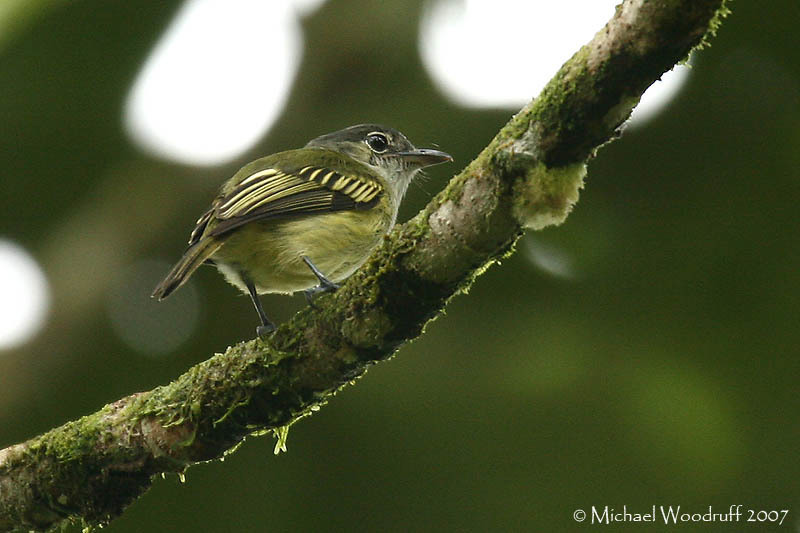
The yellow-margined flatbill is 13 to 13.5 cm (5.1 to 5.3 in) long and weighs 12 to 17.5 g (0.42 to 0.62 oz). The sexes have the same plumage. Adults of the nominate subspecies T. a. assimilis have a mostly olive-tinged gray head with a thin white broken eye-ring. Their back, rump, and uppertail coverts are olive-green. Their wings are dusky with yellow edges on the greater coverts and remiges that appear as a pale speculum and a faint wing bar on the closed wing. Their tail is dusky. Their throat is pale gray, their breast and flanks pale olive, and their belly pale yellow. Juveniles have less gray on their head than adults with wider but more diffuse ochraceous edges on the wing feathers. All subspecies have an olive to dark brown iris, a wide flat bill with a black maxilla and a pale brownish to horn mandible, and gray legs and feet. The other subspecies of the yellow-margined flatbill differ from the nominate and each other thus:
T. a. neglectus: olive crown and dull olive breast T. a. examinatus: similar to neglectus with a duller olive breast T. a. obscuriceps: olive crown with a very faint gray wash T. a. clarus: similar to obscuriceps with more gray in the crown and a brighter yellow belly T. a. sucunduri: darker and more lead-gray crown and slightly darker green back than nominate T. a. paraensis: olive crown with minimal gray T. a. …
Range & habitat
The subspecies of the yellow-margined flatbill are found thus:
T. a. neglectus: from Vichada to Vaupés departments in eastern Colombia into southwestern Venezuela's Amazonas and northern Bolívar states and to the Negro River in northwestern Brazil T. a. examinatus: from eastern and southern Bolívar in Venezuela east through the Guianas and northeastern Brazil north of the Amazon to the Atlantic in Pará and Amapá T. a. obscuriceps: from Meta Department in central Colombia south through eastern Ecuador into northeastern Peru's Department of Loreto north of the Amazon T. a. clarus: eastern Peru between the Marañón River in Amazonas Department and northern Puno Department T. a. assimilis: central Brazil from central Amazonas state east to the Tapajós River in western Pará T. a. sucunduri: central Amazonian Brazil from the Canumã River and its headwater Sucunduri River east to the lower Tapajós T. a. paraensis: northeastern Brazil from eastern Pará and northwestern Maranhão states south to northern Mato Grosso T. a. calamae: southeastern Amazonas, Rondônia, and northern Mato Grosso states in southwestern Brazil and into northern Bolivia The yellow-margined flatbill inhabits mature humid forest of several types including terra firme, várzea, secondary forest, and plantations. It occurs on the slopes of tepuis in the area where Venezuela, Guyana, and Brazil meet. …
Wikipedia: “Distribution and habitat”
What it does
The yellow-margined flatbill primarily feeds on arthropods and also includes small fruits in its diet. It typically forages singly or in pairs and often joins mixed-species feeding flocks. It feeds mostly from the forest's mid-story up to the subcanopy but will go lower at the edges. It captures prey mostly with short upward sallies from a perch to grab or hover-glean it from leaves; less often it captures prey in mid-air.
Wikipedia: “Feeding”
Listen
Looking for field recordings…
Where it lives
Recorded sightings
—
geo-referenced records in GBIF, from museums, herbaria and field observers.
Drag the globe to turn it. Dots are where records exist, not a range map; darker means more records.
In the stacks
Searching the stacks…
Every page naming Tolmomyias assimilis in the Biodiversity Heritage Library →
This page is assembled live from iNaturalist, GBIF, Wikipedia, the Source Library and the Internet Archive. It is not yet part of the hand-edited codex. iNaturalist taxon 16546.