- Animals
- ›Chordates
- ›Vertebrates
- ›Mammals
- ›Therians
- ›Placental Mammals
- ›Ungulates, Carnivorans, and Allies
- ›Carnivorans
- ›Bears
- ›Typical Bears
- ›Ursus
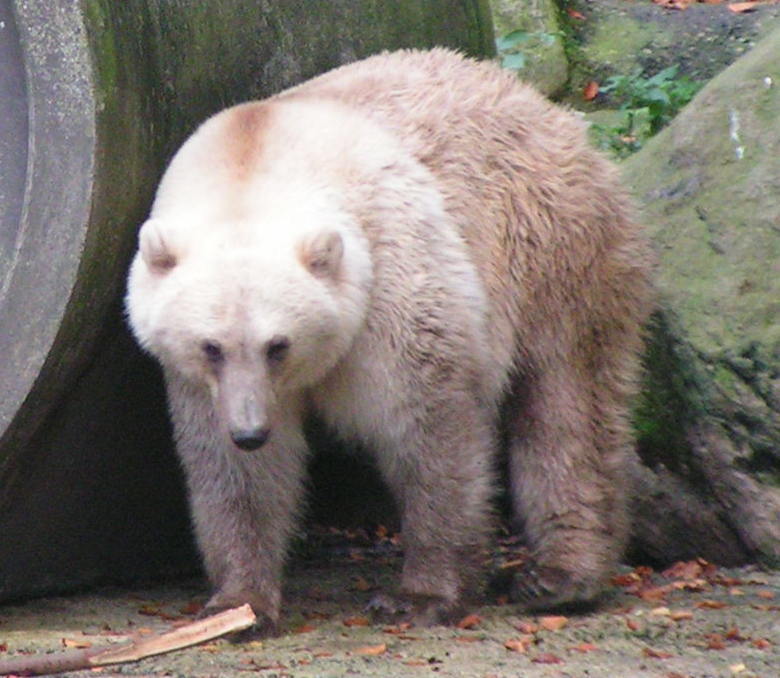
Pizzly bear
Ursus arctos × maritimus
A grizzly–polar-bear hybrid (also named grolar bear, pizzly bear, zebra bear, grizzlar, or nanulak) is a rare ursid hybrid that has occurred both in captivity and in the wild. In 2006, the occurrence of this hybrid in nature was confirmed by testing the DNA of a unique-looking bear who had been shot near Sachs Harbour, Northwest Territories, on Banks Island in the Canadian Arctic. The number of confirmed hybrids has since risen to eight, all of them descending from the same female polar bear.
Possible wild-bred polar bear–grizzly bear hybrids have been reported and shot in the past, but DNA tests were not available to verify the bears' ancestry.
From the article Grizzly–polar bear hybrid on Wikipedia (CC BY-SA), quoted section by section
Range & habitat
It is currently unknown why grizzly bears are being found in the habitat of polar bears. Although a grizzly bear was killed on Banks Island in 1951, it has, until recently, been rare for this species to stray far north of the coast of mainland Canada. In 1991, one or more grizzly bears were documented hunting seals and polar bears on the sea ice near Melville island, over 500 km from the mainland coast. In 2003 and 2004, a geological team working on Melville Island obtained photographic and DNA evidence of a grizzly bear in the area. Their report also collated information on several other sightings in the Canadian Arctic Archipelago. Grizzly bears have apparently also been extending their range east across the Barren Grounds towards Hudson Bay, and south towards northern Saskatchewan and Manitoba. Between 2003 and 2008, seven individuals were spotted in Wapusk National Park south of Churchill, Manitoba, an area used by polar bears for maternity dens and as a refuge during the ice-free season on Hudson Bay.
Wikipedia: “Range expansion of brown bears as a possible contributing factor”
Listen
Looking for field recordings…
Where it lives
Recorded sightings
—
geo-referenced records in GBIF, from museums, herbaria and field observers.
Drag the globe to turn it. Dots are where records exist, not a range map; darker means more records.
In the stacks
Searching the stacks…
Every page naming Ursus arctos × maritimus in the Biodiversity Heritage Library →
This page is assembled live from iNaturalist, GBIF, Wikipedia, the Source Library and the Internet Archive. It is not yet part of the hand-edited codex. iNaturalist taxon 1655158.