- Animals
- ›Chordates
- ›Vertebrates
- ›Mammals
- ›Therians
- ›Placental Mammals
- ›Ungulates, Carnivorans, and Allies
- ›Carnivorans
- ›Felids
- ›Big Cats
- ›Panthera
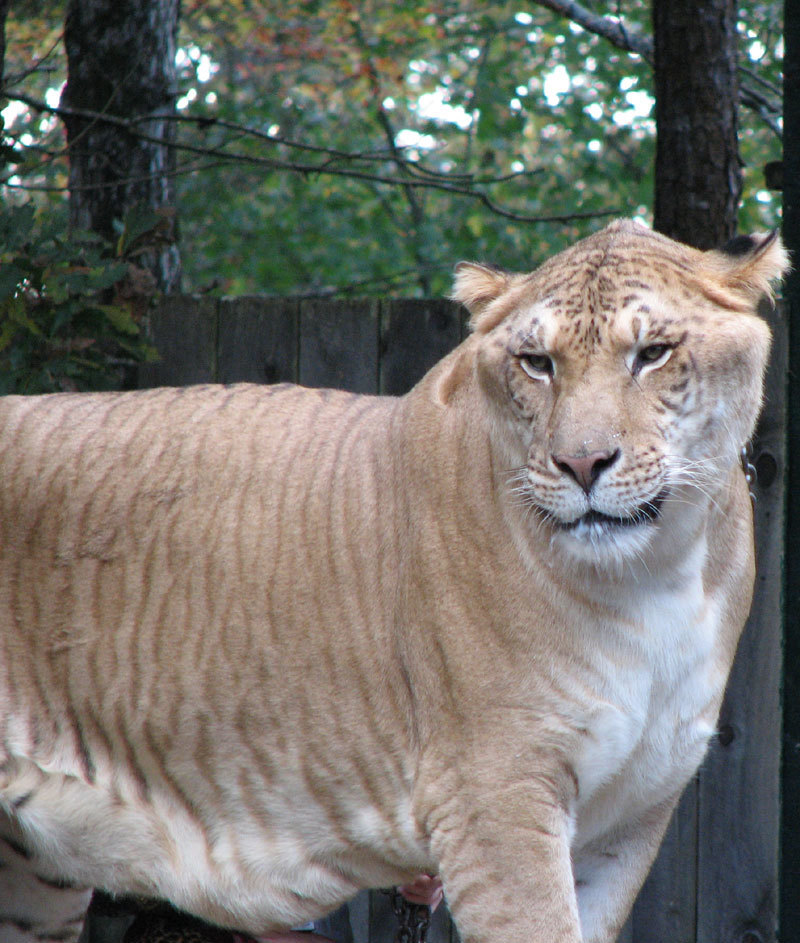
Liger
Panthera leo × tigris
The liger is a hybrid offspring of a male lion (Panthera leo) and a tigress, or female tiger (Panthera tigris). The liger has parents in the same genus but of different species. The liger is distinct from the opposite hybrid called the tigon (of a male tiger and a lioness), and is the largest of all known extant felids. They enjoy swimming, which is a characteristic of tigers, and are very sociable like lions. Notably, ligers typically grow larger than either parent species, unlike tigons.
From the article Liger on Wikipedia (CC BY-SA), quoted section by section
Description
The liger has a faint tiger-like striped pattern upon a lionesque tawny background. In addition, it may inherit rosettes from the lion parent (lion cubs are rosetted and some adults retain faint markings). These markings may be black, dark brown or sandy. The background color may be correspondingly tawny, sandy or golden. In common with tigers, as an example of countershading, the underparts are pale. The specific pattern and color depend upon which subspecies the parents were and how the genes interact in the offspring. White tigers have been crossed with lions to produce "white" (actually pale golden) ligers. In theory, white tigers could be crossed with white lions to produce white, very pale or even stripeless ligers. There are no black ligers. Very few melanistic tigers have ever been recorded, most being due to excessive markings (pseudo-melanism or abundism) rather than true melanism; no reports of black lions have ever been substantiated. As blue or Maltese tigers probably no longer exist, gray or blue ligers are exceedingly improbable. It is not impossible for a liger to be white, but it is very rare. The first known white ligers were born in December 2013 at Myrtle Beach Safari in Myrtle Beach, South Carolina to a white male lion and a white female tiger.
Wikipedia: “Appearance”
In human culture
The history of lion–tiger hybrids dates to at least the early 19th century in India. In 1798, Étienne Geoffroy Saint-Hilaire (1772–1844) made a colour plate of the offspring of a lion and a tiger. The name "liger", a portmanteau of lion and tiger, was coined by the 1930s. "Ligress" is used to refer to a female liger, on the model of "tigress". In 1825, G. B. Whittaker made an engraving of liger cubs born in 1824. The parents and their three liger offspring are also depicted with their trainer in a 19th-century painting in the naïve style. Two liger cubs born in 1837 were exhibited to King William IV and to his successor Queen Victoria. On 14 December 1900 and on 31 May 1901, Carl Hagenbeck wrote to zoologist James Cossar Ewart with details and photographs of ligers born at the Hagenbeck's Tierpark in Hamburg in 1897. In Animal Life and the World of Nature (1902–1903), A. H. Bryden described Hagenbeck's "lion-tiger" hybrids:
It has remained for one of the most enterprising collectors and naturalists of our time, Mr. Carl Hagenbeck, not only to breed but to bring successfully to a healthy maturity, specimens of this rare alliance between those two great and formidable Felidae, the lion and tiger. The illustrations will indicate sufficiently how fortunate Mr. Hagenbeck has been in his efforts to produce these hybrids. …
Wikipedia: “History”
Listen
Looking for field recordings…
Where it lives
Recorded sightings
—
geo-referenced records in GBIF, from museums, herbaria and field observers.
Drag the globe to turn it. Dots are where records exist, not a range map; darker means more records.
In the stacks
Searching the stacks…
Every page naming Panthera leo × tigris in the Biodiversity Heritage Library →
This page is assembled live from iNaturalist, GBIF, Wikipedia, the Source Library and the Internet Archive. It is not yet part of the hand-edited codex. iNaturalist taxon 1655159.