On eBird ↗
Willow Flycatcher
Live sightings near you, the range map, bar charts of when it is seen, and Macaulay Library photos and recordings.
Willow Flycatcher
Empidonax traillii
The willow flycatcher (Empidonax traillii) is a small insect-eating, neotropical migrant bird of the tyrant flycatcher family. There are four subspecies of the willow flycatcher currently recognized, all of which breed in North America (including three subspecies that breed in California). Empidonax flycatchers are almost impossible to tell apart in the field so biologists use their songs to distinguish between them. The binomial commemorates the Scottish zoologist Thomas Stewart Traill.
From the article Willow flycatcher on Wikipedia (CC BY-SA), quoted section by section
Description
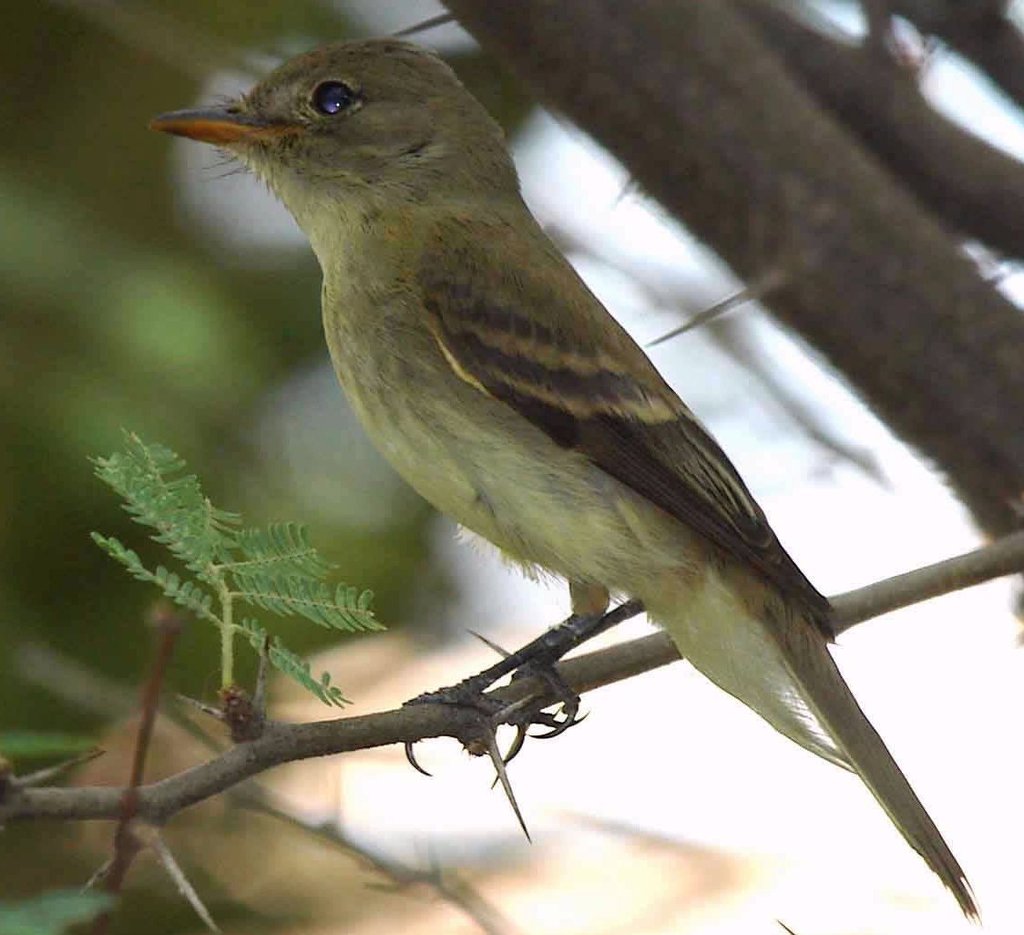
Adults have brown-olive upperparts, darker on the wings and tail, with whitish underparts; they have an indistinct white eye ring, white wing bars and a small bill. The breast is washed with olive-gray. The upper part of the bill is gray; the lower part is orangish.
Range & habitat
Their breeding habitat is deciduous thickets, especially willows and often near water, across the United States and southern Canada. They make a cup nest in a vertical fork in a shrub or tree. These neotropical birds migrate to Mexico and Central America, and in small numbers as far south as Ecuador in South America, often selecting winter habitat near water. Willow flycatchers travel approximately 1,500–8,000 km (930–4,970 mi) each way between wintering and breeding areas. This bird's song is a sneezed fitz-bew. The call is a dry whit.
Wikipedia: “Distribution and habitat”
At the table
Willow flycatchers are generalist insectivores, and the insects which comprise their diet vary substantially across different habitats. For example, flies of the order Diptera made up the majority of adult willow flycatcher diets in Ontario, Canada, but only composed 10.6% of the diet of California flycatchers, who instead favor Lepidopterans, mayflies, and snakeflies. They are "sit-and-wait" predators, remaining on a perch near the top of a shrub and flying out to catch insects on the wing, but are also reported to glean insects off of leaves and stems.
Wikipedia: “Food resources”
Listen
Looking for field recordings…
Where it lives
Recorded sightings
—
geo-referenced records in GBIF, from museums, herbaria and field observers.
Drag the globe to turn it. Dots are where records exist, not a range map; darker means more records.
In the stacks
Searching the stacks…
Every page naming Empidonax traillii in the Biodiversity Heritage Library →
This page is assembled live from iNaturalist, GBIF, Wikipedia, the Source Library and the Internet Archive. It is not yet part of the hand-edited codex. iNaturalist taxon 16611.