- Animals
- ›Chordates
- ›Vertebrates
- ›Reptiles
- ›Snakes and Lizards
- ›Snakes
- ›Colubrid Snakes
- ›Colubrine Snakes
- ›Pantherophis
- ›Pantherophis alleghaniensis
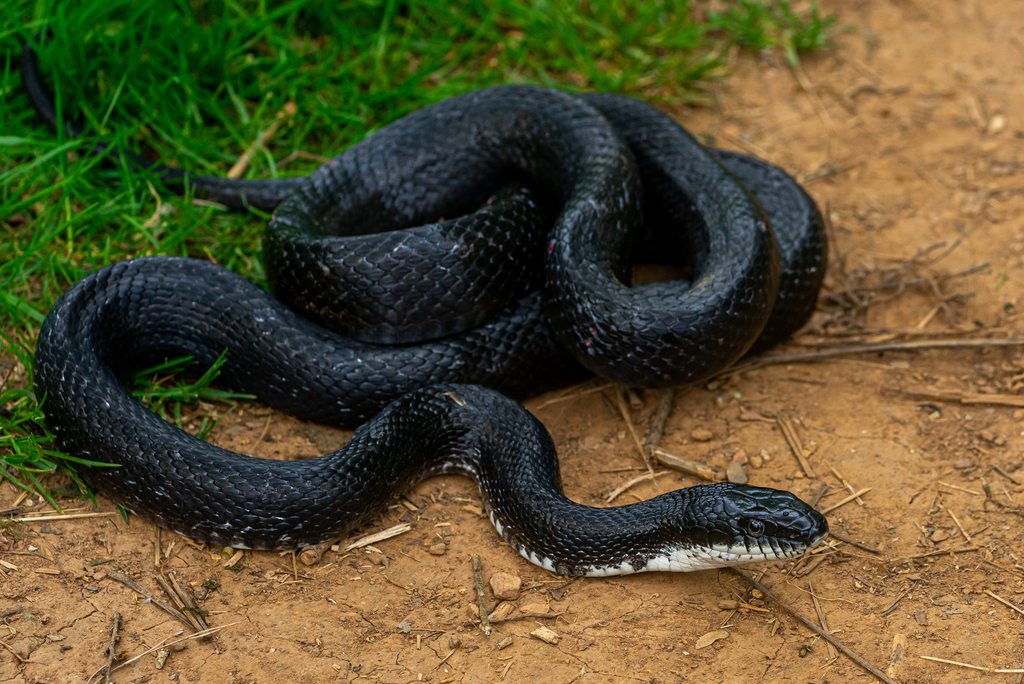
Central Ratsnake
Pantherophis alleghaniensis
The gray ratsnake or gray rat snake (Pantherophis alleghaniensis), also commonly known as the black ratsnake, central ratsnake, chicken snake, midland ratsnake, or pilot black snake, is a species of nonvenomous snake in the subfamily Colubrinae of the family Colubridae. The gray ratsnake is one of eight species within the American ratsnake genus Pantherophis.
From the article Central ratsnake on Wikipedia (CC BY-SA), quoted section by section
Description
A medium to large serpent, the gray ratsnake typically reaches an adult size of 99–183 cm (3.25–6.00 ft) total length (including tail); however, the record is 213.9 cm (7.02 ft). Unlike other Pantherophis, whose conspicuous juvenile pattern fades into adulthood, the gray ratsnake in the southern part of its range does not undergo drastic ontogenetic changes in color or markings. Instead, it retains the juvenile pattern of dark elongate dorsal blotches separated by four, or more, pale gray body scales, a light gray crown with dark striping that forms an anteriorly facing spearpoint, and a solid band which covers the eyes and extends rearward to the posterior upper labial scales. However, in the northern part of its range it is black in adulthood, like P. quadrivittatus (yellow ratsnake) and P. obsoletus (western ratsnake). The venter is usually off-white or pale gray with darker irregular blotches, and a double row of black spots behind the divided anal plate of the vent. The dorsal scale rows around midbody are usually weakly keeled.
Range & habitat
Native to North America, Pantherophis alleghaniensis is commonly found in the forests of the eastern and central United States, west of the Appalachian Mountains and east of the Mississippi River. It occurs relatively continuously throughout the major part of the eastern half of the United States, along the Piedmont throughout Kentucky, from southwestern New England to the Gulf of Mexico, westward to the Mississippi River, and northward from northern Louisiana to southwestern Wisconsin. In Canada, this species is known to occur in two disjunct regions of southern Ontario: the Carolinian forest region along the north shore of Lake Erie in the southwest, and the Great Lakes/St. Lawrence region in the southeast. The species readily hybridizes with P. quadrivittatus in the east and P. obsoletus in the west. This hybridization creates large zones of taxonomic uncertainty, where species-level identification can be difficult.
Habitat. An agile climber, the central ratsnake is at home from the ground to the tree tops in many types of hardwood forest and cypress stands, along tree-lined streams and fields, and even around barns and sheds in close proximity to people. It will ascend trees in search of bird nests and squirrel dreys, among other arboreal prey. …
Wikipedia: “Geographic distribution and habitat”
What it does
A scent-hunter and a powerful constrictor, Pantherophis alleghaniensis feeds primarily on small mammals, birds, and bird eggs. Neonates and juveniles prefer a diet of frogs and lizards. The central ratsnake hunts using a combination of sit and wait, active pursuit, and nest predation strategies. Its active hunting style leads to a consistent high metabolic state and high average body temperature.
Wikipedia: “Diet”
In human culture
The generic name Pantherophis, meaning "panther-like snake", is from Ancient Greek: πάνθηρ: pánthēr, "panther" and Ancient Greek: ὄφις: óphis, "snake". The specific name alleghaniensis , meaning "of the Allegheny Mountains", refers to the Allegheny Mountains in eastern North America.
Wikipedia: “Etymology”
Where it lives
Recorded sightings
—
geo-referenced records in GBIF, from museums, herbaria and field observers.
Drag the globe to turn it. Dots are where records exist, not a range map; darker means more records.
In the stacks
Searching the stacks…
Every page naming Pantherophis alleghaniensis in the Biodiversity Heritage Library →
This page is assembled live from iNaturalist, GBIF, Wikipedia, the Source Library and the Internet Archive. It is not yet part of the hand-edited codex. iNaturalist taxon 1661279.