On eBird ↗
White-throated Flycatcher
Live sightings near you, the range map, bar charts of when it is seen, and Macaulay Library photos and recordings.
White-throated Flycatcher
Empidonax albigularis
The white-throated flycatcher (Empidonax albigularis) is a species of bird in the family Tyrannidae. It is found in Belize, Costa Rica, El Salvador, Guatemala, Honduras, Mexico, Nicaragua, and Panama. Its natural habitats are subtropical or tropical moist shrubland and heavily degraded former forest.
From the article White-throated flycatcher on Wikipedia (CC BY-SA), quoted section by section
Description
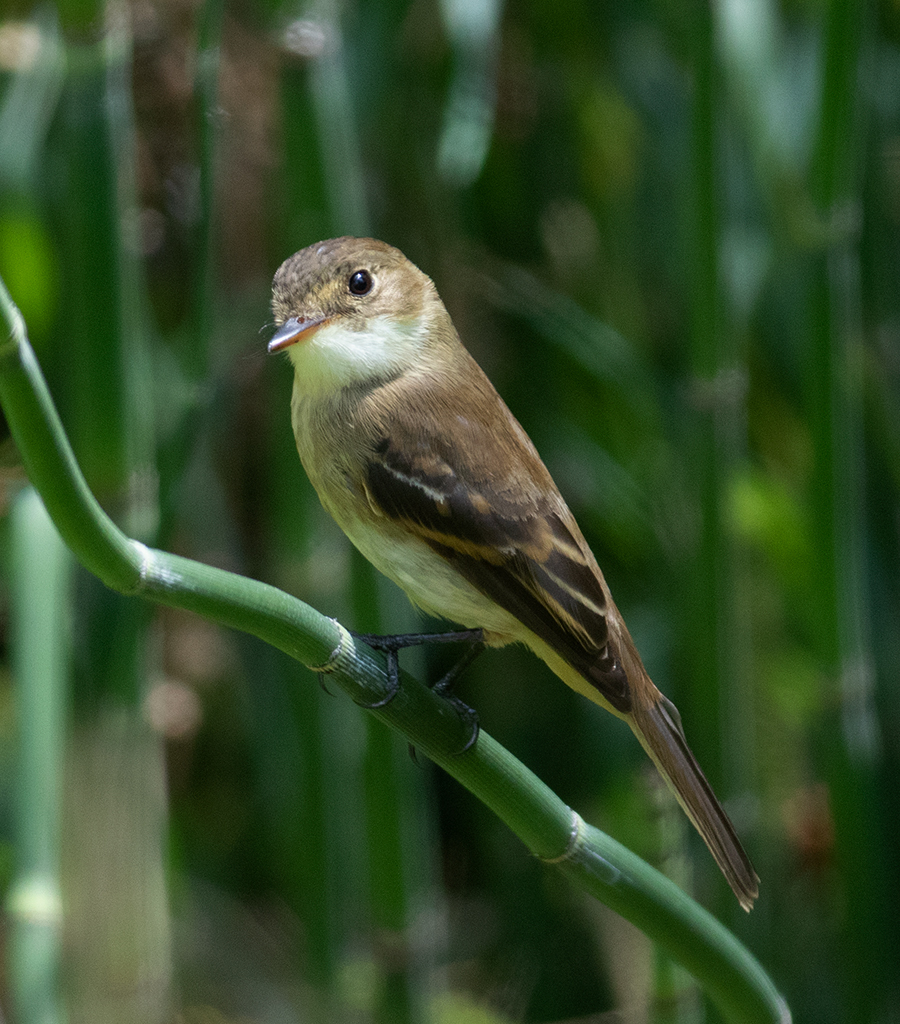
The white-throated flycatcher is 12 to 14 cm (4.7 to 5.5 in) long. Three individuals weighed 10.4 to 11 g (0.37 to 0.39 oz). The sexes are alike. Adults of the nominate subspecies have a brownish olive or olive brown crown and dull buffy-white lores and eye-ring on an otherwise paler brownish olive or olive brown face. Their upperparts are brownish olive or olive brown. Their tail is deep grayish brown with light brownish olive on the feather edges. Their wings are mostly a darker grayish brown than the upperparts, with wide light buffy brown or brownish buff tips on the median and greater coverts that show prominently as two wing bars. The wing's secondaries have pale buffy grayish or grayish buff edges. Their chin and throat are dull white, their breast buffy olive brownish that is paler on the sides and flanks, their belly pale buffy yellow or yellowish buff, and their undertail coverts brownish buff. They have a dark brown iris, a black maxilla, a pink-orange or yellowish pink mandible often with a dusky outer half, and blackish legs and feet. Immature birds have more brownish upperparts and more buffy underparts than adults, with cinnamon wing bars and pale buffy brown edges on the secondaries. Subspecies E. a. timidus is slightly larger than the nominate with paler upperparts, less buffy wing bars, and brighter buffy-yellowish flanks. E. a. …
Range & habitat
The white-throated flycatcher has a disjunct distribution. Subspecies E. a. timidus is found on the Pacific slope of western Mexico from far southeastern Sonora and southwestern Chihuahua south to Morelos. The nominate subspecies is more widespread. It is found on the Caribbean slope from southwestern Tamaulipas south through eastern and southern Mexico and discontinuously south through Belize, Guatemala, El Salvador and Honduras. It possibly winters further south. E. a. australis is found discontinuously from Nicaragua south through Costa Rica into western Panama's Chiriquí Province. There are also scattered records further south in Panama to the Canal Zone. In the breeding season the white-throated flycatcher inhabits open and partially open landscapes in the subtropical and lower temperate zones. It is generally near water, such as in wet meadows with brush or hedgerows and vegetation along streams and irrigation ditches. It also inhabits openings in higher elevation pine-oak forest. In the non-breeding season it moves in part to the tropical zone where it favors freshwater marshes with tall rushes and weeds and scrubby edges. In Mexico it ranges between 1,200 and 3,000 m (3,900 and 9,800 ft) of elevation in the breeding season and between sea level and 1,200 m (3,900 ft) in the non-breeding season. …
Wikipedia: “Distribution and habitat”
What it does
The white-throated flycatcher feeds mostly on insects and includes a small amount of fruit in its diet. It perches low to the ground in or on the edge of open areas and captures prey in mid-air with sallies from it ("hawking") or by gleaning from vegetation after a short flight. It quivers the wings and tail when it lands back on a perch.
Wikipedia: “Feeding”
Listen
Looking for field recordings…
Where it lives
Recorded sightings
—
geo-referenced records in GBIF, from museums, herbaria and field observers.
Drag the globe to turn it. Dots are where records exist, not a range map; darker means more records.
In the stacks
Searching the stacks…
Every page naming Empidonax albigularis in the Biodiversity Heritage Library →
This page is assembled live from iNaturalist, GBIF, Wikipedia, the Source Library and the Internet Archive. It is not yet part of the hand-edited codex. iNaturalist taxon 16616.