On eBird ↗
Alder Flycatcher
Live sightings near you, the range map, bar charts of when it is seen, and Macaulay Library photos and recordings.
Alder Flycatcher
Empidonax alnorum
The Alder Flycatcher (Empidonax alnorum) is a small insect-eating bird of the tyrant flycatcher family. The genus name Empidonax is from Ancient Greek empis, "gnat", and anax, "master". The specific alnorum is Latin and means "of the alders".
From the article Alder flycatcher on Wikipedia (CC BY-SA), quoted section by section
Description
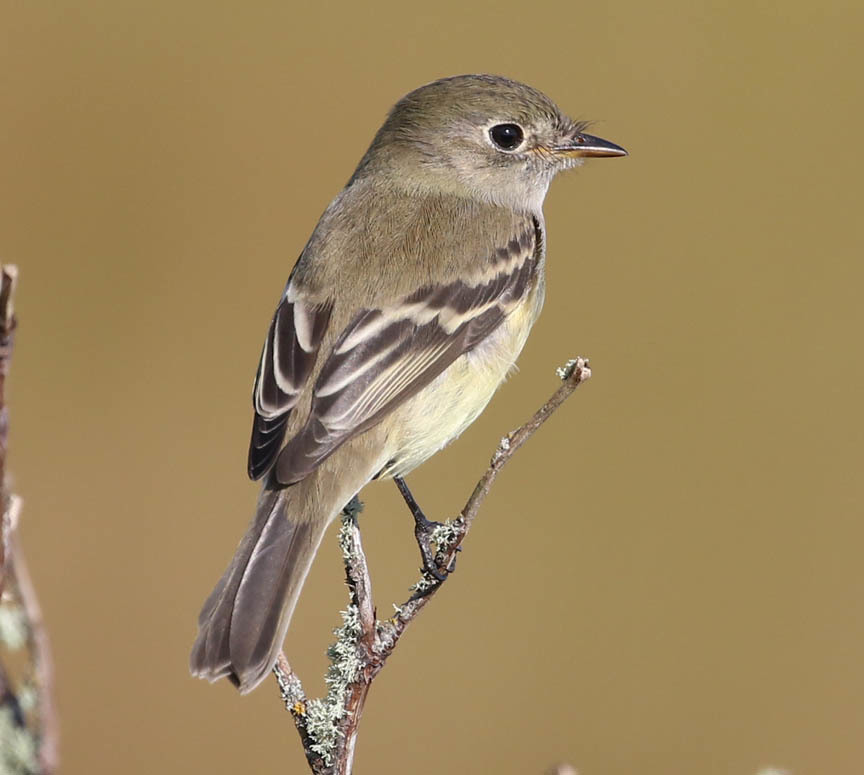
E. alnorum is one of the larger Empidonax species, attaining a length of 13–17 cm (5.1–6.7 in), and a weight of 12–14 g (0.42–0.49 oz). The wingspan ranges from 21–24 cm (8.3–9.4 in). The upperparts of E. alnorum are dull greenish-olive. The crown is a slightly darker olive-green than the back. The throat is white, with a darker breast band. Thin white rings surround the eyes. The bill is wide and moderate in length, with pinkish or yellow-orange lower mandible and black upper mandible. Wings are generally black, with white wing bars and white edges of the innermost secondaries (tertials). Juveniles have brownish upperparts, yellow underparts, and yellowish brown or buff wingbars. E. alnorum is similar in appearance to the eastern wood pewee (Contopus virens) and the eastern phoebe (Sayornis phoebe), as well as the nearly identical willow flycatcher (Empidonax traillii) but E. alnorum can be distinguished by its smaller size and upward tail flicking behavior. Birds in the genus Empidonax are notoriously hard to identify. Novel approaches to identification have been employed to try and increase the accuracy of species identification of mist-netted individuals, such as using ratios of and differences between the measured lengths of various body parts, including wings and beaks. …
Range & habitat
The summer breeding range of the species covers most of Canada and Alaska, descending to a southernmost point in the northeastern United States. In autumn, E. alnorum migrates south through the eastern United States, Mexico and Central America, wintering in the western range of South America. In the summer breeding season, E. alnorum occupies wet, dense, shrubby thickets of young (typically 3–8 years old) alder (Alnus sp.), maple (Acer sp.), and birch (Betula sp.), from sea level up to 1,300 m (4,300 ft). During migration, the species occupies humid and semi-arid habitats, including forest edges and fields at elevations up to 2,500 m (8,200 ft). Early successional scrubby vegetation or woodland edges are preferred habitats in winter, particularly those near water and below 1,100 m (3,600 ft).
Wikipedia: “Habitat and distribution”
What it does
The diet is composed primarily of insects such as those from the Hymenoptera (sawflies, bees, wasps and ants), Coleoptera (beetles), Diptera (flies), Lepidoptera (butterflies and moths) and Orthoptera (locusts, grasshoppers and crickets) families. Insects are captured during flight or gleaned from the foliage of trees. In the winter, some birds will include fruit and seeds in their diet.
Wikipedia: “Diet”
Listen
Looking for field recordings…
Where it lives
Recorded sightings
—
geo-referenced records in GBIF, from museums, herbaria and field observers.
Drag the globe to turn it. Dots are where records exist, not a range map; darker means more records.
In the stacks
Searching the stacks…
Every page naming Empidonax alnorum in the Biodiversity Heritage Library →
This page is assembled live from iNaturalist, GBIF, Wikipedia, the Source Library and the Internet Archive. It is not yet part of the hand-edited codex. iNaturalist taxon 16620.