On eBird ↗
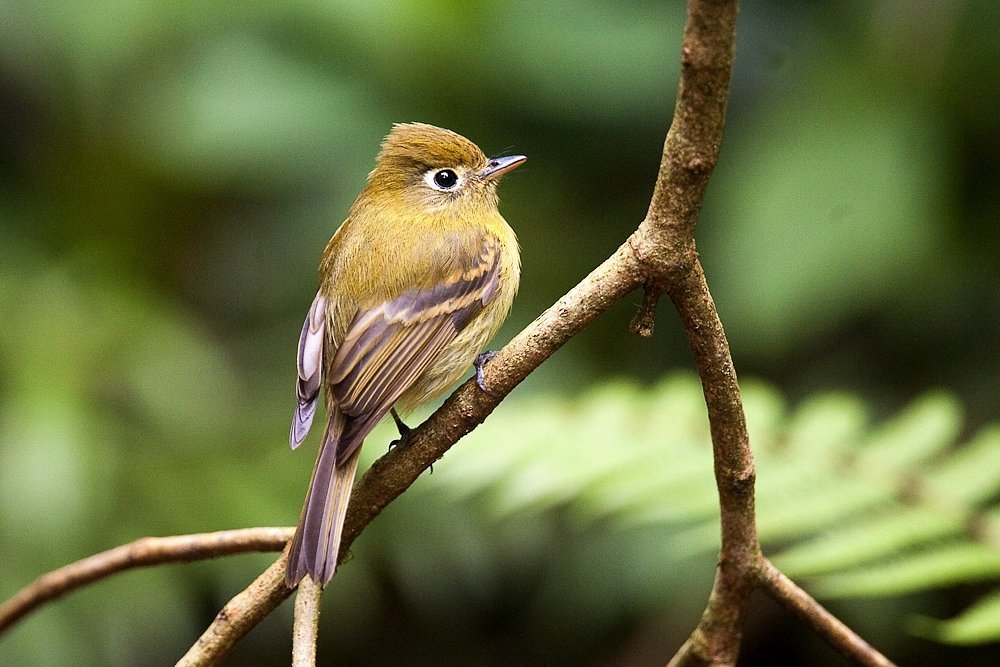
Yellowish Flycatcher
Live sightings near you, the range map, bar charts of when it is seen, and Macaulay Library photos and recordings.
Yellowish Flycatcher
Empidonax flavescens
The yellowish flycatcher (Empidonax flavescens) is a small passerine bird in the tyrant flycatcher family. It breeds in highlands from southeastern Mexico south to western Panama.
From the article Yellowish flycatcher on Wikipedia (CC BY-SA), quoted section by section
Description
The yellowish flycatcher is 12.5 to 14 cm (4.9 to 5.5 in) long and weighs 9 to 16 g (0.32 to 0.56 oz). The sexes are alike. Adults of the nominate subspecies have a pale yellow almond-shaped eye-ring on an otherwise yellowish green face. Their crown, nape, and upperparts are olive-green. Their tail is dusky to blackish with yellowish green edges on the feathers. Their remiges are mostly dusky to blackish and glossy. Their primaries have pale olive edges and the secondaries and tertials have pale yellow edges to the outer webs. The wing coverts are grayish brown with wide yellow tips that show as two wing bars. Their chin and throat are yellowish white, their breast deep yellow, and the rest of their underparts yellowish with hidden white to yellowish white tufts on the flanks. The colors, especially on feather tips, fade with wear. Subspecies E. f. imperturbatus has duller and less yellowish green upperparts than the nominate, with paler colored edges to the flight and tail feathers, a grayer throat, breast, and flanks, and a more yellowish belly. E. f. salvini is larger than the nominate and has greener (less yellowish) upperparts, a greenish olive breast, and a duller yellow belly. …
Range & habitat
The yellowish flycatcher has a disjunct distribution. Subspecies E. f. imperturbatus has the most limited range. It is found in the Sierra de los Tuxtlas of coastal Veracruz in southeastern Mexico. Subspecies E. f. salvini is found from southern Mexico's Chiapas state south intermittently through Guatemala, El Salvador, and Honduras into northern Nicaragua. The nominate subspecies is found through central Costa Rica into western Panama as far as Veraguas Province. The yellowish flycatcher inhabits highlands in the subtropical and temperate zones. It primarily occurs in humid evergreen broadleaf forest heavy with moss, lichen, and bromeliads, for example cloudforest. It also occurs in pine and pine-oak forest. It favors the forest understory and is partial to areas near running water. It mostly occurs in the forest interior but also on its edges and in human-modified landscapes such as coffee and cacao plantations, pastures with scattered trees, and gardens. In the Sierra de los Tuxtlas it occurs mostly between 900 and 1,660 m (3,000 and 5,400 ft) but has been seen as low as 100 m (300 ft). The other Mexican population, in Chiapas, ranges between 1,200 and 2,400 m (3,900 and 7,900 ft). In Guatemala, El Salvador, and Honduras it ranges between 650 and 3,000 m (2,100 and 9,800 ft) but mostly occurs above 1,400 m (4,600 ft). …
Wikipedia: “Distribution and habitat”
What it does
The yellowish flycatcher feeds primarily on arthropods and also includes small amounts of fruit in its diet. During the breeding season it typically forages in pairs, and singly outside that season. It forages mostly from the forest's mid-story to its canopy but will descend to the understory and the ground. It captures prey in mid-air with sallies from it ("hawking"), by gleaning from vegetation and branches while perched, and from bare ground and grass. It has been observed following army ant swarms to capture prey fleeing the ants. It occasionally joins mixed-species feeding flocks. After a sally it usually lands on a different perch than the one it left from, and quivers the wings and tail when it lands.
Wikipedia: “Feeding”
Listen
Looking for field recordings…
Where it lives
Recorded sightings
—
geo-referenced records in GBIF, from museums, herbaria and field observers.
Drag the globe to turn it. Dots are where records exist, not a range map; darker means more records.
In the stacks
Searching the stacks…
Every page naming Empidonax flavescens in the Biodiversity Heritage Library →
This page is assembled live from iNaturalist, GBIF, Wikipedia, the Source Library and the Internet Archive. It is not yet part of the hand-edited codex. iNaturalist taxon 16628.