On eBird ↗
Fork-tailed Flycatcher
Live sightings near you, the range map, bar charts of when it is seen, and Macaulay Library photos and recordings.
Fork-tailed Flycatcher
Tyrannus savana
The fork-tailed flycatcher (Tyrannus savana) is a passerine bird of the tyrant flycatcher family and is a member of a genus typically referred to as kingbirds. Named for the long, forked tail, particularly in males, fork-tailed flycatchers are seen in shrubland, savanna, lightly forested and grassland areas, from southern Mexico to Argentina. They are frequently observed on conspicuous perches whence they sally after insect prey. Northern populations near southern Mexico tend to be permanent residents, while fork-tailed flycatchers that live further south are migrants with a reputation for wandering as far north as New Brunswick, Canada.
From the article Fork-tailed flycatcher on Wikipedia (CC BY-SA), quoted section by section
Description
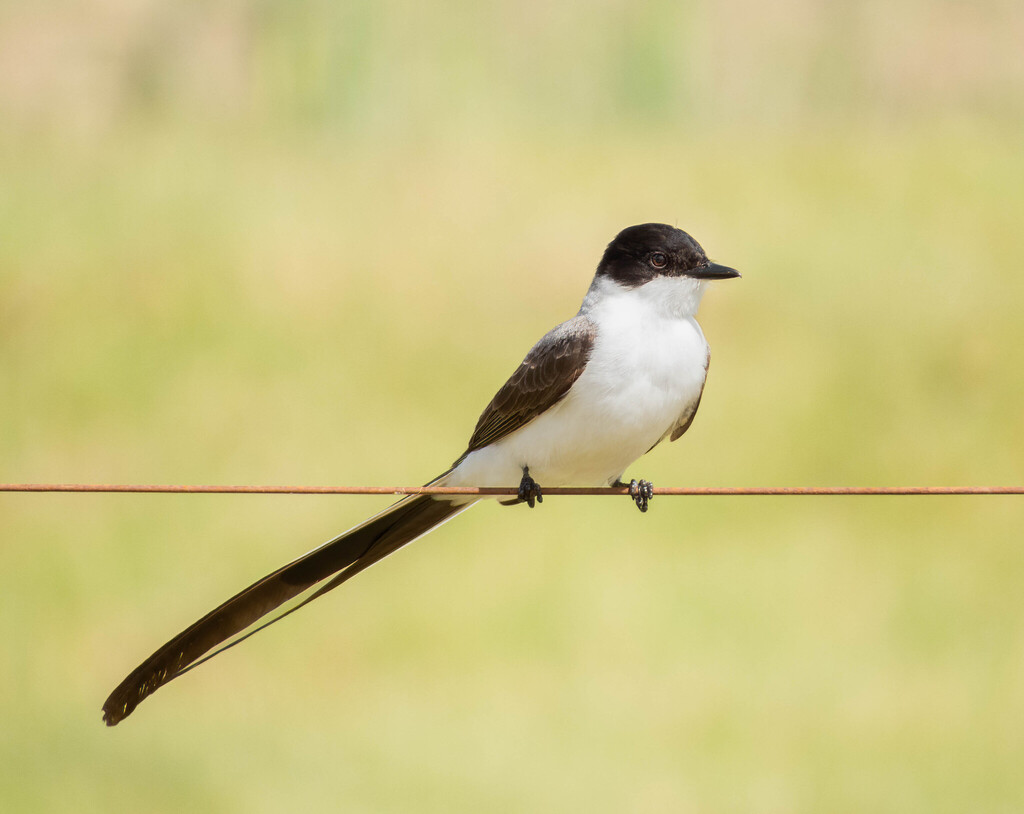
The fork-tailed flycatcher is white below, gray above, and has a black cap. Males sometimes show a yellow crown stripe. Males also have an extremely long, forked tail, of even greater length than that of the related scissor-tailed flycatcher. Females have a somewhat shorter tail, and it is significantly shorter in juveniles. Males are 37–41 cm (15–16 in) in length; females, 28–30 cm (11–12 in), including tail. They weigh only 28–32 g (0.99–1.13 oz), much less than closely related kingbirds, which are half the total length of this species. The tail in adult males is two to three times longer than the length of the bird from the bill to the base of the tail. Generally, males and females of the species look quite similar, but can be distinguished by the longer tail in males. The nominate subspecies T. s. savana has a darker grey back compared to T. s. monachus and T. s. sanctaemartae, which have notable light backs that contrast greatly with their black heads. Discrete notches on the primary feathers are also quite handy in identifying subspecies. Most fork-tailed flycatchers are migratory, but some stay year-round, especially in southern Mexico. Migratory fork-tailed flycatchers tend to have more pointed wings than nonmigratory flycatchers.
Vocalizations. Fork-tailed flycatchers produce both vocal and nonvocal sounds. …
Range & habitat
Fork-tailed flycatchers are usually found below 1000 m elevation where they occur in a wide variety of habitats including pastures, riparian forests, forest edges, mangroves, and open residential areas with scattered trees. During migration, however, T. savana may be found in an even broader range of habitats. Its breeding range is from central Mexico to central Argentina. In most of this range, it is usually found year-round, but in the southern parts of its range, it retreats northward for the winter. During migration, fork-tailed flycatchers are quite gregarious, nesting in flocks of up to 10,000 individuals. This species is known to wander widely. It is spotted almost annually in the eastern United States seaboard and Canada, normally around fall (September–November). During migration, fork-tailed flycatchers have been observed flying accompanied by relative species such as eastern kingbirds and aggressively chasing off predators. The nominate subspecies, T. s. savana, is found in central and southern Brazil, Bolivia, Paraguay, Uruguay, and Argentina (south to the Río Negro), and overwinters in Amazonia, a large portion of northern South America (i.e., within the Orinoco River Basin), and Trinidad and Tobago, occasionally appearing in the West Indies.
Wikipedia: “Distribution and habitat”
What it does
This species is primarily insectivorous. Fork-tailed flycatchers sally from their perches to eat flying insects or glean them off of leaves and fruit. When insects become less available in winter months, they have been observed eating fruits. The fork-tailed flycatcher's long tail allows for quick turns and stops in their pursuit of flying prey. They can reach speeds up to 65 miles per hour (105 km/h).
Wikipedia: “Diet”
Listen
Looking for field recordings…
Where it lives
Recorded sightings
—
geo-referenced records in GBIF, from museums, herbaria and field observers.
Drag the globe to turn it. Dots are where records exist, not a range map; darker means more records.
In the stacks
Searching the stacks…
Every page naming Tyrannus savana in the Biodiversity Heritage Library →
This page is assembled live from iNaturalist, GBIF, Wikipedia, the Source Library and the Internet Archive. It is not yet part of the hand-edited codex. iNaturalist taxon 16793.