On eBird ↗
Giant Kingbird
Live sightings near you, the range map, bar charts of when it is seen, and Macaulay Library photos and recordings.
Giant Kingbird
Tyrannus cubensis
The giant kingbird (Tyrannus cubensis) is a species of bird in the tyrant flycatcher family Tyrannidae. It is endemic to Cuba, although there are historical records of it on other islands. The species is probably mostly closely related to the loggerhead kingbird, which also occurs in Cuba as well as several other nearby Caribbean islands.
From the article Giant kingbird on Wikipedia (CC BY-SA), quoted section by section
Description
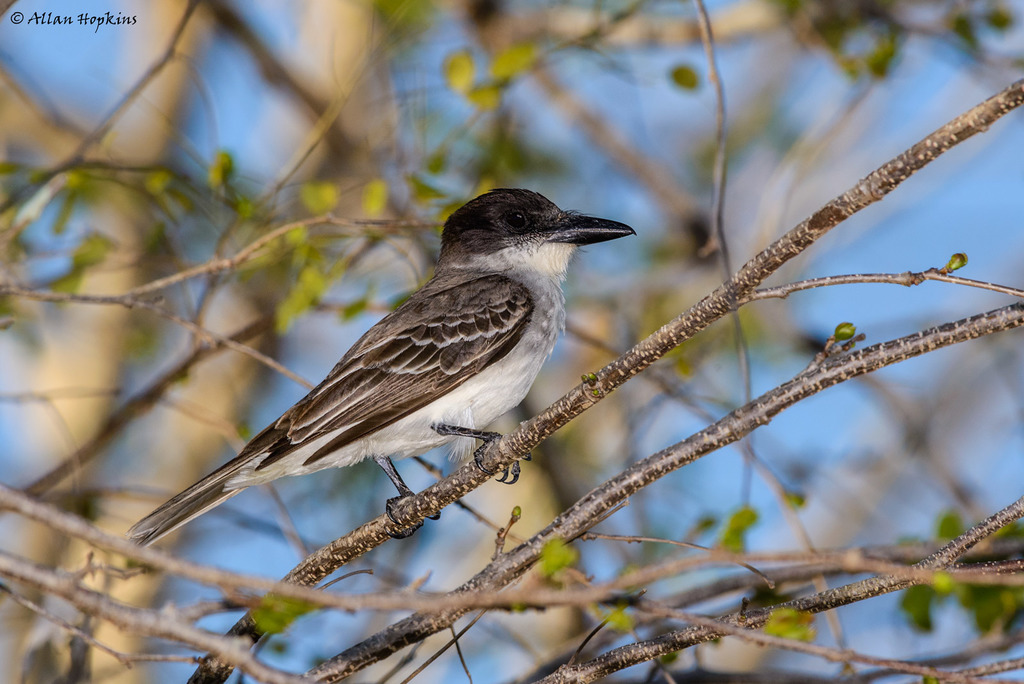
The giant kingbird is the largest member of genus Tyrannus. It is 23 to 26 cm (9.1 to 10 in) long and weighs about 94 g (3.3 oz) with a maximum weight of about 108 g (3.8 oz). It is nearly as heavy as the largest tyrant flycatcher, the great shrike-tyrant (Agriornis lividus). The sexes have the same plumage. Adults have a mostly blackish to black head with white cheeks and a partially hidden deep orange or red patch in the center of the crown. Often they have some white on the lores that extends to the forehead. Their upperparts are medium dark gray to sooty gray. Their wings are mostly medium dark gray to sooty gray with white edges on the median and greater coverts that show as two wing bars. Their remiges are blackish with white edges on the inner secondaries and tertials. Their tail is slightly notched and blackish with white feather tips when fresh. Their chin, throat, and underparts are white with sometimes a light grayish wash on the breast. They have a dark brown iris, a massive black bill with an arched culmen, and blackish legs and feet.
Range & habitat
The giant kingbird is found only on Cuba, where it has a highly disjunct distribution. There it is found along the northwestern coast, the southeastern coast, a few locations in the interior, and on Isla de la Juventud (the "Isle of Pines"). It formerly was found on Great Inagua and the Caicos Islands where it was last documented in 1891. There are also Pleistocene fossils from islands in the northern Bahamas. It has been documented as a vagrant in Mexico and possibly in Haiti, where its origin is uncertain. There are also undocumented sight records in Florida. The giant kingbird primarily inhabits tall forest and the borders of rivers and swamps in the lowlands. It also occurs in pine and mixed pine-deciduous woodlands and open swamps and dry savanna with scattered tall trees. In some areas it occurs in groves of palms interspersed with coffee and cacao plantations. In all areas it appears to require a canopy height of at least 13 m (45 ft). In elevation it ranges from sea level to 1,100 m (3,600 ft).
Wikipedia: “Distribution and habitat”
What it does
The giant kingbird feeds primarily on large insects and also includes small vertebrates and fruit in its diet. It usually forages singly or in pairs, perching on an exposed branch in a tall tree. It usually captures insects in mid-air and possibly gleans them during a sally from the perch. It usually takes fruit while briefly hovering.
Wikipedia: “Feeding”
Listen
Looking for field recordings…
Where it lives
Recorded sightings
—
geo-referenced records in GBIF, from museums, herbaria and field observers.
Drag the globe to turn it. Dots are where records exist, not a range map; darker means more records.
In the stacks
Searching the stacks…
Every page naming Tyrannus cubensis in the Biodiversity Heritage Library →
This page is assembled live from iNaturalist, GBIF, Wikipedia, the Source Library and the Internet Archive. It is not yet part of the hand-edited codex. iNaturalist taxon 16801.