On eBird ↗
Hudson's Black-Tyrant
Live sightings near you, the range map, bar charts of when it is seen, and Macaulay Library photos and recordings.
Hudson's Black-Tyrant
Knipolegus hudsoni
Hudson's black tyrant (Knipolegus hudsoni) is a species of bird in the family Tyrannidae, the tyrant flycatchers. It is found in Argentina, Bolivia, Paraguay, and as a vagrant to Brazil and Peru.
From the article Hudson's black tyrant on Wikipedia (CC BY-SA), quoted section by section
Description
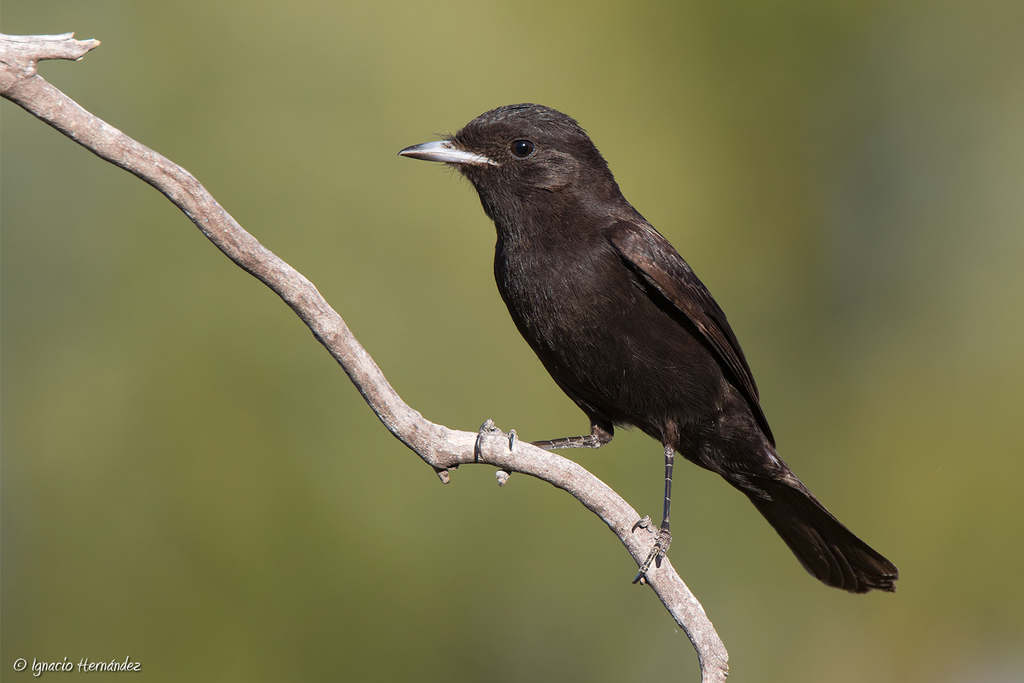
Hudson's black tyrant is about 15 to 15.5 cm (5.9 to 6.1 in) long. Adult males are almost entirely shiny black. Their wings have a wide white band on the inner webs of the primaries that is very conspicuous in flight but usually hidden when perched. They also has some whitish on the lower flanks. Adult females have a mostly grayish brown head and upperparts with a rufous rump and basal half of the tail. The rest of the tail is grayish brown with a blackish band across the end. Their wings are dusky with buff tips on the coverts that show as two wing bars. Their underparts are mostly buffy to ochre with dusky-olive streaks on the breast that extend more lightly onto the belly. Both sexes have a red iris, a blue-gray bill with a black tip, and black legs and feet.
Range & habitat
Hudson's black tyrant is found from northern Bolivia south through western Paraguay into Argentina as far south as eastern Neuquén, northern Río Negro, and southwestern Buenos Aires provinces. It has also occurred as a vagrant in Brazil and Peru. The species inhabits somewhat open woodland and scrubland; in the north it also inhabits Gran Chaco woodlands, shrubby pastures, and gardens. In elevation it is found mostly below 500 m (1,600 ft).
Wikipedia: “Distribution and habitat”
What it does
Hudson's black tyrant feeds on insects. It usually forages in dense cover near the ground. Nothing else is known about its foraging behavior and diet.
Wikipedia: “Feeding”
Listen
Looking for field recordings…
Where it lives
Recorded sightings
—
geo-referenced records in GBIF, from museums, herbaria and field observers.
Drag the globe to turn it. Dots are where records exist, not a range map; darker means more records.
In the stacks
Searching the stacks…
Every page naming Knipolegus hudsoni in the Biodiversity Heritage Library →
This page is assembled live from iNaturalist, GBIF, Wikipedia, the Source Library and the Internet Archive. It is not yet part of the hand-edited codex. iNaturalist taxon 16806.