On eBird ↗
Crested Black-Tyrant
Live sightings near you, the range map, bar charts of when it is seen, and Macaulay Library photos and recordings.
Crested Black-Tyrant
Knipolegus lophotes
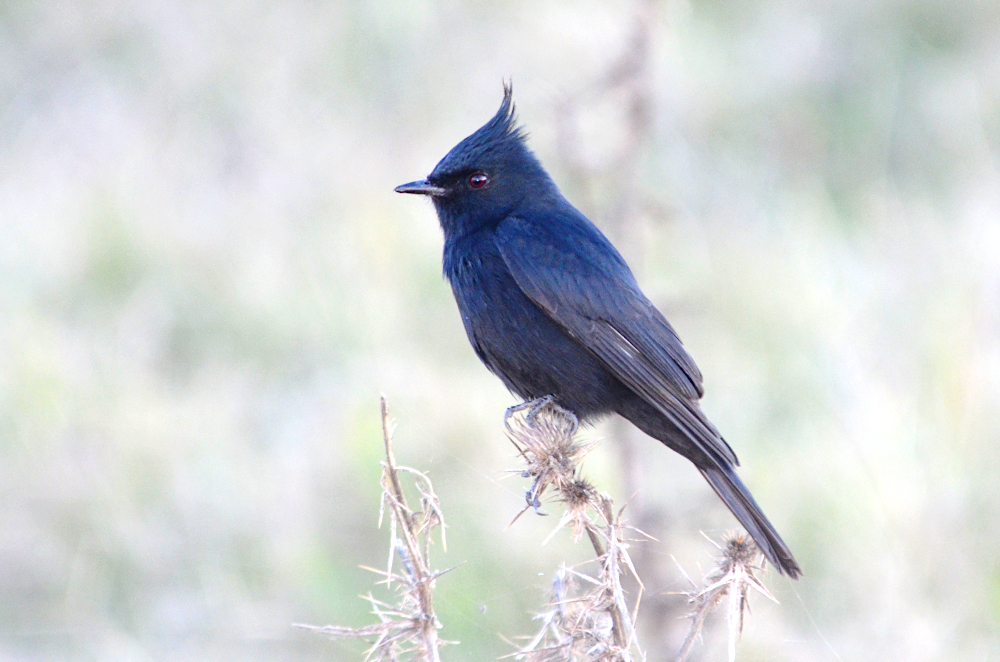
The crested black tyrant (Knipolegus lophotes) is a species of bird in the family Tyrannidae. It is found in Brazil, Uruguay and northeastern Paraguay. Its natural habitats are dry savanna and pastureland.
From the article Crested black tyrant on Wikipedia (CC BY-SA), quoted section by section
Description
The crested black tyrant is 20 to 21 cm (7.9 to 8.3 in) long. Unique in its genus, it has a long thin crest. The sexes have the same plumage; males are slightly larger than females. Adults are almost entirely glossy blue-black. Their remiges have white bases that are conspicuous in flight but usually not visible at rest. Both sexes have a dark red or reddish-brown iris, a black bill, and black legs and feet. The crested black tyrant and the phainopepla (Phainopepla nitens), a member of the silky-flycatcher family Ptiliogonatidae, are almost alike in appearance. Often such a close resemblance is a result of competitive mimicry. They inhabit similar landscapes, however their ranges are more than 4,000 km (2,500 mi) apart so mimicry cannot be the reason.
Range & habitat
The crested black tyrant is found in Brazil from southern Bahia south to Rio Grande do Sul and west to southern Mato Grosso and its range continues into northern and eastern Uruguay. There is a small separate population in Amambay Department in eastern Paraguay. The species inhabits shrubby cerrado grasslands and pastures, usually those with some stands of trees. In elevation it ranges from near sea level to 1,100 m (3,600 ft).
Wikipedia: “Distribution and habitat”
What it does
The crested black tyrant feeds mostly on insects and occasionally includes small fruits in its diet. It usually forages in pairs, though not close to each other. It captures prey with sallies from a perch.
Wikipedia: “Feeding”
Listen
Looking for field recordings…
Where it lives
Recorded sightings
—
geo-referenced records in GBIF, from museums, herbaria and field observers.
Drag the globe to turn it. Dots are where records exist, not a range map; darker means more records.
In the stacks
Searching the stacks…
Every page naming Knipolegus lophotes in the Biodiversity Heritage Library →
This page is assembled live from iNaturalist, GBIF, Wikipedia, the Source Library and the Internet Archive. It is not yet part of the hand-edited codex. iNaturalist taxon 16818.