On eBird ↗
Cinereous Tyrant
Live sightings near you, the range map, bar charts of when it is seen, and Macaulay Library photos and recordings.
Cinereous Tyrant
Knipolegus striaticeps
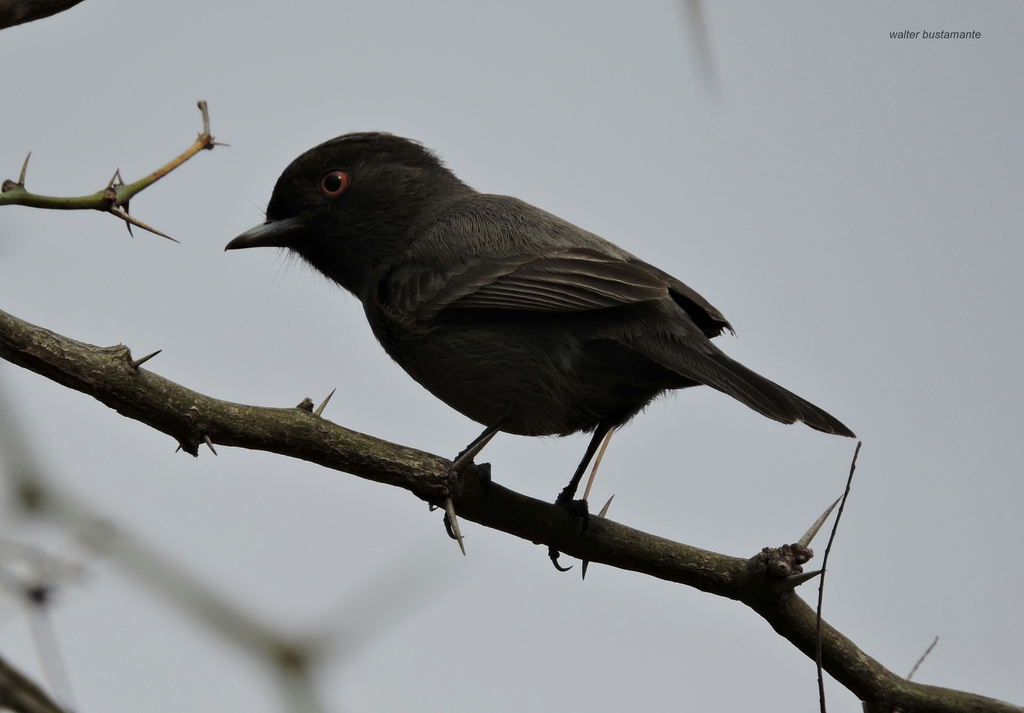
The cinereous tyrant (Knipolegus striaticeps) is a species of bird in the family Tyrannidae. The term cinereous describes its colouration. It inhabits the Gran Chaco, where Its natural habitat is subtropical or tropical dry shrubland.
From the article Cinereous tyrant on Wikipedia (CC BY-SA), quoted section by section
Description
The cinereous tyrant is 13 to 13.5 cm (5.1 to 5.3 in) long. Adult males are shades of gray. ("Cinereous" means ash-colored.) They have mostly dark gray upperparts. Their head is darker than their body, giving the appearance of a hood, though the face is blackish gray. Their wings are dusky gray or blackish gray with grayish edges on the inner remiges and thin pale gray tips on the coverts that show as two wing bars. Their tail is dusky with pale outer webs on the outer feathers. Their throat and breast are a duskier gray than their back and their belly is grayish white or whitish with thin dusky streaks. Adult females have a mostly olive-brown head and upperparts with a rufous crown, whitish lores, dusky streaks on the nape, and rufous uppertail coverts. Their wings are olive-brown with white tips on the coverts that show as two wing bars. Their tail is olive-brown with rufous inner webs to the feathers. Their throat and breast are buff with thin gray streaks on the breast. Their belly is whitish. Males have a bright scarlet iris and females a pale brown iris. Both sexes have a black bill and black legs and feet.
Range & habitat
The cinereous tyrant is found from eastern Bolivia's Santa Cruz Department south through western Paraguay into northwestern Argentina as far as western Córdoba and northern San Luis provinces. It has also occurred as a vagrant in extreme western Mato Grosso do Sul in southwestern Brazil. It inhabits the edges and openings of woodlands in the Gran Chaco. In elevation it mostly occurs below 1,000 m (3,300 ft) but locally reaches 1,900 m (6,200 ft).
Wikipedia: “Distribution and habitat”
What it does
The cinereous tyrant feeds on insects. It mostly forages singly and occasionally in pairs. It sits erect on an exposed perch and captures prey in mid-air with sallies from it ("hawking").
Wikipedia: “Feeding”
Listen
Looking for field recordings…
Where it lives
Recorded sightings
—
geo-referenced records in GBIF, from museums, herbaria and field observers.
Drag the globe to turn it. Dots are where records exist, not a range map; darker means more records.
In the stacks
Searching the stacks…
Every page naming Knipolegus striaticeps in the Biodiversity Heritage Library →
This page is assembled live from iNaturalist, GBIF, Wikipedia, the Source Library and the Internet Archive. It is not yet part of the hand-edited codex. iNaturalist taxon 16819.