On eBird ↗
Gray-capped Flycatcher
Live sightings near you, the range map, bar charts of when it is seen, and Macaulay Library photos and recordings.
Gray-capped Flycatcher
Myiozetetes granadensis
The grey-capped flycatcher (Myiozetetes granadensis) is a passerine bird, a member of the large tyrant flycatcher family Tyrannidae. It is found in Bolivia, Brazil, Colombia, Costa Rica, Ecuador, Honduras, Nicaragua, Panama, Peru, and Venezuela.
From the article Grey-capped flycatcher on Wikipedia (CC BY-SA), quoted section by section
Description
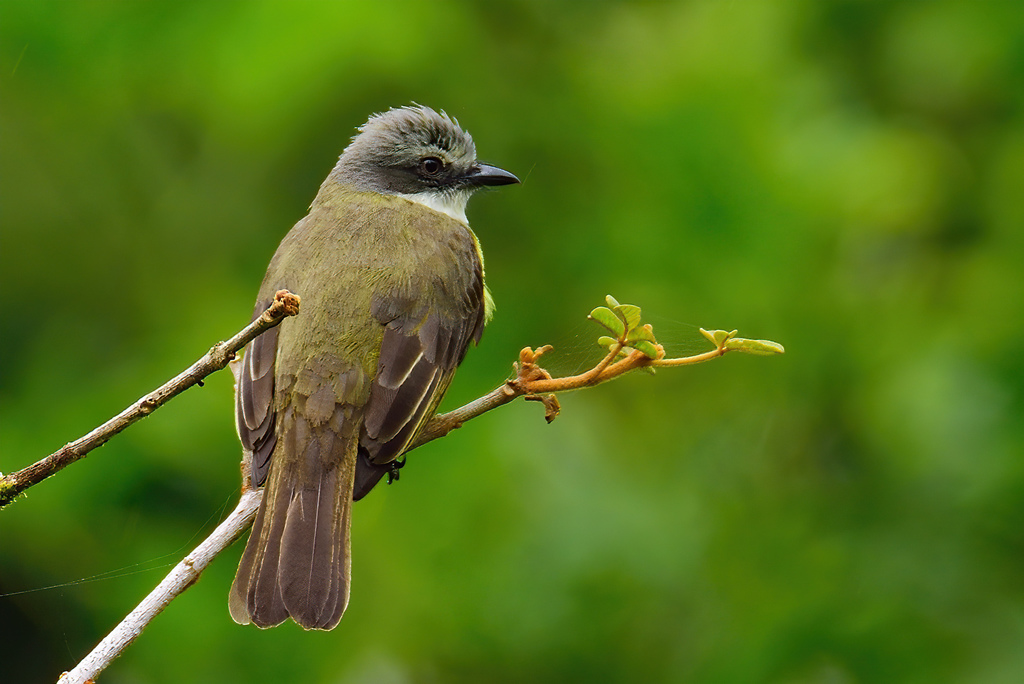
The grey-capped flycatcher is 16 to 18 cm (6.3 to 7.1 in) long and weighs 28 to 30 g (0.99 to 1.1 oz). The sexes have almost the same plumage. Adult males of the nominate subspecies have a gray crown and nape with a mostly hidden orange-yellow to reddish orange patch in the center of the crown. Females sometimes have a smaller patch or none at all. Adults of both sexes have a white forehead that extends as a thin supercilium to just past the eye. They have dusky lores and ear coverts. Their upperparts are mostly olive-green with dusky to dark olive uppertail coverts that have paler edges. Their wings are dusky grayish brown with pale olive-green lesser coverts and olive edges on all the coverts. Their remiges are dusky grayish brown with light yellowish olive or cinnamon edges. Their tail is dusky grayish brown with pale olive edges on the feathers. Their chin and throat are white to yellowish white and their underparts are bright yellow with a slight olive tinge on the sides of the breast. Juveniles have a grayish olive tinge on the crown and nape and little or no orange on the crown. Compared to adults they have lighter tawny brown or cinnamon edges on the wing coverts, wider, more tawny, edges on the tail feathers, and slightly paler underparts. Subspecies M. g. occidentalis is slightly smaller than the nominate but otherwise the same. M. g. …
Range & habitat
The grey-capped flycatcher has a disjunct distribution. The nominate subspecies is found on the Caribbean slope of eastern Honduras and Nicaragua south on the Caribbean and Pacific slopes through Costa Rica to central Panama. Subspecies M. g. occidentalis is found from Darién Province in eastern Panama and west of the Andes south through northern and western Colombia into northwestern Ecuador to northern Manabí Province. M. g. obscurior is found apart from the other two subspecies. It ranges from the lower Magdalena River valley in Colombia south through eastern Ecuador and eastern Peru into northern Bolivia and from the east side of Colombia's Eastern Andes into southeastern Venezuela's Amazonas and western Bolívar states and in western Brazil's northern Roraima, western Amazonas, and Rondônia states. The grey-capped flycatcher inhabits a variety of humid landscapes in the tropical and lower subtropical zones, most of which are somewhat open. These include the edges and shrubby clearings of evergreen forest, secondary forest, gallery forest, and agricultural areas with scattered trees. It often occurs near areas of standing water. In elevation it ranges mostly from sea level to 1,650 m (5,400 ft) overall but reaches 1,800 m (5,900 ft) in Honduras. …
Wikipedia: “Distribution and habitat”
What it does
The grey-capped flycatcher feeds mostly on insects and also includes a significant amount of berries and seeds in its diet. It forages singly, in pairs, and in small family groups. Outside the breeding season large numbers may share a fruiting tree. It usually perches up to the forest's mid-level but sometimes in a treetop. It captures most insect prey in mid-air ("hawking ") and sometimes with sallies to foliage.
Wikipedia: “Feeding”
Listen
Looking for field recordings…
Where it lives
Recorded sightings
—
geo-referenced records in GBIF, from museums, herbaria and field observers.
Drag the globe to turn it. Dots are where records exist, not a range map; darker means more records.
In the stacks
Searching the stacks…
Every page naming Myiozetetes granadensis in the Biodiversity Heritage Library →
This page is assembled live from iNaturalist, GBIF, Wikipedia, the Source Library and the Internet Archive. It is not yet part of the hand-edited codex. iNaturalist taxon 16838.