- Animals
- ›Chordates
- ›Vertebrates
- ›Ray-finned Fishes
- ›Spiny-rayed fishes
- ›Perches, Scorpionfishes, Sticklebacks, and Allies
- ›Sculpins and Allies
- ›Sandfishes
- ›Trichodon
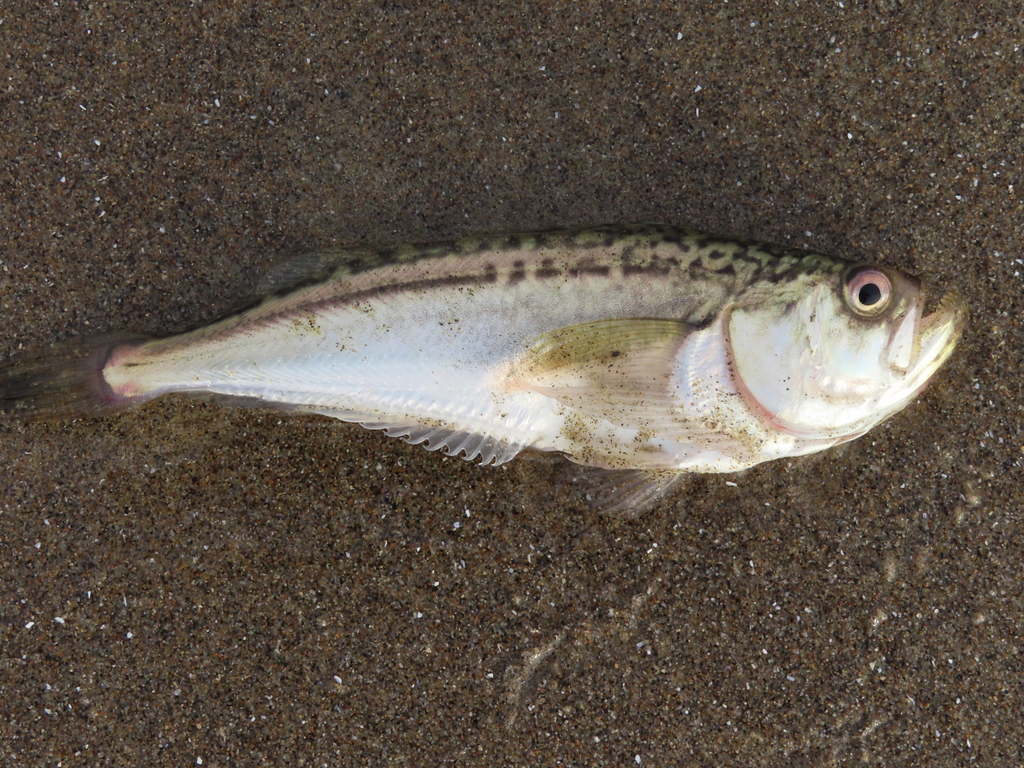
Pacific Sandfish
Trichodon trichodon
Trichodon trichodon, the Pacific sandfish, is a species of sandfish native to the Pacific coast of North America, from San Francisco Bay to Unimak Island in the Aleutian Islands. Like its cousin the sailfin or Japanese sandfish (Arctoscopus japonicus), the Pacific sandfish is a small, deepwater fish distributed over sandy and muddy depths. It is not valued for sushi like its Japanese cousin, but is occasionally caught from piers by recreational anglers.
From the article Pacific sandfish on Wikipedia (CC BY-SA), quoted section by section
Description
Pacific sandfish are small, reaching a maximum length of 12 inches (30 cm) and a weight of 12 oz (340 g). They have a long, slender body, with a silvery belly and a darker top side with black spots. The fish's fins and tail are long and thin, with a scaleless body. The Pacific sandfish is found over muddy and sandy bottoms to depths of 1,230 feet (370 m). Females lay a clutch of about 1000 eggs during the spawning months in winter. After a one-year incubation, the eggs hatch 0.5 inches (13 mm) larvae. Sandfish larvae are excellent swimmers, swimming freely in open nearshore water, sometimes in the company of juvenile salmon. These schoolings of sandfish and salmon are considered beneficial to the former since the latter swarm in schools and give protection from predators to the normally solitary sandfish. Sandfish and salmon smolt are also considered to have the same diet, which is another theory for these schoolings. At 2–3 months and 2.5 inches(50–60 mm) in length, they have attained the laterally compressed adult form, and bury themselves in the seabed. The Pacific sandfish is known to live a maximum of 9 years; females grow larger than males. Adult sandfish are only known to inhabit sandy shores along beaches, whereas the egg masses are usually laid near rocky shores where they can be attached to rocks and seaweed easier. …
Wikipedia: “Description and life cycle”
What it does
Pacific sandfish are mostly shrimp eaters, feeding by waiting for small fish, shrimp or krill to come into range and then sucking the prey up with its unusually large upturned mouth. The sandfish's teeth are needle-sharp for grasping prey. Most shrimp eaten are between 1 and 3 inches long. The sandfish waits for prey by burying itself in sand or mud and using is upturned eyes to watch passing prey. Sandfish themselves are preyed upon by Pacific cod and Pacific halibut. Seabirds such as pigeon guillemots, gulls, and puffins will also prey on sandfishes.
Wikipedia: “Diet”
Where it lives
Recorded sightings
—
geo-referenced records in GBIF, from museums, herbaria and field observers.
Drag the globe to turn it. Dots are where records exist, not a range map; darker means more records.
In the stacks
Searching the stacks…
Every page naming Trichodon trichodon in the Biodiversity Heritage Library →
This page is assembled live from iNaturalist, GBIF, Wikipedia, the Source Library and the Internet Archive. It is not yet part of the hand-edited codex. iNaturalist taxon 169919.