On eBird ↗
Black-and-white Tody-Flycatcher
Live sightings near you, the range map, bar charts of when it is seen, and Macaulay Library photos and recordings.
Black-and-white Tody-Flycatcher
Poecilotriccus capitalis
The black-and-white tody-flycatcher (Poecilotriccus capitalis) is a species of bird in the family Tyrannidae. It was formerly placed in the genus Todirostrum, and known as the black-and-white tody-tyrant. It is found in thickets, especially bamboo, in southern Colombia, eastern Ecuador, eastern Peru, and south-western Brazil.
From the article Black-and-white tody-flycatcher on Wikipedia (CC BY-SA), quoted section by section
Description
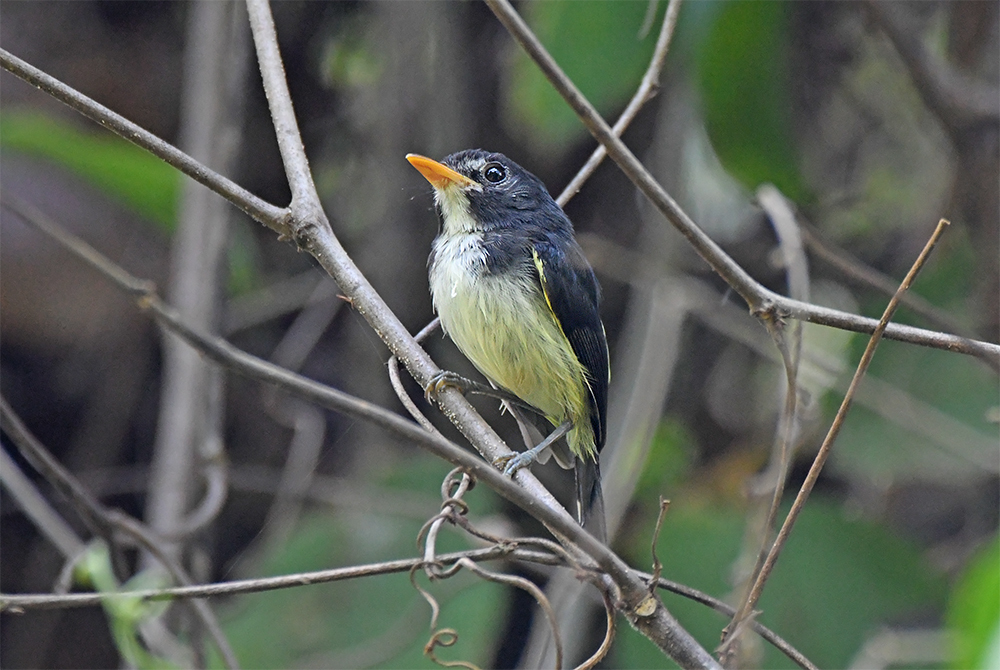
The black-and-white tody-flycatcher is about 9 to 9.5 cm (3.5 to 3.7 in) long and weighs 5.6 to 8 g (0.20 to 0.28 oz). Adult males have an almost entirely glossy black head and upperparts. They have a small white spot above their lores, a white eye-ring, and wide pale yellow edges on their tertials. Their throat and underparts are mostly white, with streaky black on the sides of the breast that sometimes extends in a thin band across the breast, and a pale yellow tinge on the flanks and crissum. Females have a chestnut crown and buffy lores and eye-ring on an otherwise mostly gray face. Their nape, back, and uppertail coverts are olive. Their tail and wings are blackish with wide pale yellow edges on the tertials and olive edges on the other flight feathers. Both sexes have a reddish brown iris, a black maxilla, a pale orange-yellow mandible, and gray legs and feet.
Range & habitat
The black-and-white tody-flycatcher has a highly disjunct distribution. Its largest range extends from eastern Nariño, Putumayo and Amazonas departments in southern Colombia south on the eastern Andean slope through Ecuador and into Peru as far south as San Martín Department and east into northern Loreto Department. There is also an isolated population further south in Peru's Cuzco Department and other small populations in the Brazilian states of Amazonas, Rondônia, and Mato Grosso. The species primarily inhabits the edges of lowland and foothill terra firme forest and along roads and small watercourses. It greatly favors viny tangles and stands of bamboo. It also occurs in secondary forest without bamboo. In Colombia it ranges between 250 and 1,300 m (800 and 4,300 ft), in Ecuador up to 1,350 m (4,400 ft), and in Peru between 600 and 1,300 m (2,000 and 4,300 ft).
Wikipedia: “Distribution and habitat”
What it does
The black-and-white tody-flycatcher feeds on insects. It typically forages singly or in pairs, and in Colombia and Peru at least is known to join mixed-species feeding flocks. It forages mostly in dense vegetation near the ground. It takes prey from foliage with short upward or forward sallies from a perch.
Wikipedia: “Feeding”
Listen
Looking for field recordings…
Where it lives
Recorded sightings
—
geo-referenced records in GBIF, from museums, herbaria and field observers.
Drag the globe to turn it. Dots are where records exist, not a range map; darker means more records.
In the stacks
Searching the stacks…
Every page naming Poecilotriccus capitalis in the Biodiversity Heritage Library →
This page is assembled live from iNaturalist, GBIF, Wikipedia, the Source Library and the Internet Archive. It is not yet part of the hand-edited codex. iNaturalist taxon 17021.