On eBird ↗
Ochre-faced Tody-Flycatcher
Live sightings near you, the range map, bar charts of when it is seen, and Macaulay Library photos and recordings.
Ochre-faced Tody-Flycatcher
Poecilotriccus plumbeiceps
The ochre-faced tody-flycatcher (Poecilotriccus plumbeiceps) is a species of bird in the family Tyrannidae, the tyrant flycatchers. It is found in Argentina, Bolivia, Brazil, Paraguay, Peru, and Uruguay.
From the article Ochre-faced tody-flycatcher on Wikipedia (CC BY-SA), quoted section by section
Description
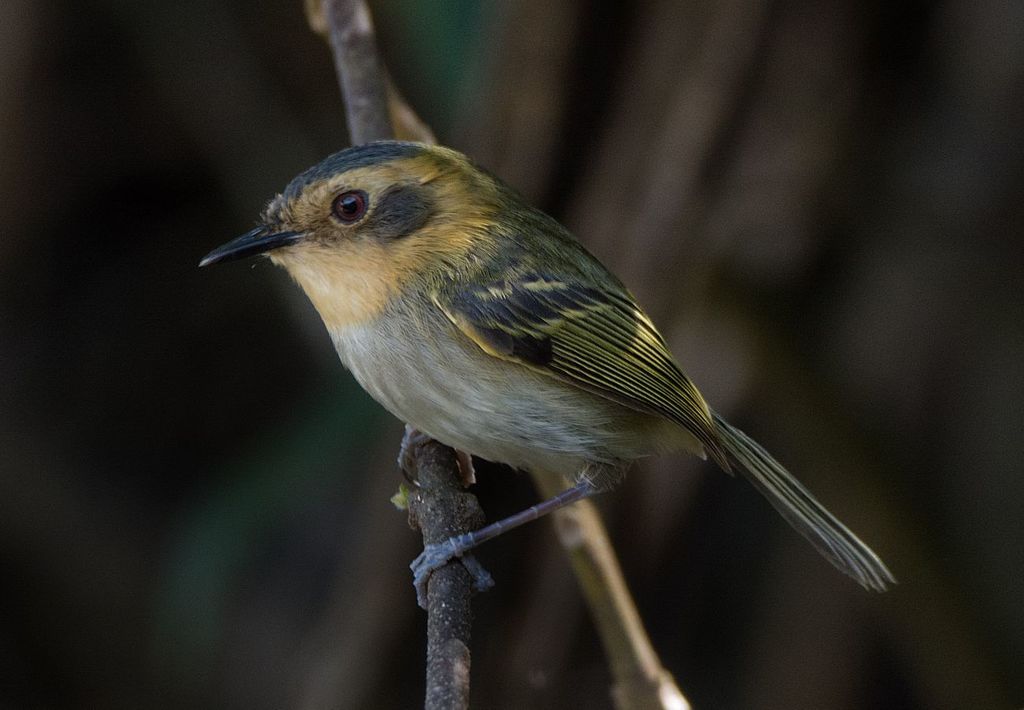
The ochre-faced tody-flycatcher is 9 to 10 cm (3.5 to 3.9 in) long and weighs 5.3 to 6 g (0.19 to 0.21 oz). The sexes have the same plumage. Adults of the nominate subspecies P. p. plumbeiceps have a buffish cinnamon forehead and a gray crown. Their face is mostly buffish cinnamon with dusky ear coverts. Their back, rump, and uppertail coverts are dark olive. Their wings are dusky with ochraceous edges on the flight feathers and tips on the coverts; the latter show as two wing bars. Their tail is dark olive. Their throat is a slightly paler buffish cinnamon than the face. Their breast and belly are grayish white. Subspecies P. p. viridiceps has an olive tinge on the crown and a grayer breast than the nominate. P. p. obscurus resembles viridiceps but is darker overall. P. p. cinereipectus has a grayer breast than the nominate. All subspecies have a brown iris, a dark grayish bill, and dark grayish legs and feet.
Range & habitat
The ochre-faced tody-flycatcher has a disjunct distribution. The subspecies are found thus:
P. p. obscurus: eastern slope of the Andes from Cuzco Department in southeastern Peru south into Bolivia as far as Santa Cruz Department P. p. viridiceps: eastern slope of the Andes from Chuquisaca Department in southern Bolivia south into northwestern Argentina as far as Salta Province P. p. plumbeiceps: eastern Paraguay, Misiones and Corrientes provinces in northeastern Argentina, southeastern Brazil from (Rio de Janeiro and São Paulo states south through Rio Grande do Sul, and extreme northeastern Uruguay P. p. cinereipectus: northeastern and east-central Brazil from Pernambuco south to southeastern Minas Gerais and Espírito Santo The species was first documented in Uruguay in 1997. It was again documented in 1999 and then in 2006. The ochre-faced tody-flycatcher inhabits the edges of humid forest and also dense undergrowth in secondary forest. It favors areas with dense vine tangles, Chusquea bamboo, Pteridium bracken, and shrubs.
Wikipedia: “Distribution and habitat”
What it does
The ochre-faced tody-flycatcher feeds on insects. It typically forages in pairs and very seldom joins mixed-species feeding flocks. It mostly forages in dense vegetation and takes prey from foliage close to the ground with short sallies from a perch.
Wikipedia: “Feeding”
Listen
Looking for field recordings…
Where it lives
Recorded sightings
—
geo-referenced records in GBIF, from museums, herbaria and field observers.
Drag the globe to turn it. Dots are where records exist, not a range map; darker means more records.
In the stacks
Searching the stacks…
Every page naming Poecilotriccus plumbeiceps in the Biodiversity Heritage Library →
This page is assembled live from iNaturalist, GBIF, Wikipedia, the Source Library and the Internet Archive. It is not yet part of the hand-edited codex. iNaturalist taxon 17050.