On eBird ↗
River Tyrannulet
Live sightings near you, the range map, bar charts of when it is seen, and Macaulay Library photos and recordings.
River Tyrannulet
Serpophaga hypoleuca
The river tyrannulet (Serpophaga hypoleuca) is a species of bird in the family Tyrannidae, the tyrant flycatchers. It is found in Peru, Venezuela and Brazil; also river extensions into Ecuador, Colombia-(border) and Bolivia.
From the article River tyrannulet on Wikipedia (CC BY-SA), quoted section by section
Description
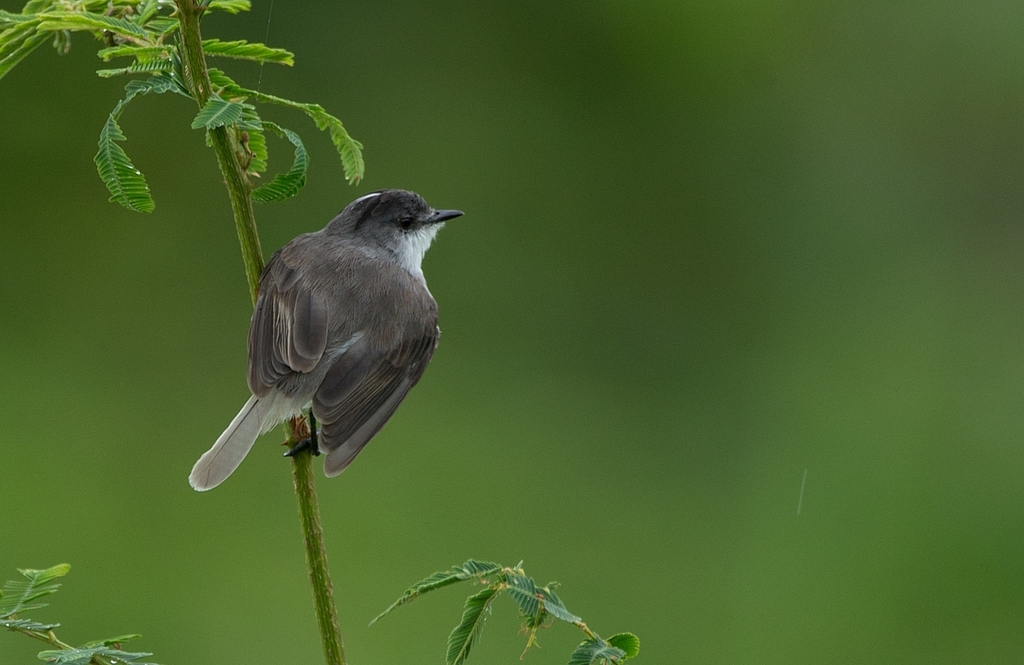
The river tyrannulet is 10.5 to 12.5 cm (4.1 to 4.9 in) long and weighs 5.5 to 6.7 g (0.19 to 0.24 oz). The sexes have the same plumage. Adults of the nominate subspecies have a gray forehead and a black crown with white central feathers that are usually hidden; the black extends as a flat crest. They have white lores, a white partial eye-ring, and a black line through the eye on an otherwise white face. Their upperparts are brownish gray. Their wings are dusky brownish gray and their tail long and dusky. Their chin, throat, and underparts are white with a pale gray tinge across the breast. Subspecies S. h. venezuelana is smaller and paler than the nominate with less black on its crown. S. h. pallida is also paler than the nominate, with less black on its crown and almost no gray tinge on the breast. Juveniles are like adults. Both sexes of all subspecies have a dark brown iris, a black bill, and dark gray legs and feet.
Range & habitat
The river tyrannulet has a disjunct distribution on two major South American river corridors. Subspecies S. h. venezuelana has the smallest range and is separated from the other two subspecies. It is found primarily in Venezuela, along the middle and lower Orinoco River and its tributaries the Meta and Apure rivers. It is found on the Meta in far eastern Vichada Department of Colombia as well. The other two subspecies have contiguous ranges along the Amazon and many of its tributaries. The nominate is found along the Putumayo River on the southeastern Colombia-northeastern Peru border, along the Napo and Pastaza rivers from Ecuador to their confluences with the Marañon River in Peru, along the Ucayali River to the Marañon in Peru, along the Marañon from Peru to the Amazon in Brazil, along the Madre de Dios River from Peru across northern Bolivia to the Madeira River in Brazil and the Madeira to the Amazon, and along the upper and middle Amazon approximately to the Madeira. Subspecies S. h. pallida is found in Brazil, along the lower Amazon and the lower reaches of the Tapajós and Tocantins rivers. The river tyrannulet inhabits low-stature and sparse early-successional scrub on river islands and the "mainland" river edges. In eastern Colombia and western Venezuela it occurs in scrubby and thorny areas along watercourses in the Llanos. …
Wikipedia: “Distribution and habitat”
What it does
The river tyrannulet feeds on insects. It forages alone, in pairs, or in family groups, actively and restlessly moving through shrubs and young trees. It captures prey mostly by gleaning while perched but also while briefly hovering after a short flight, and only rarely makes captures in flight.
Wikipedia: “Feeding”
Listen
Looking for field recordings…
Where it lives
Recorded sightings
—
geo-referenced records in GBIF, from museums, herbaria and field observers.
Drag the globe to turn it. Dots are where records exist, not a range map; darker means more records.
In the stacks
Searching the stacks…
Every page naming Serpophaga hypoleuca in the Biodiversity Heritage Library →
This page is assembled live from iNaturalist, GBIF, Wikipedia, the Source Library and the Internet Archive. It is not yet part of the hand-edited codex. iNaturalist taxon 17202.