On eBird ↗
White-crested Tyrannulet
Live sightings near you, the range map, bar charts of when it is seen, and Macaulay Library photos and recordings.
White-crested Tyrannulet
Serpophaga subcristata
The white-crested tyrannulet (Serpophaga subcristata) is a small species of bird in the family Tyrannidae. It is found in woodland and open habitats with scatted bushes and trees in Argentina, Bolivia, Brazil, Paraguay, and Uruguay. It is closely related to the white-bellied tyrannulet, but unlike that species the belly of the white-crested tyrannulet is yellow. The recently described Straneck's tyrannulet is extremely similar to the white-crested tyrannulet and was for a long time confused with that...
From the article White-crested tyrannulet on Wikipedia (CC BY-SA), quoted section by section
Description
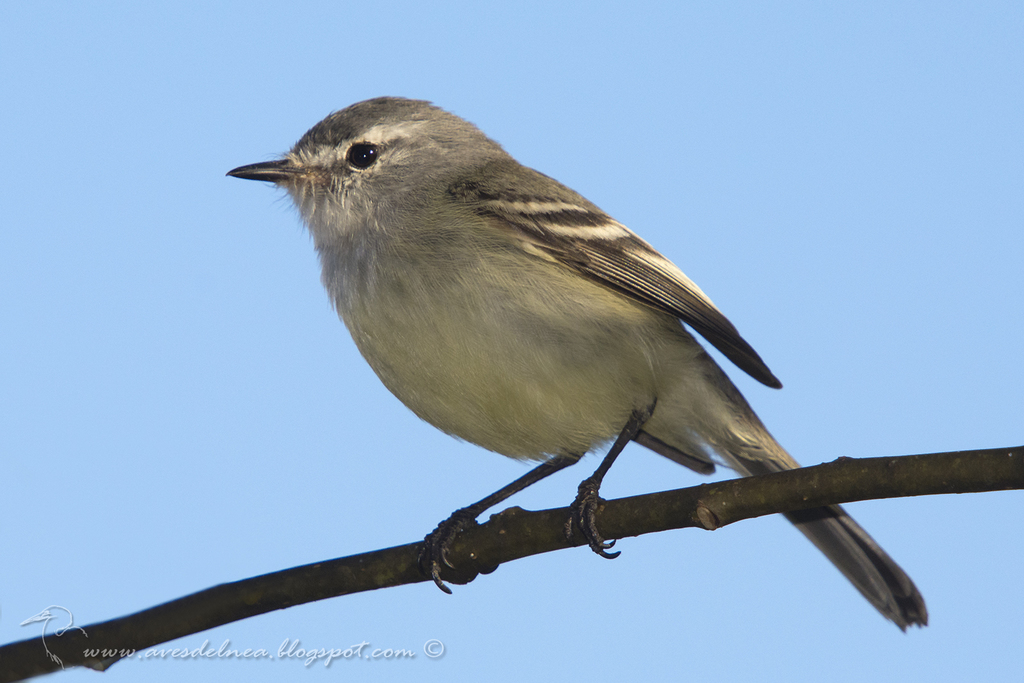
The white-crested tyrannulet is 11 cm (4.3 in) long and weighs 6 to 8.6 g (0.21 to 0.30 oz). The sexes have the same plumage. Adults of the nominate subspecies have a gray crown and nape with white central crown feathers that are usually hidden but sometimes raised as a crest. They have a thin white supercilium, a white partial eye-ring, and a dusky line through the eye on an otherwise grayish white face. Their upperparts are grayish olive. Their wings are dusky to blackish with pale buffy edges to most of the flight feathers and two whitish to pale buffy wing bars. Their tail is dusky with whitish edges on the outer feathers. Their chin and throat are white, their breast gray, and their belly pale yellow. Juveniles have buff wing bars and little or no white on the crown. Subspecies S. s. straminea is very similar to the nominate but with a brighter yellow belly. S. s. munda is larger than the nominate. Its upperparts are gray with a faint olive tinge, its wing bars are white, and its belly is white with sometimes a faint creamy yellow tinge. Both sexes of all subspecies have a dark brown iris, a black bill, and gray legs and feet.
Range & habitat
The nominate subspecies of the white-crested tyrannulet is found from Bolivia's La Paz Department east to southern Mato Grosso in Brazil and south through Paraguay to northeastern Chubut Province in Argentina. Subspecies S. s. straminea is found in Uruguay and eastern Brazil. S. s. munda is found from western Bolivia and Argentina west of straminea and migrates east to north-central Bolivia, southeastern Brazil, and Uruguay. In all seasons the species inhabits a variety of landscapes including the edges of tropical forest, deciduous woodlands, gallery forest, thorn forest, dryish scrublands, cerrado, plantations, gardens, and agricultural areas. In the non-breeding season it tends to prefer the more open landscapes like scrublands and agricultural areas. In elevation it ranges from sea level to 2,800 m (9,200 ft) in Brazil, and up to 700 m (2,300 ft) in Argentina and 2,900 m (9,500 ft) in Bolivia.
Wikipedia: “Distribution and habitat”
What it does
The white-crested tyrannulet's diet has not been detailed but is believed to be entirely small insects. It is an active forager, flitting around in scrubby vegetation. It takes prey by gleaning while perched and while briefly hovering after a short flight; it also takes some prey in mid-air.
Wikipedia: “Feeding”
Listen
Looking for field recordings…
Where it lives
Recorded sightings
—
geo-referenced records in GBIF, from museums, herbaria and field observers.
Drag the globe to turn it. Dots are where records exist, not a range map; darker means more records.
In the stacks
Searching the stacks…
Every page naming Serpophaga subcristata in the Biodiversity Heritage Library →
This page is assembled live from iNaturalist, GBIF, Wikipedia, the Source Library and the Internet Archive. It is not yet part of the hand-edited codex. iNaturalist taxon 17211.