On eBird ↗
Cocos Tyrannulet
Live sightings near you, the range map, bar charts of when it is seen, and Macaulay Library photos and recordings.
Cocos Flycatcher
Nesotriccus ridgwayi
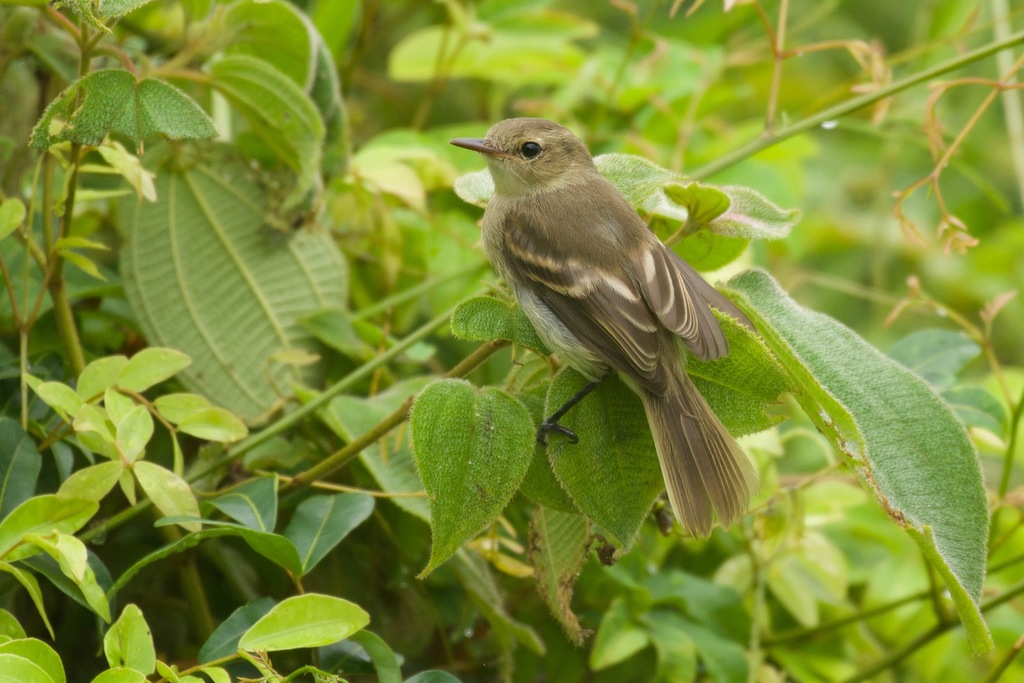
The Cocos tyrannulet (Nesotriccus ridgwayi), also known as the Cocos flycatcher, is a vulnerable species of bird in subfamily Elaeniinae of family Tyrannidae, the tyrant flycatchers. It is endemic to Cocos Island off Costa Rica.
From the article Cocos tyrannulet on Wikipedia (CC BY-SA), quoted section by section
Description
The Cocos tyrannulet is about 11 cm (4.3 in) long and weighs about 11 g (0.39 oz). The sexes have the same plumage. Adults have a grayish olive to dark brownish olive crown, a slightly paler supercilium and cheeks, and a thin dark line through the eye. Their upperparts are grayish olive to dark brownish olive. Their wings are dusky with dull yellowish buff edges on the flight feathers and tips on the coverts; the latter show as two wing bars. Their tail is dusky. Their throat and underparts are pale yellowish with a brownish to olive wash on the breast. Both sexes have a dark brown iris, a long, wide bill whose maxilla is brown to black and its mandible pale with a dusky tip, and dark gray legs and feet. Juveniles are browner than adults and have buffy to cinnamon wingbars.
Range & habitat
The Cocos tyrannulet is found only on Cocos Island, which is politically part of Costa Rica though about 550 km (340 mi) distant from the mainland in the Pacific. It inhabits the edges and interior of subtropical and tropical evergreen forest, secondary forest, and scrubby and swampy areas. In elevation it ranges from sea level to about 575 m (1,900 ft).
Wikipedia: “Distribution and habitat”
What it does
The Cocos tyrannulet feeds mostly on arthropods but also occasionally includes fruit in its diet. It forages fairly high in dense vegetation. It takes prey mostly by striking upward to foliage from a perch; it also gleans while perched, briefly hovers to glean, and makes sallies to take prey on the wing.
Wikipedia: “Feeding”
Listen
Looking for field recordings…
Where it lives
Recorded sightings
—
geo-referenced records in GBIF, from museums, herbaria and field observers.
Drag the globe to turn it. Dots are where records exist, not a range map; darker means more records.
In the stacks
Searching the stacks…
Every page naming Nesotriccus ridgwayi in the Biodiversity Heritage Library →
This page is assembled live from iNaturalist, GBIF, Wikipedia, the Source Library and the Internet Archive. It is not yet part of the hand-edited codex. iNaturalist taxon 17215.