On eBird ↗
Gray Vireo
Live sightings near you, the range map, bar charts of when it is seen, and Macaulay Library photos and recordings.
Gray Vireo
Vireo vicinior
The gray vireo (Vireo vicinior) is a small North American passerine bird. It breeds from the southwestern United States and northern Baja California to western Texas. It is a migrant, wintering in northwestern Mexico in western Sonora state, and the southern Baja Peninsula in Baja California Sur; it remains all year only in Big Bend National Park in southwest Texas. It is usually found at altitudes between 400 and 2,500 metres (1,300 and 8,200 ft) in its...
From the article Gray vireo on Wikipedia (CC BY-SA), quoted section by section
Description
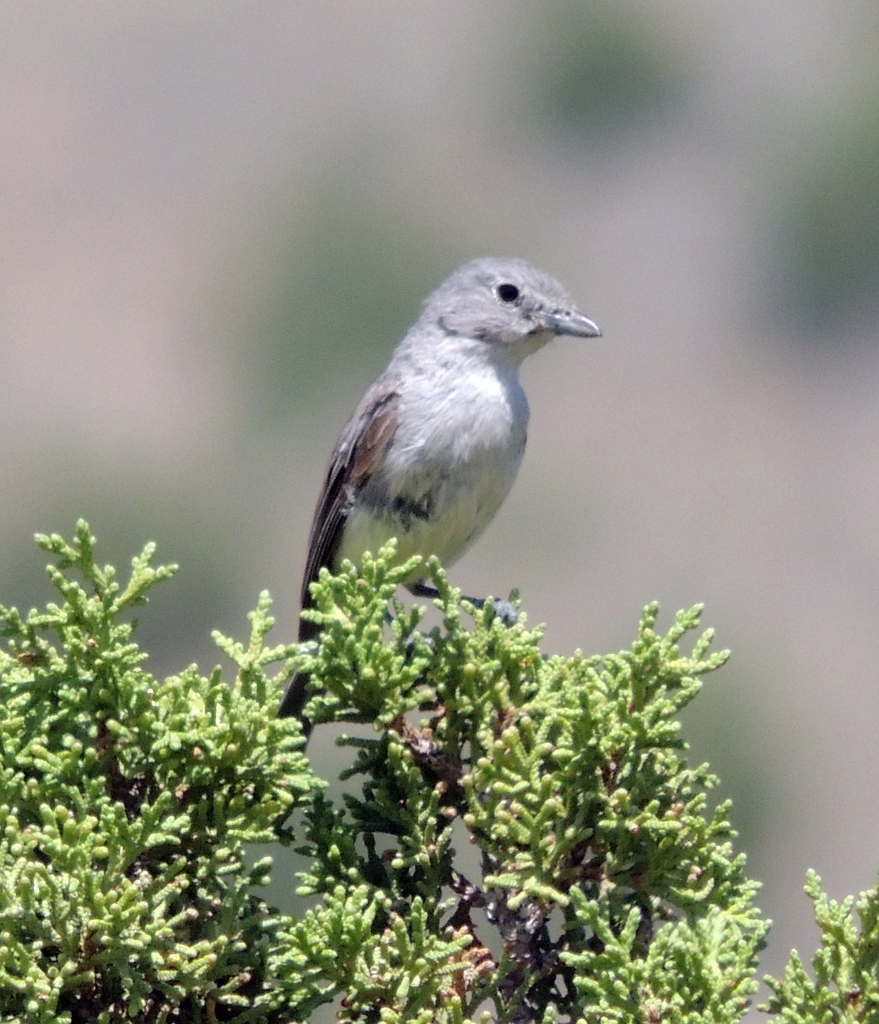
The gray vireo is about 13 to 15 cm (5.1 to 5.9 in) long and weighs 11.5 to 13.5 g (0.41 to 0.48 oz). The sexes have the same plumage. Adults have a mostly gray crown and face with white lores and a thin white eye-ring. Their upperparts are gray that gains a greenish cast late in the year. Their wings are mostly dark gray to blackish with white tips on the greater coverts that form a wing bar. Their tail is gray with white edges on the outer webs of the outer feathers. Their chin, throat, and upper breast are a paler gray than their upperparts; their belly and undertail coverts are white. They have a dark brown iris, a plumbeous or blackish maxilla, a paler grayish blue mandible, and plumbeous or blue-gray legs and feet.
Range & habitat
The gray vireo has a disjunct distribution on both its breeding and wintering ranges. Its principal breeding range is in the southwestern United States in an area roughly bordered by far southeastern California, northeastern Utah and northwestern Colorado, central New Mexico, and southwestern New Mexico and southeastern Arizona. It also breeds in a few small areas in south-central California, southeastern Colorado, southeastern New Mexico, southwestern Texas, and northern Baja California. It winters in southern Baja California and from southwestern Arizona south through most of Mexico's Sonora state. It is present year-round in the Big Bend region of southwestern Texas. The species has also been documented as a vagrant in Kansas, Oklahoma, Wyoming, and Wisconsin. The gray vireo year-round inhabits a variety of dry landscapes including oak-juniper and pinyon-juniper woodlands, chaparral, and thorn scrub. During migration and on its winter ranges it also inhabits arid and desert scrublands. In much of its breeding range it occurs in elevations between about 1,600 and 2,300 m (5,200 and 7,500 ft) though is found as low as 900 m (3,000 ft) in west Texas and 400 m (1,300 ft) in northern Mexico.
Wikipedia: “Distribution and habitat”
What it does
In its breeding range the gray vireo feeds mainly on arthropods. Birds wintering in Big Bend are also mostly insectivorous, while those wintering from southwestern Arizona into Sonora feed primarily on fruit. In all seasons the species tends to forage in fairly thick vegetation such as thickets, scrub, and small trees within about 4 m (15 ft) of the ground. It takes food by several methods including gleaning from foliage and branches, snatching while briefly hovering after a short flight, hawking in mid-air, and by pouncing from a perch. During the breeding season the species typically is seen singly, in pairs, or in family groups; on the wintering grounds it sometimes forms small flocks with other gray vireos and other species.
Wikipedia: “Feeding”
Listen
Looking for field recordings…
Where it lives
Recorded sightings
—
geo-referenced records in GBIF, from museums, herbaria and field observers.
Drag the globe to turn it. Dots are where records exist, not a range map; darker means more records.
In the stacks
Searching the stacks…
Every page naming Vireo vicinior in the Biodiversity Heritage Library →
This page is assembled live from iNaturalist, GBIF, Wikipedia, the Source Library and the Internet Archive. It is not yet part of the hand-edited codex. iNaturalist taxon 17363.