On eBird ↗
Cozumel Vireo
Live sightings near you, the range map, bar charts of when it is seen, and Macaulay Library photos and recordings.
Cozumel Vireo
Vireo bairdi
The Cozumel vireo (Vireo bairdi) is a species of bird in the family Vireonidae. It is endemic to the Mexican island of Cozumel off the Yucatán Peninsula. Its natural habitats are subtropical or tropical dry forests and heavily degraded former forest.
From the article Cozumel vireo on Wikipedia (CC BY-SA), quoted section by section
Description
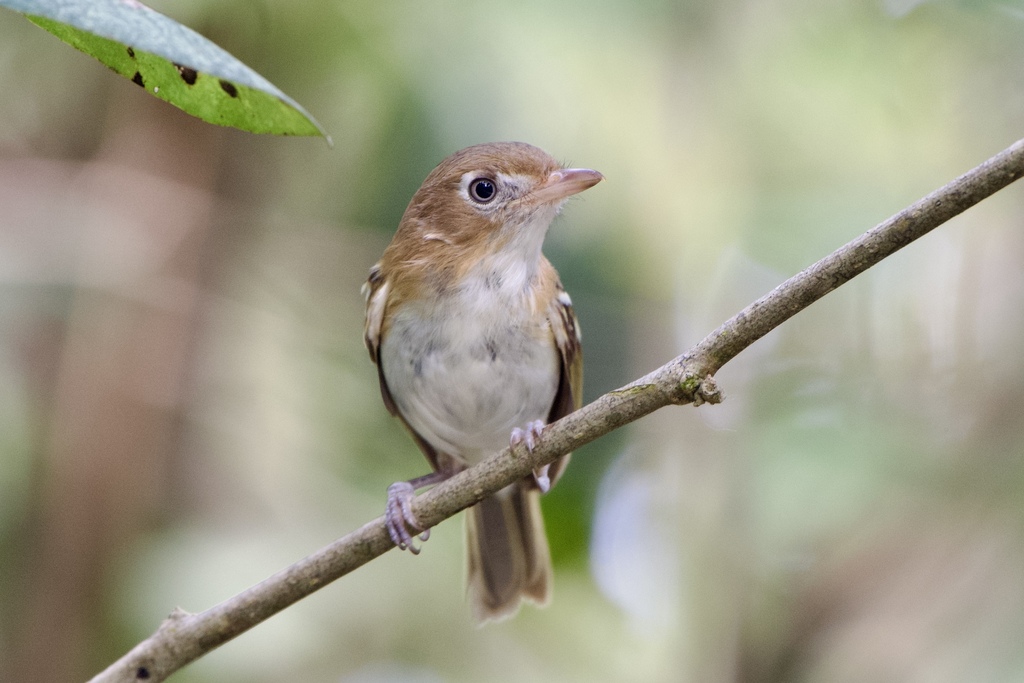
The Cozumel vireo is 11.5 to 12.5 cm (4.5 to 4.9 in) long and weighs about 11 to 14.5 g (0.39 to 0.51 oz). The sexes have the same plumage. Adults have a dark chestnut-brown crown, nape, and ear coverts. They have an off-white patch from the lores to the eye and a wide white eye-ring; together they look like spectacles. Their upperparts are light chestnut-brown. Their wing coverts are gray-brown with wide yellowish-white tips that form two bold wing bars. Their flight feathers are gray-brown; the primaries and secondaries have greenish or olive-yellow edges on the outer webs and the tertials have whitish edges. Their tail is brownish gray with greenish edges on the outer webs of the feathers. Their chin and throat are off-white, their breast off-white with chestnut- or cinnamon-brown sides, their flanks brownish, and their belly and vent off-white. They have a brown iris, a pinkish bill with a darker tip, and lead-blue, bluish pink, or dusky pinkish legs and feet. Juveniles are overall paler than adults, with purer brown sides of the breast and a darker brown iris.
Range & habitat
The Cozumel vireo is found only on Cozumel Island off the coast of the Mexican state of Quintana Roo of the eastern Yucatán Peninsula. It inhabits scrubby woodlands and similar landscapes such as brushy abandoned fields, young secondary woodland, and thickets in more mature woodland.
Wikipedia: “Distribution and habitat”
What it does
The Cozumel vireo's diet has not been studied. The species typically forages in low to middle-height vegetation.
Wikipedia: “Feeding”
Listen
Looking for field recordings…
Where it lives
Recorded sightings
—
geo-referenced records in GBIF, from museums, herbaria and field observers.
Drag the globe to turn it. Dots are where records exist, not a range map; darker means more records.
In the stacks
Searching the stacks…
Every page naming Vireo bairdi in the Biodiversity Heritage Library →
This page is assembled live from iNaturalist, GBIF, Wikipedia, the Source Library and the Internet Archive. It is not yet part of the hand-edited codex. iNaturalist taxon 17381.