On eBird ↗
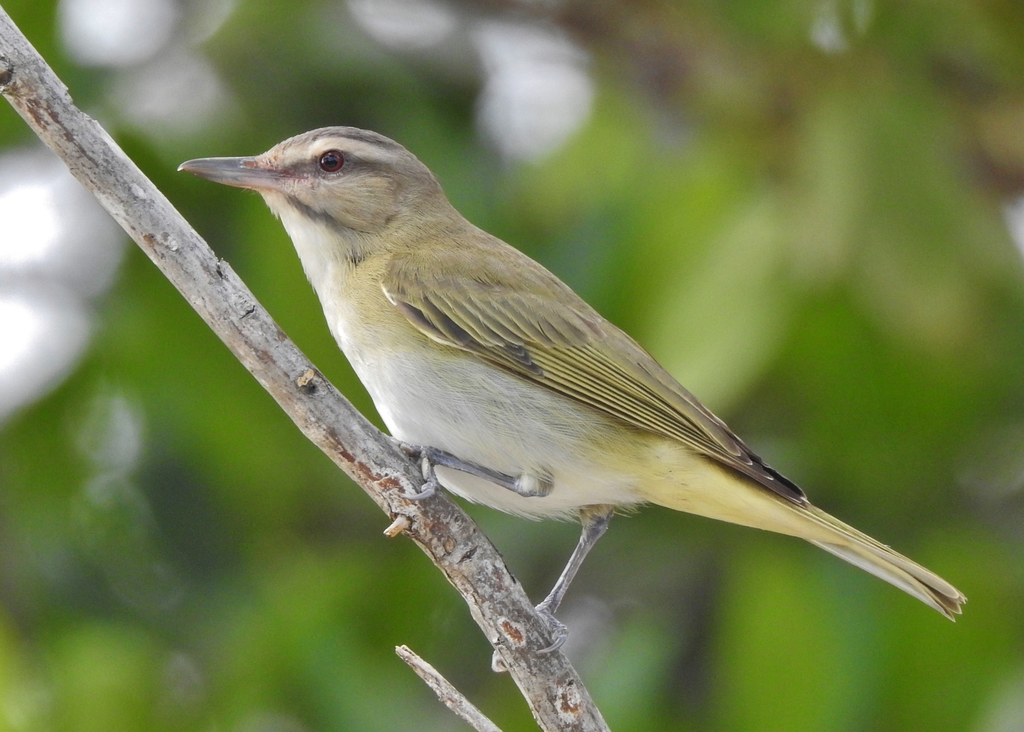
Black-whiskered Vireo
Live sightings near you, the range map, bar charts of when it is seen, and Macaulay Library photos and recordings.
Black-whiskered Vireo
Vireo altiloquus
The black-whiskered vireo (Vireo altiloquus) is a small passerine bird, which breeds in southern Florida, USA, and the West Indies as far south as the offshore islands of Venezuela. It is a partial migrant, with northern birds wintering from the Greater Antilles to northern South America. This species has occurred as a rare vagrant to Costa Rica.
From the article Black-whiskered vireo on Wikipedia (CC BY-SA), quoted section by section
Description
The black-whiskered vireo is 15 to 16.5 cm (5.9 to 6.5 in) long. The nominate subspecies V. a. altiloquus weighs an average of 18 g (0.63 oz). The sexes have the same plumage. Adults of the nominate subspecies have a bluish gray forehead and crown with a buff-olive tinge, a buffy whitish supercilium from the bill past the eye, a wide dusky stripe through the eye, and the eponymous black "whisker" on the sides of the throat. Their nape and upperparts are olive-green. Their remiges are mostly brownish black with small white tips, wide whitish or cream edges on the inner webs, and thin yellowish olive edges on the outer webs. Their rectrices are mostly brownish with thin yellowish olive edges on the outer webs and thin white or cream edges on the inner webs of the outer three pairs. Their underparts are mostly whitish with a slight buff and greenish olive tinge on the throat and upper breast, a pale olive wash on the side and flanks, and lemon-yellow undertail coverts. The other subspecies differ from the nominate and each other thus:
V. a. barbatulus: grayish-tinged olive back and rump and whiter underparts than nominate V. a. barbadensis: pale gray wash on supercilium and lighter green upperparts than barbatulus V. a. bonairensis: olive-buff back; less buff on underparts than nominate V. a. grandior: yellowish sides and flanks and pale yellow undertail coverts V. a. …
Range & habitat
The black-whiskered vireo is found in southern Florida, the Bahamas, the Greater and Lesser Antilles, Providencia and San Andrés islands, the ABC islands, Trinidad and Tobago, and the mainland South American countries of Brazil, Colombia, Guyana, Suriname, and Venezuela. It also occurs casually or has occurred as a vagrant in Mexico, Belize, Costa Rica, Panama, along the U. S. gulf coast, on the U. S. east coast from Virginia south, in Bermuda, in French Guiana, and in Peru. The subspecies of the black-whiskered vireo are found thus:
V. a. barbatulus: breeds in southern Florida, Bahamas, Cuba, and Little Cayman and Cayman Brac in the Cayman Islands; winters in the Amazon Basin V. a. altiloquus: resident on Hispaniola; breeds in Jamaica and Puerto Rico; winters in northern South America; casual on U. S. gulf coast V. a. barbadensis: primarily resident in Lesser Antilles from St. Croix to Barbados V. a. bonairensis: resident on Aruba, Bonaire, Curaçao, and Venezuela's Los Roques and Margarita islands V. a. grandior: resident on Providencia Island V. a. canescens: resident on San Andrés Island The black-whiskered vireo inhabits a variety of landscapes throughout its range. In Florida it primarily occurs in coastal mangroves and subtropical hardwood hammocks and to a lesser degree the edges of suburban woodlands. …
Wikipedia: “Distribution and habitat”
What it does
The black-whiskered vireo feeds on fruit and arthropods in about equal amounts though the ratio varies with season and location. Where its foraging behavior has been studied in Puerto Rico and Jamaica it takes most food by gleaning from foliage while perched though sometimes while briefly hovering after a short sally. It also gleans from bark and twigs and only rarely takes insects in mid-air.
Wikipedia: “Feeding”
Listen
Looking for field recordings…
Where it lives
Recorded sightings
—
geo-referenced records in GBIF, from museums, herbaria and field observers.
Drag the globe to turn it. Dots are where records exist, not a range map; darker means more records.
In the stacks
Searching the stacks…
Every page naming Vireo altiloquus in the Biodiversity Heritage Library →
This page is assembled live from iNaturalist, GBIF, Wikipedia, the Source Library and the Internet Archive. It is not yet part of the hand-edited codex. iNaturalist taxon 17399.