On eBird ↗
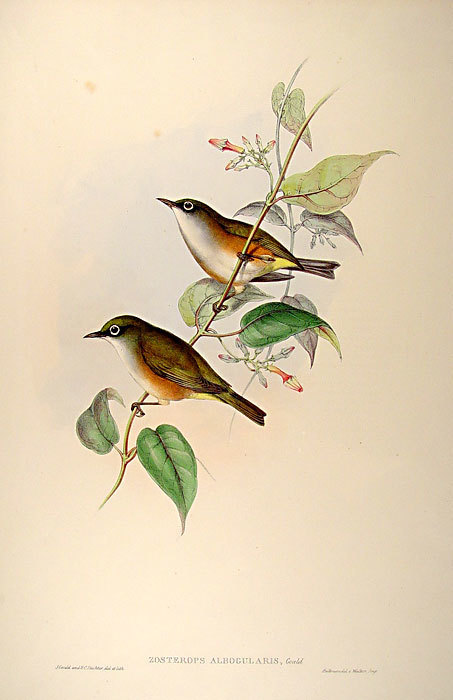
White-chested White-eye
Live sightings near you, the range map, bar charts of when it is seen, and Macaulay Library photos and recordings.
White-chested White-eye
Zosterops albogularis
The white-chested white-eye (Zosterops albogularis) also known as white-breasted white-eye or Norfolk white-eye is a passerine from the family Zosteropidae. It is endemic to Norfolk Island between New Caledonia and New Zealand and it is regarded as either extremely rare or possibly extinct. Since 2000 the Australian government has considered the species extinct.
From the article White-chested white-eye on Wikipedia (CC BY-SA), quoted section by section
Description
It had a length up 13 to 14 centimetres and therefore it was one of the largest white-eyes ever recorded. Its wingspan was 7.5 cm and its weight was about 30 grams. Its appearance was characterised by a pale green head, an olive green coloured neck and white throat and belly parts. A further feature of the bird was a conspicuous eye ring of white feathers. Males and females were coloured similarly. Its diet consisted of fruits, berries, nectar, and insects. Its only habitat was a 5 km² large forested area around Mount Pitt on Norfolk Island where it lived solitary. In the breeding season from October to December, the couple would build a cup-shaped nest in which around two white eggs were laid. The incubation time would last eleven days and the juveniles would become fully fledged another eleven days later.
Listen
Looking for field recordings…
Where it lives
Recorded sightings
—
geo-referenced records in GBIF, from museums, herbaria and field observers.
Drag the globe to turn it. Dots are where records exist, not a range map; darker means more records.
In the stacks
Searching the stacks…
Every page naming Zosterops albogularis in the Biodiversity Heritage Library →
This page is assembled live from iNaturalist, GBIF, Wikipedia, the Source Library and the Internet Archive. It is not yet part of the hand-edited codex. iNaturalist taxon 17441.