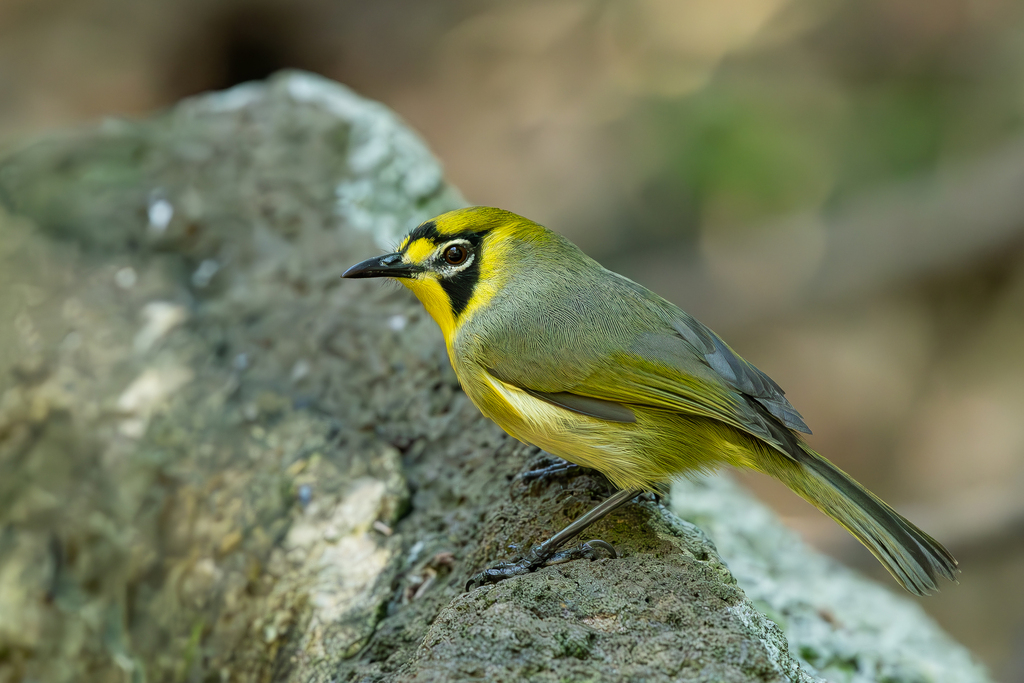
Apalopteron
The Bonin white-eye (Apalopteron familiare) is a small species of songbird endemic to the Bonin Islands (Ogasawara Islands) of Japan. It is the only species in the monotypic genus Apalopteron. The taxonomic affinities of the Bonin white-eye were a long-standing mystery and it was formerly placed with the bulbuls, babblers and more recently with the honeyeaters, during which it was known as the Bonin honeyeater. Since 1995 it is known to be a white-eye in the family Zosteropidae, that is closely related to the golden white-eye of the Marianas Islands.
The Bonin white-eye has predominately yellow and green plumage and a conspicuous black triangular patch around the eye – the eye is also surrounded by a broken white ring. It was once found on all the major islands of the Bonin Islands but is now restricted to the islands of Hahajima. On that island group it is found in almost all the habitat types, native and human-modified, although it mostly breeds in native forest. Fruit is an important part of the diet, especially mulberries, as well as insects, but flowers, seeds, spiders and reptiles are taken as well. It feeds both in trees and on the ground, as it is more terrestrial than other white-eyes. Pairs of Bonin white-eyes form long-term pair bonds and remain together throughout the year. They nest in a cup-shaped nest into which usually two eggs are laid. Both parents are responsible for incubation and raising the chicks.
1 branches of this genus, most-observed first · about 1 known species
See this branch on the Wheel of Life →
Where it lives
Recorded sightings
—
geo-referenced records in GBIF, from museums, herbaria and field observers.
Drag the globe to turn it. Dots are where records exist, not a range map; darker means more records.
In the stacks
Searching the stacks…
Every page naming Apalopteron in the Biodiversity Heritage Library →
This page is assembled live from iNaturalist, GBIF, Wikipedia, the Source Library and the Internet Archive. It is not yet part of the hand-edited codex. iNaturalist taxon 17533.