- Animals
- ›Chordates
- ›Vertebrates
- ›Ray-finned Fishes
- ›Carps, Characins, Catfishes and Allies
- ›Catfishes
- ›Loricarioidei
- ›Armored Catfishes
- ›Suckermouth Catfishes
- ›Pterygoplichthys
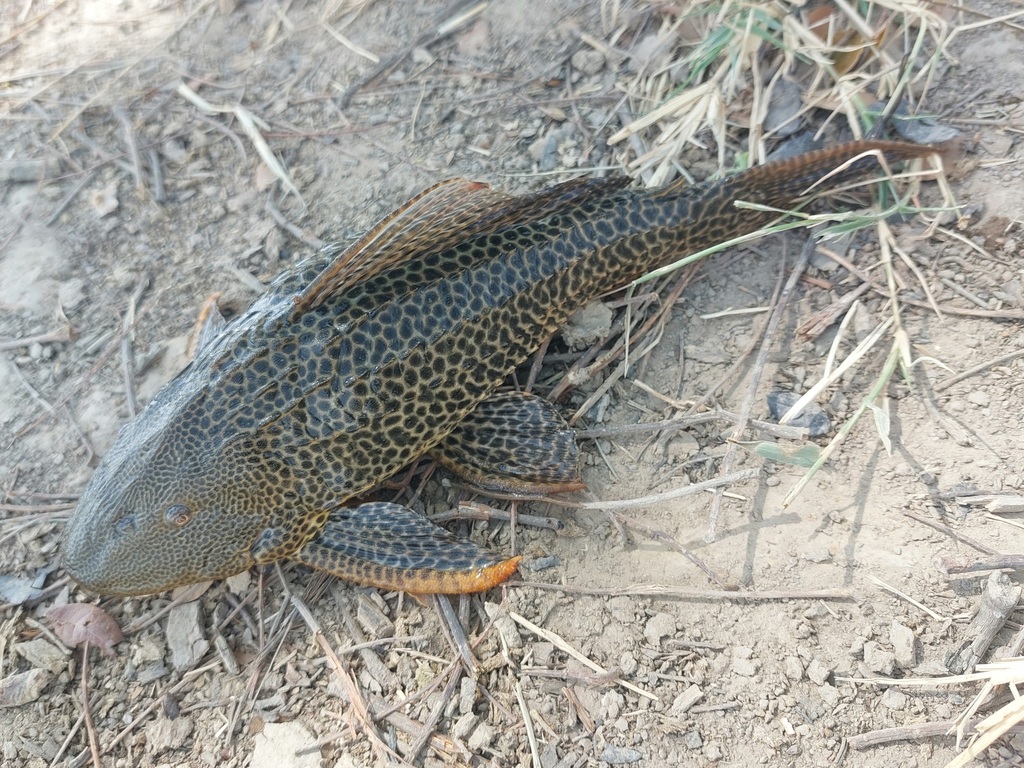
Orinoco Sailfin Catfish
Pterygoplichthys multiradiatus
Pterygoplichthys multiradiatus is one of several tropical fish commonly known as Orinoco sailfin catfish, plecostomus (or plecos). It belongs to the armored catfish family (Loricariidae). Named for its sail-like dorsal fin, the part of its scientific name multiradiatus means "many-rayed" and refers to the rays of the dorsal fin. P. multiradiatus is one of a number of species commonly referred to as the common pleco by aquarists.
Other scientific names that were used (as synonyms) for P. multiradiatus include Hypostomus multiradiatus, Ancistrus multiradiatus, and Liposarcus multiradiatus. P. multiradiatus is sometimes confused with Pterygoplichthys pardalis, which is a different species of pleco. P. multiradiatus goes by a number of common names. It can be called the "long-fin armored catfish" in Hawaii, "sailfin catfish", "sailfish catfish", "many-rayed (multiradiatus) pleco" or "radiated ptero" in the United States, 多輻翼甲鯰 in Mandarin Chinese.
From the article Pterygoplichthys multiradiatus on Wikipedia (CC BY-SA), quoted section by section
Range & habitat
P. multiradiatus has been introduced to Taiwan, Puerto Rico, Florida, Hawaii, Texas, India, and Mexico, most likely as the result of escapes or releases from aquarium fish farms. This species is firmly established in these and other locations, where it is regarded as a harmful invasive species being relatively inedible to people and predators, causing damage to fishing gear, competing and harming against native species and disrupting environments by its burrowing activities. In this context its relative, Hypostomus plecostomus, has also been similarly implicated though it seems likely that in Asia, both or related species are implicated.
Wikipedia: “Invasive introduction and range”
Where it lives
Recorded sightings
—
geo-referenced records in GBIF, from museums, herbaria and field observers.
Drag the globe to turn it. Dots are where records exist, not a range map; darker means more records.
In the stacks
This page is assembled live from iNaturalist, GBIF, Wikipedia, the Source Library and the Internet Archive. It is not yet part of the hand-edited codex. iNaturalist taxon 179472.