- Animals
- ›Chordates
- ›Vertebrates
- ›Ray-finned Fishes
- ›Carps, Characins, Catfishes and Allies
- ›Characins
- ›Characoidei
- ›American tetras
- ›Acestrorhamphinae
- ›Astyanax
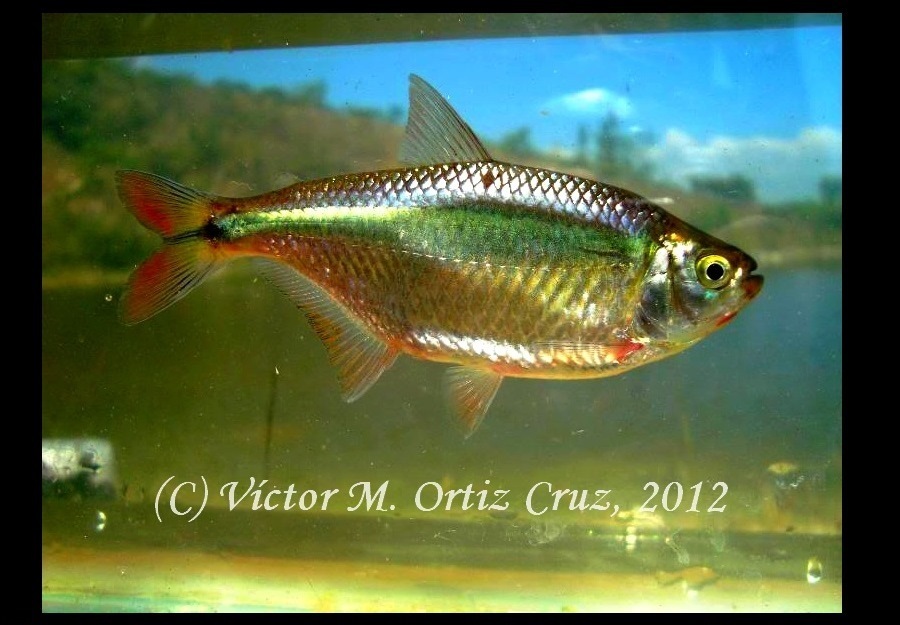
Banded Tetra
Astyanax aeneus
Astyanax aeneus, the banded tetra, is a species of freshwater ray-finned fish belonging to the family Acestrorhamphidae, the American characins. This fish is found in southern Central America and northern South America. It can be found in a variety of environments, including lakes, rivers, ponds, and slightly brackish locales like lagoons. As well as a varied habitat, it has a varied omnivorous diet: algae, seeds, leaves, insects, and fish fry appear to be the most common.
The IUCN considers A. aeneus a species of least concern, given its widespread habitat and hardy nature. Various threats throughout its range appear to have little impact on overall survivability. Despite a comparatively-short reproductive period, individuals also demonstrate high fecundity, which assists in maintaining a stable population.
From the article Astyanax aeneus on Wikipedia (CC BY-SA), quoted section by section
Description
Astyanax aeneus has silver sides, a white belly, and a greenish-brown back. There is a black rhomboidal shape on the caudal peduncle that extends to the tips of the middle caudal rays, but the fins are mostly transparent otherwise. Occasionally, the dorsal and caudal fins will display some red or yellow coloration. Upon preservation in alcohol, a gray band develops from the humeral spot to the caudal blotch; the humeral spot itself is distinct in living and deceased specimens, and is sometimes rhomboid or P-shaped. Depending on the individual, there may be the suggestion of a second spot behind the first on both sides, but this is often just an intensification of the lateral stripe located there, and is not a true second humeral spot. The snout is blunt, and the mouth opens forward (as opposed to being upturned). The eye is almost half the size of the head, and is usually wider than the snout is long. Body depth is intermediate, ranging from 34 to 39% SL in larger specimens. Notable morphometric characteristics include 9–11 dorsal-fin rays, 22–31 anal-fin rays (modally 25), and 10–11 pectoral-fin rays. A. aeneus is equipped with gill rakers for feeding, and southern populations may have a higher number of rakers than northern.
Sexual dimorphism. Astyanax aeneus demonstrates notable sexual dimorphism. …
Range & habitat
Astyanax aeneus is a widespread species. In Central America, countries include Mexico, in the rivers Papaloapan and Colima, Panama, in the rivers Cocle del Norte and Tabasara, and Honduras, in the Choluteca river. South American countries with populations of A. aeneus include El Salvador and Guatemala. While largely freshwater, A. aeneus demonstrates no preference for one specific habitat or another. It is found in fast-flowing rivers, stagnant swamps, sizable lakes, and even the occasional brackish lagoon. Whatever the case, it tends to linger in the stretch between the middle of the water column and the substrate. Because of its variable environment, A. aeneus is an adaptable species. One example of this is that the lower lip can expand to increase the surface area of the interface between water and air as a part of aquatic surface respiration (ASR) in hypoxic environments. (A specific morphological variation in response to an environmental stressor is referred to as an ecophenotype.) This specific adaptation once led to the mistaken designation of a new species, A. armandoi, which has since been synonymized with A. aeneus. Astyanax aeneus has also adapted to cave environments in a similar manner to its more well-known cousin, the blind Mexican cavefish (Astyanax mexicanus). …
Wikipedia: “Distribution”
What it does
Body weight and standard length are positively correlated with the relative fecundity of specimens; in other words, large individuals are more likely to be capable of reproduction. Spawning appears to be year-round in most of its range, but can be seasonally restricted depending on the specific site. No matter the case, peak reproductive activity appears to be during warm and wet periods. For instance, populations of A. aeneus in the Champotón river mate the most during the stretch from April to July, and if water quality is poor, they can respond by transferring energy from the liver to increase gamete production, allowing year-round spawning.
Wikipedia: “Reproduction”
In human culture
The word "aeneus" means "bronze" or "brazen" in Greek, referencing the brownish back. The specific epithet "aeneus" is not uncommon in taxonomy; consider Anolis aeneus, the bronze anole, or Molothrus aeneus, the bronzed cowbird. The genus name Astyanax refers to Astyanax, a character in Greek mythology, who was the son of Hector of Troy; a reference to the large silver scales of the type species, A. argentatus, resembling armor.
Wikipedia: “Etymology”
Where it lives
Recorded sightings
—
geo-referenced records in GBIF, from museums, herbaria and field observers.
Drag the globe to turn it. Dots are where records exist, not a range map; darker means more records.
In the stacks
Searching the stacks…
Every page naming Astyanax aeneus in the Biodiversity Heritage Library →
This page is assembled live from iNaturalist, GBIF, Wikipedia, the Source Library and the Internet Archive. It is not yet part of the hand-edited codex. iNaturalist taxon 179510.