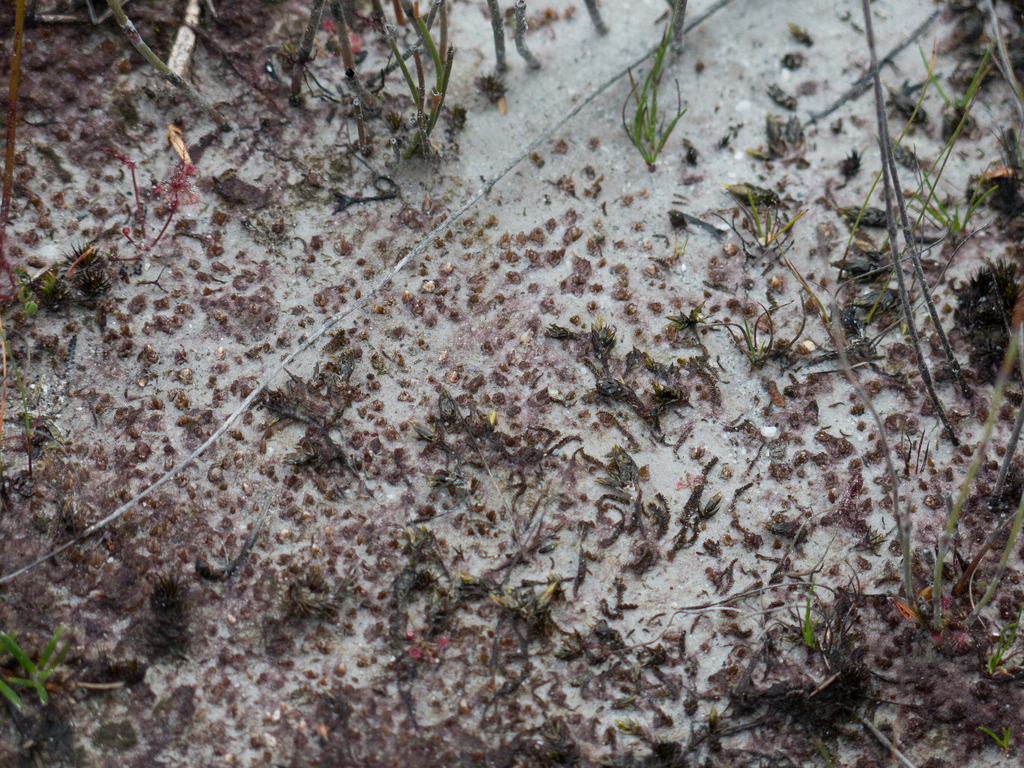
Ambuchanania leucobryoides
Ambuchanania leucobryoides is the only species in the monotypic genus Ambuchanania. It is a Sphagnum-like moss endemic to Tasmania. Originally described as a species of Sphagnum, it is now a separate genus named after the original collector Alex M. Buchanan, (b.1944) an Australian botanist from the Tasmanian Herbarium in Hobart, (it was first collected in 1987). A. leucobryoides differs from the family Sphagnaceae in having elongate antheridia. It is entirely restricted to south-west Tasmania's Wilderness World Heritage Area where it occurs on white Precambrian quartzitic sand deposited by alluvial flows, and on margins of buttongrass (Gymnoschoenus sphaerocephalus) sedge land. Species most commonly found in association with A. leucobryoides include: Leptocarpus tenax, Chordifex hookeri, and Actinotus suffocatus. Currently, A. leucobryoides is listed as rare under the Tasmanian Threatened Species Protection Act 1995.
From the article Ambuchanania on Wikipedia (CC BY-SA), quoted section by section
Description
Mature plants are small, pale brown or whitish green when dry. The stems are approximately 2 cm long, and are irregularly and sparsely branched. Leaves on the stem have a broadly lanceolate shape 3.6-4.3 mm long. Spore capsules are whitish-yellow and globose, atop a seta (stalk) that is 1.2 cm long.
Where it lives
Recorded sightings
—
geo-referenced records in GBIF, from museums, herbaria and field observers.
Drag the globe to turn it. Dots are where records exist, not a range map; darker means more records.
In the stacks
Searching the stacks…
Every page naming Ambuchanania leucobryoides in the Biodiversity Heritage Library →
This page is assembled live from iNaturalist, GBIF, Wikipedia, the Source Library and the Internet Archive. It is not yet part of the hand-edited codex. iNaturalist taxon 180628.