- Animals
- ›Chordates
- ›Vertebrates
- ›Birds
- ›Cuckoos
- ›Cuckoos
- ›Typical Cuckoos, Malkohas, and allies
- ›Cacomantis
On eBird ↗
Fan-tailed Cuckoo
Live sightings near you, the range map, bar charts of when it is seen, and Macaulay Library photos and recordings.
Fan-tailed Cuckoo
Cacomantis flabelliformis
The fan-tailed cuckoo (Cacomantis flabelliformis) is a species of cuckoo in the family Cuculidae. It is found in Australia, Fiji, Indonesia, New Caledonia, New Zealand, Papua New Guinea, Solomon Islands, and Vanuatu.
From the article Fan-tailed cuckoo on Wikipedia (CC BY-SA), quoted section by section
Description
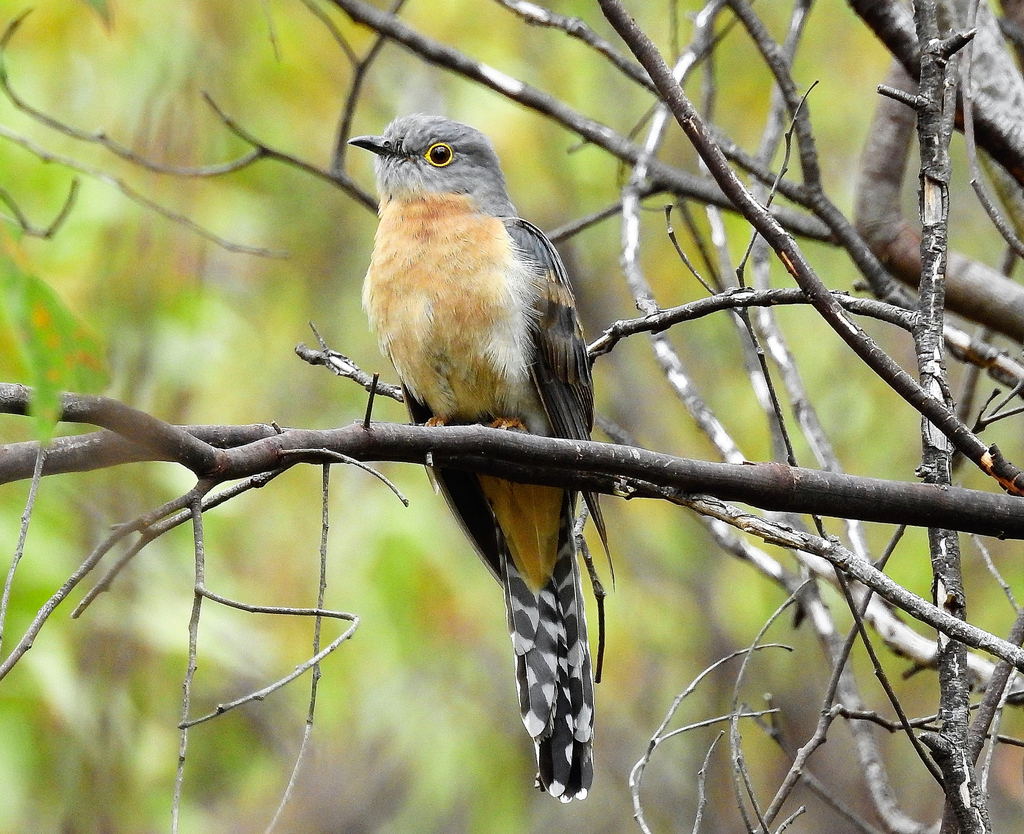
The fan-tailed cuckoo is about 25–27 cm (9.8–10.6 in) long. The fan-tailed cuckoo has a slate-grey head, back and wings, rufous underparts and barred black and white tail. Its eye is surrounded by a yellow orbital eye ring which helps to distinguish it from the smaller and paler brush cuckoo (C. variolosus) and the also smaller chestnut-breasted cuckoo (C. castaneiventris).
Range & habitat
Its natural habitats are temperate forests, subtropical or tropical mangrove forests, subtropical or tropical moist montane forests, paddocks, orchards and gardens. The Australian range is from Cape York in Queensland following the coast south to Shark Bay in Western Australia. Along the west coast, its range extends no more than 1000 km inland. In South Australia the range is along the coast except in the south-east corner around Mount Gambier and the Eyre Peninsula. It also inhabits Tasmania.
Wikipedia: “Habitat”
What it does
The species in Australia eats a variety of insect and their larvae, fruits and vegetables, small reptiles, mammals and birds, especially bird chicks. It perches in an exposed position to locate its prey and then pounces, catching it in the air or on the ground.
Wikipedia: “Diet”
Listen
Looking for field recordings…
Where it lives
Recorded sightings
—
geo-referenced records in GBIF, from museums, herbaria and field observers.
Drag the globe to turn it. Dots are where records exist, not a range map; darker means more records.
In the stacks
Searching the stacks…
Every page naming Cacomantis flabelliformis in the Biodiversity Heritage Library →
This page is assembled live from iNaturalist, GBIF, Wikipedia, the Source Library and the Internet Archive. It is not yet part of the hand-edited codex. iNaturalist taxon 1850.